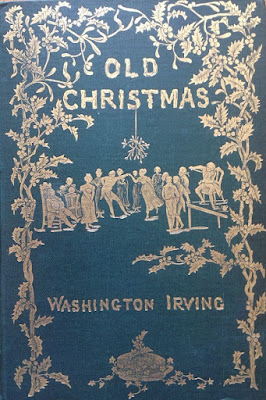
Old Christmas
Washington Irving
Published 1876
American Literature
⭐⭐⭐⭐
Old Christmas, written by American author Washington Irving, is a collection of five short stories about the fading traditions of Christmas.
CHRISTMAS
In this first chapter, Irving described the meaning of Christmas, that he liked to "linger on the holiday customs" of old. He had "romanticized imaginations" and regretted that they were fading from time.
I am apt to think the world was more home-bred, social, and joyous than at present.
Irving said that Christmas festivals were the fondest; "solemn and sacred feelings blended conviviality and lifted spirits." Christmas was a time when families drew closer together, calling back (adult children) home to the "paternal hearth," to return to their youth and recall loving memories of childhood. During Christmas, as in winter, people stayed close to and depended upon their social circles more.
Heart calleth unto heart: and we draw our pleasures from the deep wells of living kindness, which lie in the quiet recesses of our bosoms; and which, when resorted to, furnish forth the pure element of domestic felicity.
Christmas is a "general call to happiness. What bosom can remain insensible?" It is a season of hospitality and "genial flame of charity in the heart."
THE STAGE COACH
In this second chapter, the fictional narrator, American Geoffrey Crayon, traveling by public coach while in England, was invited to the family home of a friend to stay for the Christmas festivities. The coach ride gave the reader a view of Yorkshire on Christmas Eve, of joyful passengers visiting relatives for the holidays, excited to return home.
CHRISTMAS EVE
The narrator described the manner of hospitality displayed by the host, which put him at ease. There were dancing and singing, including a band that played music under the window of his sleeping quarters as he went off to sleep.
CHRISTMAS DAY
On Christmas Day, the children of the home sang at the bedroom door of the waking guests. There were family prayers and morning service. They all walked to church together. Christmas Day was a day of giving thanks and rejoicing.
Be merry and thankful, feast poor neighbors great and small.
The parson delivered a sermon -- the case for Christmas rites and ceremonies, as supported by the earliest saints; though the narrator was convinced that no congregant seemed to need any evidence. The Parson blamed the Puritans for their attack upon Christmas, when they drove it from the land, along with mince pie and plum porridge; and "roast beef as antiChristian." Only after two hundred years, Christmas returned with King Charles at the Restoration when he declared to "feast and make merry on this joyful anniversary of the church." It was evident, at the close of church, that no one had forgotten the true Christmas virtue of charity.
On the trek home, the sunny day warmed the "chills of selfishness and thawed the heart into a flow of hospitality." Both poor and rich keep Christmas, making them equal. At one time, the rich opened their homes to the poor, but it became too sketchy; instead, the wealthy delivered food to the poor that they may celebrate in their own homes.
CHRISTMAS DINNER
Back at the family estate, there were games, music, conversation, stories, laughter, dancing, and eating. There was even Christmas mummery and costumes for all. Lots of merriment, revelry, and mirth! These "fleeting customs were posting fast into oblivion..." and Irving paused to address the reader's quiet thought,
To what purpose is all this? - how is the world to be made wiser by all this talk?
And here is the point of Irving's testimonial to Christmas past:
If I can by chance, in these days of evil, rub out one wrinkle from the brow of care, or beguile the heavy heart of one moment of sorrow; if I can now and then penetrate through the gathering film of misanthropy, prompt a benevolent view of human nature, and make ye reader more in good humor with his fellow-beings and himself, surely I shall not then have written entirely in vain.
SOME TRIVIA
While reading this, I could not help but think of A Christmas Carol and Charles Dickens, as a little research confirmed that Dickens was a fan of Washington Irving and greatly influenced by these stories when he wrote A Christmas Carol, in 1843. And apparently, Irving is responsible, in part, for bringing Christmas traditions to America.
AND MY OPINION
My first thought was that Old Christmas was a sweet, joyous, and delightful rendezvous with Christmas past. This was such a pleasure to read, especially given these days before us.
My next thought was of the absence of stress. If Christmas were only preoccupied with the traditions presented in Old Christmas, I would not lose one ounce of joy. I could do without shopping, traffic, crowds, giving Jeff Bezos more of my money, and getting more stuff. While giving gifts is absolutely joyful; if it were never part of Christmas, I wouldn't miss it. I would prefer to focus on family and friends, enjoying company, signing, dancing, playing games, walking to church together, and definitely partaking in a Christmas mummery. But...it's not only up to me, and my family would think I was a nutcase if I suggested a Christmas mummery. LOL! Speaking of mummeries...many years ago, our homeschool group performed a Christmas mummery during out Medieval year/Christmas Medieval feast, in which we performed all of those great Medieval Christmas traditions, and why I am so fond of these old traditions.