Showing posts with label pride. Show all posts

Monday, June 27, 2022

Pride and Prejudice by Jane Austen

Pride and Prejudice
Jane Austen
Published 1813
⭐⭐⭐⭐⭐

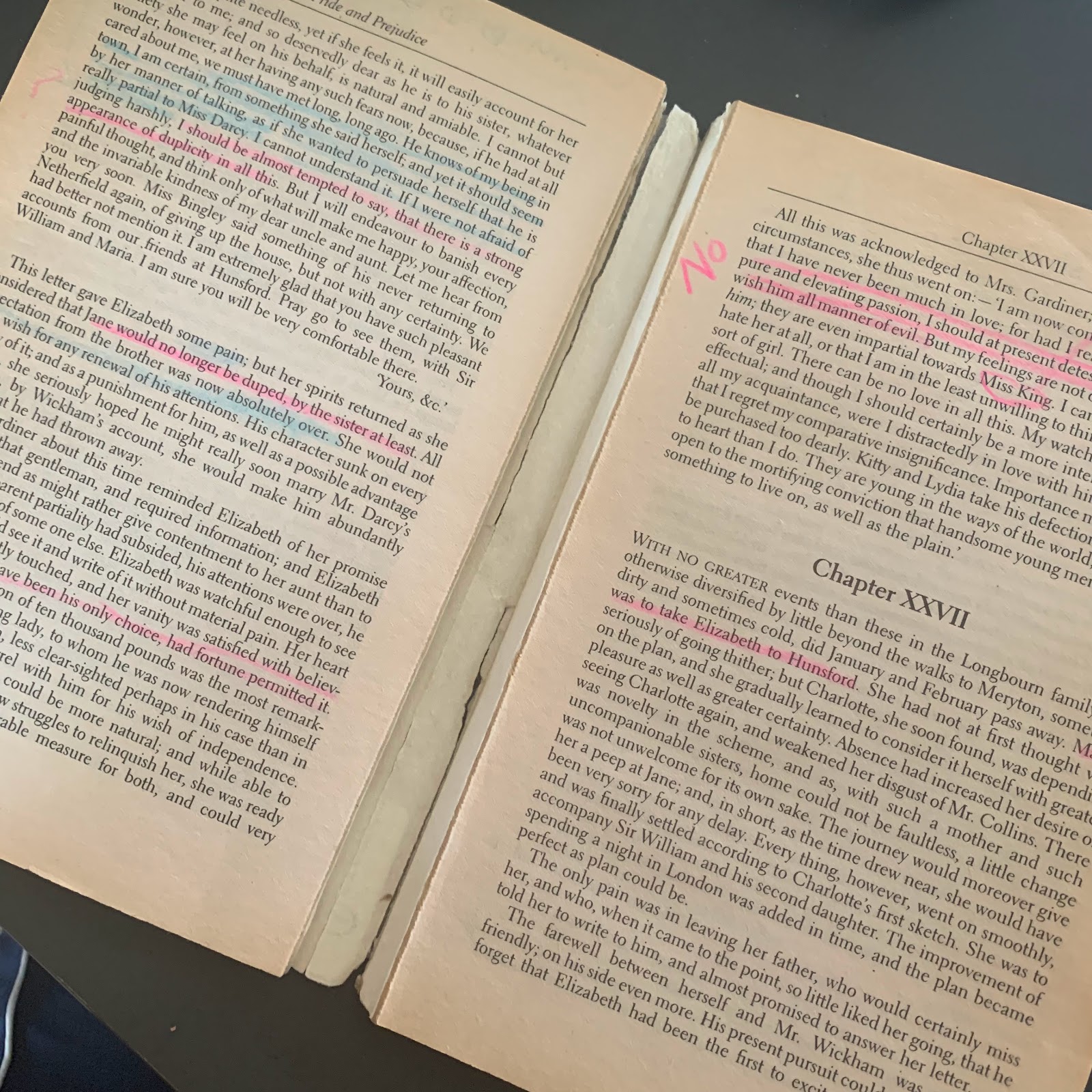
I definitely need a new copy of Pride and Prejudice because mine is falling off its hinges. 


I assume that most classical readers have read P&P, and many are familiar with the story. So I do not want to rehash it. Here is my First Review (2012), which I read for The Well-Educated Mind novels. I was terrified to read and review it because I had never read Austen before. However, it turned out wonderful and humorous and entertainly smart. Next, I reread without writing a review back in 2018, just for fun. 

But this year I desired to reread it for the experience, as I was hoping; but I am learning, as I return to my old reads of years ago, that my first experience with a good book is always the best experience, and I will never have that same experience again. 

Of course, rereading is essential to going deeper, exploring, and discovering more -- maybe even making new experiences. I did glean more this third read where I had overlooked previously. I had question marks in the margins regarding certain passages and finally I was able to answer them: "Oh, I get it!" 

This time I made new observations, too; for example, how Austen (through Elizabeth) spent so much time loathing Mr. Collins. And when Charlotte "made designs on him" -- that is what I wrote in the margin -- Elizabeth was beside herself for a long time. Charlotte's "unaccountable" marriage to Mr. Collins was truly an offense to Elizabeth. Especially for a woman like Charlotte, who knew much before it happened -- something else in my margin. She was a quick observer of character and foreknew that Jane was likely to discourage Mr. Bingley because she was not showing him enough love...uh, interest. Elizabeth accused Charlotte of not having "a proper way of thinking" because she accepted a most embarrassing and "silly man" like Mr. Collins. Elizabeth went on and on for chapters. I thought it was a little much. Really, Lizzy!

But Jane's wisdom is always ready with a comeback. She assured her sister that she may change her mind when she sees them happy (with each other). I believe eventually that did happen.

Another new idea that stood out to me was how undoubtedly sad Mr. Bennet's absent behavior was in leading his household. He truly was the example of a lazy father and husband --  physically present but emotionally and mentally absent. Actually, he was always in his study (how nice), therefore, he was just as physically absent. How interesting that Austen made that an obvious issue, too, because it tied directly to the poor behavior of Lydia and Kitty. And Mrs. Bennet, too. Men...lead your households!

And lastly, I found a new favorite quote. Jane, in response to Elizabeth's concerns over character (and alluding to Mr. Bingley disinterest in Jane...) said:
We must not be so ready to fancy ourselves intentionally injured. We must not expect a lively young man to be always so guarded and circumspect. It is very often nothing but our own vanity that deceives us. Women fancy admiration means more than it does. 

Elizabeth was more upset over Mr. Bingley's disappearance (walking away from Jane) than Jane was of being dropped. Jane let it go. She gave Mr. Bingley the benefit of the doubt and blamed herself for reading too much into his attentions. She was OK. How many of us can handle what feels and looks like rejection as well as Jane? 

While I think of Jane as a woman of virtue, maturity, and empathy, I believe Elizabeth shares those qualities also. In addition, Elizabeth is lively (what Mr. Darcy found attractive), feisty, and keen -- and we all cheer for her because of these. However, this time, for me, Jane really stood out. I really appreciated her character even more so. And even though her story is not the main point, it is essential and provides many lessons for readers. 

source

Thursday, November 05, 2020

Moby-Dick by Herman Melville


  Moby-Dick

Herman Melville

Published 1851

American Novel

The Well-Educated Mind Novels

⭐⭐⭐⭐⭐


Herman Melville hated God, and he loathed Christianity and its followers; but mostly he was angry with God. 


Melville was raised in a strict form of Calvinism and the Reformed Church. At age 12, he witnessed his father die a terrible death and had to work to help support his family. Eventually he went to sea, where, on many voyages, he witnessed every intolerable misfortune and immoral deed imaginable: lust, theft, disease, pestilence, hunger, hatred, murder, racism, poverty, and death. Many crimes and tribulations he connected with Christianity because these crimes were perpetrated by so-called Christians or in the name of "Christian" nations, with no relief even from the sympathetic God of his youth. Hence, Melville's heart hardened against Christianity, believers, and the Christian God.


In interpreting this novel, it is commonly held that Moby-Dick, the white whale, represents nature, a god, or the God of the Bible. I am 100% certain now, after this second read, that Melville intended to portray Moby-Dick as the Christian God, exactly as the author experienced His character.


To Melville, God was a colossal bully who exploited His power, harassing and tormenting small, powerless man on the earth, especially in his time of misery and affliction. To Melville, God was not a God of mercy, grace, or love. God was heartless. 


Here's food for thought, had Ahab time to think; but Ahab never thinks; he only feels, feels; that's tingling enough for mortal man! to think's audacity. God only has that right and privilege. Thinking is, or ought to be, a coolness and a calmness; and our poor hearts throb, and our poor brains beat too much for that. 


According to Melville, at least we humans can feel. God cannot. We are nobler than God, even though we can never overpower Him; at least we have a conscience, Melville argued.


On and on and on...the entire book is contempt, suspicion, animosity, and vexation directed at Christianity and God. Melville is not the first to experience rebellion toward his religion or to blame God for all the world's calamity, hardship, and injustice. But why did he fiercely reject and challenge Him? I cannot fully understand this answer until I dig deeper into Melville's personal life. 


Moby-Dick is not genuinely about whaling or struggles at sea or even a lunatic sea captain bent on revenge. It is a written record of one man's personal and private struggle with his pride. Melville knew his Bible very well, and He knew the truth; but he chose not to believe. He bitterly turned away from God, and he put himself in God's place, as man is want to do generation after generation. In the end, I think Melville knew it was dangerous to take this position; but he refused to yield. 


According to Hawthorne, he said of Melville, "He can neither believe, nor be comfortable in his unbelief; he is too honest and courageous not to try to do one or the other. He has a very high and noble nature, and better worth immortality than most of us." 


Moby-Dick, the novel, is a raging case against the God of the Bible, but it is also Melville's justification for his own self-righteousness. He said he felt "as spotless as a lamb" for writing a "wicked book," but I wonder if his conscience burned within him. With his obvious religious symbolism and parody of theology, Melville must have known he was accountable by Christians (and God). 

Furthermore, his rebellion against God is so blatant and arrogant that I believe he was unbearably cognizant of his circumstance. In other words, he needed to prove unequivocally to himself that he was not afraid of the wrath of God; and therefore should no one else.


Well, having said all that, what do I really think of Moby-Dick


I will never get rid of this book, and I will read it again, God willing. It is rightly considered important literature, cleverly written, and at times poetry. Melville wrote about what many people only struggle with privately: we have and will continue to throw temper tantrums at God; we rage about the world's misery and injustice; we question our own beliefs; and the hypocrisy of the religious confines us. Naturally, we all are at enmity with God; we all wrestle with our faith.


Moby-Dick is the written record of that universally personal, private human conflict with God. 


Unfortunately, Melville's rebellious pride was more valuable to him, even though he knew man never wins in his conflict with God; nonetheless, he would not yield to God's will. To me, that is the most notable and inescapable part of the story - the personal story behind the story


And so, if I can end on this note...while I think Moby-Dick is a literary treasure and that it should be read for its brilliance, just know that there is something far deeper about the story and its author than what you may initially read upon its surface -- something very melancholy and heartbreaking. That is how I feel about Moby-Dick and what I see when I look at the eyes of the man in this portrait.


Monday, June 10, 2013

The Great Gatsby by F. Scott Fitzgerald


The Great Gatsby

F. Scott Fitzgerald

Published 1925

American Novel

The Well-Educated Mind Novels

⭐⭐⭐⭐⭐ 


I. Grammar Stage Inquiry [The What]


Who is (are) the central character(s) in this book? James Gatz A.K.A. Jay Gatsby


What is the book’s most important event? This is the event in which the main character changes the most.   


I am stumped.  I want to say that the most important event is the accident that kills Myrtle, however it does not seem to affect Gatsby.  It affected others, including myself, but Gatsby is completely oblivious to what has just happened; he does not even consider how it will completely change his life after he takes the blame for Daisy. 


In fact, he does not seem to change throughout the entire story.  From the time we meet him as a mysterious man who hosts extravagant parties for the wealthy and powerful to the end of the book, he is still dreaming about Daisy who does not care about anyone but herself.  The only time we get an inkling of any change from Gatsby is when we hear a story about how, as a poor, restless young man, he worked for five years with Dan Cody, a wealthy man, on his yacht and came away seduced by wealth and power; it was then that he became committed to gaining that wealth and power for himself.


However, then I spoke with an avid Great Gatsby extraordinaire who carries a copy of The Great Gatsby on her person at all times, and she was certain that the story was about Nick: he’s the one who changes drastically.  But if she had to choose when Gatsby changes, she suggested it was in his youth, when he wrote that list of self-improvement and decided not to follow in his parents’ footsteps but to (in my words) “blaze his own trail.”  He never strayed from it.  Then again, she thought maybe Gatsby changed most when he took the bullet for Daisy.  He just had to.


What do you think?  What is the most important event in The Great Gatsby, and do you think Gatsby ever changes within the story?  If so, when???


II. Logic Stage Inquiry [The Why and How]


What does the central character want?


Gatsby wants wealth and prestige.  After he meets Daisy, she becomes a status symbol for wealth and high society, and he turns her into an idol and worships her.  It appears he wants her, but his love for her does not seem genuine or believable.  Does he want Daisy or what she represents?


What is standing in his way, and what strategies does he use to get what he wants?  


Gatsby comes from a poor family, so that forces him to have to work for a living and to work harder for a specific class or position in society.  After the War, he gets a janitorial job to pay for his schooling, but out of humiliation from the work that he does, he quits.  He wants to get rich quick, and he is willing to earn his wealth immorally.  


As for Daisy, Gatsby is foolishly living in the past, which is not realistic, and he ignores the fact that Daisy is legally married to someone else, and he cannot just break up the marriage and pick up where he and Daisy left off.  His greedy pride is standing in his way because he wants to have what he wants because he wants it without considering the reality of his demands.


III. Rhetoric-Stage Inquiry [The So What]


Is there an argument in this book?  Do you agree?


There are numerous arguments in The Great Gatsby, but I rather address an argument that is prevalent within Great Gatsby circles: “The American dream is dead” or “unattainable.”  


Maybe during the author’s time, he had a sense that America’s bubble was going to burst - like the housing market where I live in California: builders kept building; prices went higher; banks kept lending; people kept buying until they could not afford what they purchased; then they lost their houses; banks lost money; builders lost, too; and now houses sit vacant and prices are lower than ever, but no one can buy.  Surely, greed is a destructive end regardless of the goal.


But what is the American dream?  I would argue that it is not the same for everyone.  For some, it may be to build their own home, or to earn a doctorate and open a private practice, or to own a business and create a job for one’s self.  My son’s second piano teacher was from Russia, and her American dream: to open a piano studio.  My grandparents are from Italy, and their American dream: for their children and grandchildren to have more opportunity than they did.   I know someone whose dream was just to escape communism in her country and be free.  Success may be part of the American dream, but it is not the same for everyone.  To suggest that the American dream is one specific idea is foolishness.


However, since F. Scott Fitzgerald portrays the American dream as wealth, power, and prestige, while not painting a very pleasant picture of high society, the reader is forced to renounce high society with disdain.  The author’s point is that these people are absolutely miserable, careless, shallow, selfish, and dull.  This may be true in many cases, but not all.  But, again, I do not agree that wealthy people and their place in society represent the American dream.


People are messy because of their sinfulness, just as Myrtle Wilson, who was poor, practiced adultery.  Nick observes that Mr. Wilson was in the same position as Tom Buchanan.  And what can we say about Mr. Wilson who took judgment into his own hands and murdered Gatsby?  Is he any better?  And Nick, who was wealthy, did not subscribe to the debauchery that existed within his circles, but rather it exhausted him.  People are corrupted at all levels of society – don’t blame the American dream for success and wealth. People need boundaries and limits, but it is not freedom and liberty’s fault for the sinfulness of man’s heart. 


To get preachy, if man’s heart is right with God he does not have continuous conflict with (in no particular order of importance): success, wealth, prestige, honor, truth, justice, friendships, relationships, or marriage.  When man’s will is his own will, apart from God, then he is open to disappointment and destruction.  But if man’s will is God’s will, he shall attain his goals, and hence he shall have a healthy “American dream.”


Bottom line: I love The Great Gatsby, nonetheless, because it is poignant, thought provoking, and aesthetically written.  A definite re-read!  


Wednesday, May 16, 2012

Pride and Prejudice by Jane Austen

Pride and Prejudice

Jane Austen

Published 1813

English Novel

The Well-Educated Mind Novels

⭐⭐⭐⭐⭐


First level of inquiry:

What is the book’s most important event?  When does the character change?

Elizabeth is most affected and changes after she refuses Mr. Darcy’s proposal and then receives a thorough letter from him explaining and defending himself on and from all accusations made by Elizabeth regarding Jane and Bingley and Mr. Wickham.  The reader can see the slow but definite progress Elizabeth makes from first realizing that she did not have all of the facts on Mr. Wickham to finally being able to see events from someone else’s perspective, such as she did with Mr. Darcy and how he saw Jane’s indifference towards Mr. Bingley and that he was concerned for his friend’s heart.  


Second level of inquiry:

What is the author trying to convince you of?  What evidence does she give you for believing this argument?  I believe the author is trying to warn us of our prejudices towards others before we have all of the information to make a judgment or form an opinion of someone.  Often, it is our own pride that blinds us from being able to see truth.  


Evidence of this is in Elizabeth and her mother and many of the other characters in town that automatically prejudge Mr. Darcy as prideful because of his reserved behavior at the ball in addition to his wealthy status.  It isn’t until Elizabeth gets to know him on a more intimate level that reveals his shyness around people he does not know. 


And yet, when Mr. Darcy proposes to Elizabeth, it is pride he displays when he assumes that Elizabeth should accept him simply because of his wealth and status. 


What does central character want?  What is standing in his or her way?  What strategy does she pursue in order to overcome this block?  

Elizabeth is so full of pride that she is blind as a bat!  She trusts no one, and I suppose to remedy that, she wants to protect herself from ever being duped or wronged or hurt.  So she prejudges everyone if they in the least unfavorable towards her and puts up a barrier around herself.  She wants to always be right and leaves no room for changes, unlike her sister Jane.


The problem is, because of her blindness, she cannot see the truth.  And she misses opportunities to know someone for who they really are.  She can appear really conceited and spiteful in her words and her actions.

I don’t think she meant to use any strategy to overcome her barrier, but it happened unexpectedly for her when she was forced to see the truth in Darcy’s letter that she had been prejudice towards him because of what she had wrongly believed to be right.  


Who is telling this story?  What point of view?  The author is telling this story.

Where is story set?  The story is set in England in the early 1800s.

What style does the writer employ?  The author uses a very complex and thorough style. It is almost as doing math or logic problems. 


Images and metaphors?  I actually had to research this: Marriage and dancing continues to come up.  Being asked to dance seems to be the equivalent to being proposed to or actually signing a marriage contract.  Remember how personal the women took Mr. Darcy’s rejection to dance at the first ball?  How offensive!  But when Mr. Darcy did ask Elizabeth to dance at the second ball, she was beside herself that she said yes to him.  And she was also incensed that she had to agree to dance with Mr. Collins at that same ball.  (It’s not the end of the world…it’s just a dance.)


Beginning and ending?  Is it resolution (no further event can take place), or is it logical exhaustion (infinite repetition)?  Do you agree?  

The author takes you immediately into the urgent idea of the story, marrying well, with the arrival of a wealthy prospect in to the neighborhood, and the civil formalities of the time to wait on the gentlemen and make an acquaintance of him with the hope of making his daughters available to him.  


And the author ends the story in resolution settling every character around the marriages of Mr. Bingley and Jane and Mr. Darcy and Elizabeth.  Every character is getting on with his life, and most of them are doing so in a happy fashion.  It is a Happily Ever After story.  No more changes need to take place.


Third level of inquiry:

Is this story an accurate portrayal of life?  Is it true?  (What are people like?  What shapes them?  Are we free, or are we restricted by something?)

Yes, yes!  I completely agree.  How easily we are caught up in our prejudices because of our own pride, especially concerning social status. 


It takes place at all levels of the socioeconomic ladder.  Class warfare is very real, and it is fueled by our greedy desires of “self.”  Lower classes desire to take from the rich to redistribute elsewhere even if that distribution never makes a difference in their own lives because they have predetermined that the rich are well-off enough; and, yet, even those who are able to be charitable live worlds apart from the very people they help because there is a wall of status that separates them from having to connect personally.  


In a way, we all have the potential to be rather snobby because of our self-pride to feel better about ourselves by making someone less than what he is.  We can be restricted by our greed, self-regard, and self-importance before we truly get to know why someone behaves the way they do.


When I was in college, my architecture professor taught us to always find out why someone does what they do, in order to learn about someone.  Get to the very core of their behavior.  


In this case, Elizabeth had to get to know Mr. Darcy to understand that her first impression of him appearing arrogant was prevented by her lack of knowledge that he is quite uncomfortable or introverted around people he is not familiar with.


Is there an argument in this book?  What is the idea?  Do you agree?  Is the book true?

Absolutely!  First, we need to remove pride from our heart, that desire to protect ourselves from being offended causing us to invent prejudices, and “leave room for change,” as the author describes Jane Bennet’s disposition on people.  We don’t know all the facts about someone; maybe we should know someone before we agree with gossip or take our first impression to heart.