Showing posts with label ancients. Show all posts

Thursday, January 23, 2025

King Oedipus by Sophocles

Oedipus Rex
Sophocles
Written 430-420 BC
Athenian Tragedy
⭐⭐⭐⭐

This was the second play from The Well-Educated Mind Reading Challenge, and unlike Agamemnon, I was familiar with the plot, though the details were fuzzy.

Before the play began, there was a tale about Oedipus. Ahead of his birth, Oedipus' parents, king and queen of Thebes, Laius and Jocasta, discovered through Apollo's oracle that their son would one day kill his father and marry his mother. Not willing to kill him themselves, Laius and Jocasta handed him over to a servant to abandon the baby in the mountains and leave him to die. The servant, obeying the word of Apollo, took the baby beyond the borders of his country and left him with a messenger, who in turn took him to the childless king of Corinth, Polybus. 

Of course, in adulthood, Oedipus was exposed to the rumor of the curse, through Apollo, and wanting to alter the course of the prophecy, he left those whom he believed to be his true parents and went straight to Thebes, which was in chaos. King Laius had been murdered and the Sphinx was terrorizing the city. Oedipus had arrived in time, solved the riddle to rid Thebes of the Sphinx, eliminated her dominance, and was rewarded with the loyalty of the people as king. He married Jocasta and together they had four children. 

After fifteen years of peace, a devastating plague was devouring the city, and the people looked to their king for salvation. 

Oedipus sought answers from Creon, his brother-in-law, and Creon told him they needed to find out who killed Laius first. Therefore, Oedipus proclaimed that if anyone knew about the death of Laius, they must speak up. 

The blind prophet of Apollo directly told Oedipus that he was the killer. This caused much conflict between Oedipus, Creon, and the Chorus, the male elders of Thebes.

Remember, up to this point, Oedipus had no idea that the king and queen of Corinth were not his natural parents. He still believed that he avoided his fate by fleeing. But when Jocasta entered the conversation, she filled in details about the oracle, how she gave up her son as an infant. However, Jocasta was sure that her baby died when she and Laius sent him away with the servant. 

Oedipus filled in the blanks and revealed that he did kill several men on the road, and since one man had  escaped (none other than the servant), he wanted to hear from him what he remembered from the attack on Laius. Thus, they sent for the servant. 

Long story short, this servant, the same who was given orders to dispose of the cursed infant, admitted that he was instrumental in preserving the child's life. Thus, the parties concluded that Oedipus was the grown son of Laius and Jocasta. 

Upon revelation, Jocasta killed herself and Oedipus put out his eyes.
What should I do with eyes where all is ugliness? 

Where is there any beauty for me to see? Where loveliness of sight or sound? Away! Lead me quickly away out of this land. I am lost, hated of gods, no man so damned. 

I will not believe that this was not the best that could have been done. Teach me no other lesson. How could I meet my father beyond the grave with seeing eyes; or my unhappy mother, against whom I have committed such heinous sin as no mere death could pay for? Could I still love to look at my children, begotten as they were begotten? 

CHORUS:

Then learn that mortal man must always look to his ending, and none can be called happy until that day when he carries his happiness down to the grave in peace.  

* * *

THEME(S)

One major theme of this play is fate. Fate is "the development of events beyond man's control, regarded as determined by a supernatural power." Oedipus' parents thought they could change their fate by abandoning their son, and Oedipus thought he was able to affect or escape the predicted outcome of the oracle by fleeing his "parents"; and yet, they all stepped right into the prophecy. 

Is man truly in control of his own life, having free will, or is his life already preset? I suppose if you have a curse upon your head, you know the answer.

Today, the question of free will and fate still perplexes us, and some people still seek oracles (fortune tellers, horoscopes, astrologers, etc.). What do you think? Fate or free will? Are we in control of our destiny; can we affect change at all? Or is life in the hands of God?

The Finding of Oedipus - unknown (1600-1799)

The next play in TWEM reading list is Medea by Euripides. 

Thursday, January 09, 2025

Agamemnon by Aeschylus

Agamemnon 
Aeschylus
Greek Tragedy
c. 458 B. C. 
⭐⭐⭐

My first play for The Well-Educated Mind Reading Challenge was Agamemnon by Aeschylus. This was my first experience with this play, and I knew nothing about the plot ahead of reading. 

The setting was Argos, Greece, Atreus' palace, where a watchman waits for news from Troy, to see if Agamemnon, king of Argos, will return. It has been ten long years that he has been away, and he is eager to see the king. 

The Chorus, made up of twelve elders, recited the narrative of how Agamemnon had been pressured to choose between victory or shame by sacrificing his own daughter, Iphigenia, to appease Zeus and earn his favor. 

Agamemnon "...rather than retreat, endured to offer up his daughter's life to help a war fought for a faithless wife and pay the ransom for a storm-bound fleet."

Soon, news arrived that Argos had captured Troy and the king was on his way home. His wife, Clytemnestra, prepared for his arrival, to welcome him home. When the king arrived, he had with him the young Trojan princess, Cassandra, who was also a prophetess. 

While alone, she began a conversation with the god Apollo. (Obviously, very troubled she was, and I don't blame her because...) She saw the ghosts of "children butchered...by their own kindred..." who carr[ied] in their hands "their own flesh....food their father ate!" 

She also revealed that Agamemnon was cursed! There was going to be a murder..."Female shall murder male..." Agamemnon was going to "lie dead."

Near the end of the play, Aegisthus, Agamemnon's cousin and now lover to Clytemnestra, told the horrid story of how Atreus, Agamemnon's father, sought revenge on his brother Thyestes for committing adultery with Atreus' wife. He then roasted his brother's children and served them to Thyestes during a feast. When Thyestes realized what Atreus had done, he cursed his whole household, which fell upon Agamemnon. 

Aegisthus claimed to have plotted the whole "evil deed" from afar, but it was Clytemnestra who stabbed both the king and Cassandra. For Clytemnestra, it was revenge for the murder of her daughter Iphigenia.

However, it was Zeus who punished Agamemnon (for his father's wicked deed against his brother) by forcing the horrible choice to either disobey the gods and go home to Argos in shame or sacrifice his daughter and earn victory in Troy.

The play Agamemnon is about revenge and man's idea of justice. (Which is more like injustice.) Much like reality, when one seeks revenge to settle what he thinks is injustice against himself, he only perpetuates more injustice. As for the Greek gods, they were the last ones to know anything about justice. They thrived on bloodthirsty revenge. 

John Collier, Clytemnestra, 1882,

* * *

The next play for TWEM is King Oedipus by Sophocles. 


Monday, May 16, 2022

Beowulf

 Beowulf
Translated by John McNamara
Written 8th c. (?)
⭐⭐⭐⭐⭐

I never get tired of this poem. I have read children's versions, and now I have read three different translated versions. The hero, Beowulf, demonstrates honor, loyalty, and bravery, ideals that were part of  the Anglo Saxon warrior culture. 

Beowulf, warrior of the Geats, killed Grendel (a hideous monster who had been tormenting the Danes) with his bare hands, and afterward killed Grendel's mother with a sword. He was revered and honored for his brave deeds, and he gave his rewards to his own King. Years later, Beowulf became ruler of the Geats and served the people faithfully for fifty years. 
Thus the son of Ecgtheow showed himself to be brave, a man famed for fighting, with heroic deeds, living ever for glory. He never slew hearth-companions, in drunken fury, nor did he have a frenzied spirit, but the brave-battle man guarded the generous gift, given him by God, of the greatest strength of all mankind. 
In his old age, he was faced with a challenge he knew he could not win: a dragon terrorizing the people, after it has been awakened while guarding its hoard of riches (think Smaug from The Hobbit). What made this challenge exceptional is that Beowulf was not afraid, and he accepted his fate that he may die. He first made a fair speech about how he had become king, before he faced the battle with the dragon. 

In his conflict, he struggled, and Wiglaf was the only warrior who came to his aid. Beowulf defeated the dragon with Wiglaf's help. As a punishment, none of the warriors were to keep any of the treasure; instead, it was burned in a great pile with Beowulf, "among all the world's kings, the mildest of men, and the most kind in giving, the most gentle of men, and the most eager for fame." 
For the decree of God ever governs the deeds of every man, even as it still does today.
It is possible that the original stories of Beowulf were not written with Christian overtones, though the version we have now is, as the Anglo Saxon world was becoming Christian at that time. The heroes took on Christian virtues and themes, like self-sacrifice, morality, and fate. It works for me -- I like it. 

* * *
 

Tuesday, March 29, 2022

Odes by Horace

Odes
Horace
Written 23 - 13 BC
(Selections: book I: 1-9, 17, 30: book II: 19-20; book III: 1-6, 13; book IV: 1-7)
⭐⭐

I suppose Susan Wise Bauer expected readers to read all of the works by Horace in his collection of Odes, which are lyrical poems about a particular topic or theme; but I only read Bauer's suggested selection because I had already read some of Horace's poetry in the previous book, and I am not a good student of the Ancients. No matter how much I have been exposed to Ancient/Classical works, I fail to finish them. So I kept it brief.

Horace's personal life was interesting to me. He lived during the time of Augustus Caesar, and somehow became an integral part of the regime. He may have even been friends with Virgil. He certainly wrote about him in Ode III: To the Ship, In Which Virgil Was About to Sail to Athens

But about the Odes, many are centered around themes on human nature, like love, virtue, youth, friendship, and death. The selections I read were extremely short. They offered advice on living rightly or doing what is good and true. Horace even offered warnings. He was a lot like a philosopher-poet.

I did enjoy reading a few Odes, including: 

Ode IV: To Sextius
Ode I: On Contentment
Ode II: Against the Degeneracy of the Roman Youth, and 
Ode VI: To the Romans

And I found one quote that stood out: 
Seldom hath punishment, though lame, of foot, failed to overtake the wicked.

But that's all I've got. Now I'm moving on to Beowulf, translated by John McNamara.  

Friday, January 07, 2022

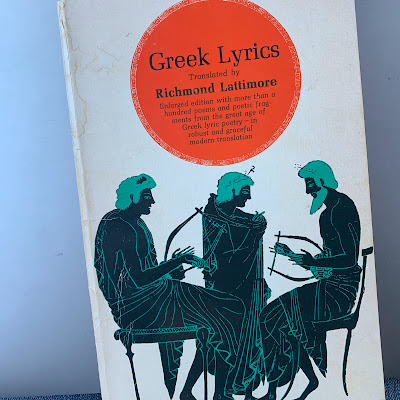
Greek Lyrics translated by Richard Lattimore


Greek Lyrics
Various Poets
Translated by Richard Lattimore
7th - 6th C. BC
The Well-Educated Mind Poetry
⭐⭐⭐

This is the fourth book or title on TWEM poetry list. It is a short book that contains short poems or fragments of poems, also known as "lyrics," from Ancient Greek poets who wrote between the mid seventh to end of the sixth century B.C. 

Lattimore incorporates twenty-six poets, including Solon, Xenóphanes, Sappho, and Pindar, some of the more well known. The poems are listed by poet, and the translator included a short introduction about each writer. I found the translation to be very readable. 

It is helpful to know or be familiar with Ancient Greek history and myths, especially about the Trojan War and Greek gods because many of the poems are about these topics. Some are only a few lines and others are a lot longer. 

I tried to find some favorites, but I had a lukewarm experience. But for the sake of choosing, I liked Anácreon of Teos:
Life is lovely. But the lifetime that remains for me is little. For this cause I mourn. The terrors of the Dark Pit never leave me. For the house of Death is deep down underneath; the downward journey to be feared, for once I go there I know well there's no returning.  

There were some other semi-interesting or entertaining ones, as well, though I am not so fond of ancient writings.  In TWEM, Susan Wise Bauer recommends only the poems of Solon, Sappho, and Pindar, but I read every single one of the poets and poems listed. So there. 

My next read is more Odes by Pindar. Several were included in this Lattimore collection; but this time I will follow Bauer's recommended number of poems because Odes is quite long, and my goal is just to get through it this first time. 

Thursday, December 02, 2021

The Odyssey by Homer


The Odyssey
Homer
(translated by Robert Fagles)
Written c. 8th C. BC
Greek Poetry
The Well-Educated Mind Poetry
⭐⭐⭐⭐ 

As part of the Well-Educated Mind reading challenge, I completed The Odyssey by Homer. I might not have read it at all had it not been for this reading challenge. I realize that I am not fond of the Ancients, but this story and the translation itself have been both entertaining and pleasurable. 

In my opinion, The Odyssey filled in many missing pieces from The Iliad. I was familiar with the story of the Trojan War, and I thought it was because of the The Iliad; but I now believe that it is because of The Odyssey that I know anything at all. It is through Odysseus, the hero, and his narrative of the events of the War that the reader gets a better picture of what took place at Troy. 

Odysseus, the great Greek warrior and king of Ithaca, struggled for ten years to get home, on top of the ten drawn out years battling the Trojans. On their way, he and his warriors endured treacherous and gruesome trials, many of which ended in death. The reader experiences these adventures, or obstacles, rather, mainly through the stories that Odysseus told to others. They were like a flashbacks.

One of the adventures included time on the island of the Cyclops, where Odysseus and his men were captured (and some eaten) until Odysseus killed Polyphemus, Poseidon's son, causing Poseidon to pursue Odysseus continuously and seek revenge throughout his voyage home. 

Next, they stayed with King Aeolus, who gave Odysseus a bag of wind to help them get home sooner, which they would have had the men not opened the bag, forcing them off course. 

Another trial took place on Circe's island for a year, in which she transformed Odysseus' men into pigs, though Odysseus was spared by eating an herb he received from Hermes. Odysseus had to appease Circe in order to restore the men's humanity, and then she sent him to see Tiresias in the Underworld, where he gave Odysseus prophecies about the remainder of his journey.

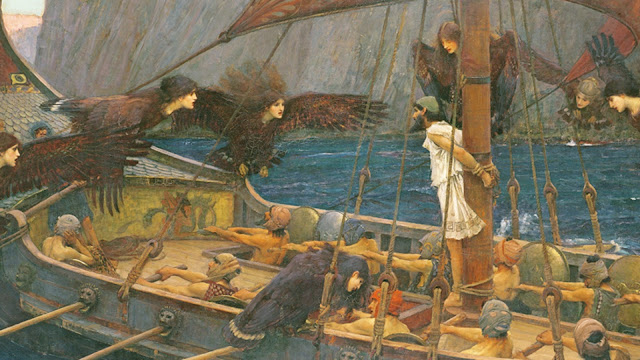
A memorable trial was sailing past the Sirens, whose beautiful singing caused sailors to kill themselves when they heard them. But because Tiresias had warned in advance, Odysseus had his men stop up their ears with wax and secure his body to the mast so that he could not jump overboard. He wanted to hear their voices and live.

Waterhouse: Ulysses and the Sirens, 1891

On the Island of the Sacred Cattle, Odysseus' men angered the gods and were destroyed because they ate the cattle. He alone survived and ended up on Calypso's island where she kept him miserable for seven lonely years. When she relented, she gave him a raft to get home, until Poseidon destroyed it. 

Odysseus barely made it to another island where he was well attended and refreshed by the king and princess. Here Odysseus told them his long stories of all that had happened to him and how he was trying to get home to his kingdom, his wife, and their son. Sympathetic, the king outfitted Odysseus with his best ship and sailors, and Odysseus finally made it to Ithaca.  

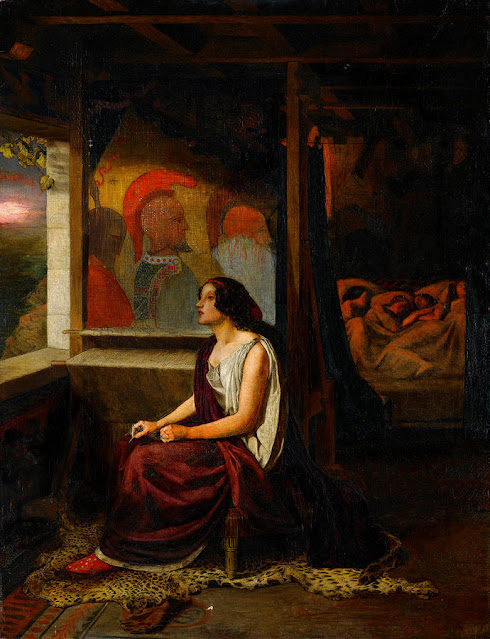
Meanwhile, in Ithaca, during those last years, Penelope, Odysseus' wife, had been pursued by suitors, who were merely interested in the kingdom. They loitered the palace and ate Odysseus' food and drank his wine. Tactfully, Penelope played a game, weaving a shroud for her father-in-law, Laertes, which she expected he would need once he learned that Odysseus was dead, as supposed. She promised the suitors she would choose the lucky one once she had completed the shroud. But at night, she unwound all of her work only to begin again in the morning, so as to prolong the regretful day. 

Seddon: Penelope, 1800s

When the suitors discovered her trick, they called her on it, and she had to yield. However, it was just in time because Odysseus had arrived home. Together with his son, Telemachus -- who had also recently arrived from searching abroad for news of his father -- they made a plan to challenge the suitors. 

With the help of Athena, she disguised Odysseus as an old beggar. Without recognizing her husband, Penelope took the beggar into her home and catered to him, as the suitors mocked him. Penelope made her decision how to choose a suitor, but it involved a feat only her husband could solve; so when the old beggar took a shot, he was the only one able to achieve it, which led to the final battle and victory over all of the suitors. 

Even still, convincing Penelope that he was her husband was another trial. When he revealed the one trait only he could know about their bed which he built for them, it was then that Penelope knew: Odysseus was finally home. 

In the final chapter, the following day, Odysseus visited his grieving father, and then he prepared himself to be avenged by all the fathers of the suitors he and his son killed the night before. Fortunately, Athena intervened in time and brought peace to all of Ithaca for good. 

My final thoughts: I am really pleased with the Fagles translation. I believe it suited me well. If you prefer a more poetic reading, maybe there are translations that would serve better. This one was very readable. The adventures are thrilling and intriguing, even for a 21st century mind. The descriptions and comparisons of humans as godlike were cheesy - not realistic at all -- but it's 8th century Greek poetry, right? I had to get over that. 

One last opinion: I wish The Odyssey ended with the reunion between Odysseus and Penelope because the continuation of the final chapter ruined the mood for me. I think the meeting with Laertes was important, but the battle with the dead suitors' fathers took away from the previous chapter's event. I wish it ended without the last chapter, but there is nothing I can do about that either. So that's it.

And now, I leave you with this outstanding, massive Lego build of the story of The Odyssey. If you are a fan of this Greek poem, you will want to see this:
 

Monday, November 01, 2021

The Iliad of Homer


The Iliad of Homer
edited by Richmond Lattimore
Written 850-750 BC
Ancient Greek poetry
The Well-Educated Mind Poetry
⭐⭐/ 5

I have finally read The Iliad of Homer.

I know the story well, through years of reading younger/abridged versions with my children through our Ancient Greek school years, but I did not enjoy this translated version, which was my first time reading an "adult" version. It could be the timing of the reading for me, or it could be the story itself. Therefore, it was just ok for me, and that's all. 

I found the the gods' infantile bickering difficult to endure. The Greek and the Trojan warriors were the pawns - or more like puppets - of the god's greedy manipulation to work out their own selfish pride and jealousies against one another. It was cruel and contentious, and after a short while, quite annoying. 

As far as the translation: it was acceptable; but obviously I have only read this one translations. Therefore, if I dare reread The Iliad, it will be a different edition. 

I read this for The Well-Educated Mind - Poetry. The next book on the poetry list is Homer's The Odyssey. This is a story I know well (also through younger abridged versions) and actually prefer over the Iliad. I am excited to begin it; let's see how it goes!

Friday, April 26, 2019

The History of the Decline and Fall of the Roman Empire by Edward Gibbon


The History of the Decline and Fall of the Roman Empire: Abridged Edition

Edward Gibbon  

Published 1776-89  

The Well-Educated Mind Histories

⭐⭐⭐⭐⭐


Check out the chunkiness of the abridged version of this book! It was originally published in six volumes, but I am grateful to have had the whole thing between two covers, and abridged.


This work was beyond impressive, thanks to Gibbon's superb writing style. It is a history of Western Civilization, from AD 98 until 1590, with fascinating detail given to Ancient Rome, Medieval Europe, Byzantium, the Crusades, the barbaric invasions, and a comprehensive historical review of Christianity and Islam.


It took me two and a half months to read, which was not adequate time to spend on such a brilliant work of important history. Someday when I reread this - because I absolutely must - it would be better to stretch it out for at least a year. It is massive in content and context. Unfortunately, because I read quickly, I am not prepared to give an extensive review. 


In a general answer to the question, "Why did the Roman Empire decline and fall?" Gibbon made the argument that Rome's power grew too massive, became ensnared in corruption, and meddled unnecessarily in the Middle East. (This sounds so much like America today.) Furthermore, Gibbon blamed the spread of Christianity (more specifically, the Roman Church) for the decline of Rome. He also gave a positively raving history of Muhammad and the rise of Islam. 


Gibbon, who published the first volume during America's revolution and birth, in 1776, mentioned the new nation once (that I recall) to demonstrate that the Europeans carried Rome's principles to the Americas, where he hoped liberty would continue. Liberty was a principle Gibbon esteemed above all else. 


Furthermore, I want to share the first paragraph of chapter one because I think it parallels our current age, specifically America, which has frequently been compared to the Roman Empire. Gibbon writes:


In the second century of the Christian Era, the empire of Rome comprehended the fairest part of the earth, and the most civilized portion of mankind. The frontiers of that extensive monarchy were guarded by ancient renown and disciplined valour. The gentle, but powerful influence of laws and manners had gradually cemented the union of the provinces. Their peaceful inhabitants enjoyed and abused the advantages of wealth and luxury. The image of a free constitution was preserved with decent reverence. The Roman senate appeared to posses the sovereign authority, and devolved on the emperors all the executive powers of government. During a happy period of more than fourscore years, the public administration was conducted by the virtue and abilities of Nerva, Trajan, Hadrian, and the two Antonines. It is the design of this, and of the two succeeding chapters, to describe the prosperous condition of their empire; and afterwards, from the death of Marcus Antoninus, to deduce the most important circumstances of its decline and fall; a revolution which will ever be remembered, and is still felt by the nations of the earth. 


This is interesting because America enjoys and abuses great wealth and luxury and has the appearance of a representative government operating under a free constitution, all for the cause of liberty. But our liberties are eroding, if not through voluntary relinquishment, in exchange for a sense of security, excessive affluence, and abundant entertainment, just as the Romans desired. And also like the Romans, America is troubled over what to do about the massive influx of immigrants, is still entangled in the Middle East, and Christianity is nevertheless at odds with Islam (although Christianity is rapidly declining in America). 


Gibbon used extensive historical resources to support his arguments and ideas. Though he never made reference (that I can remember), I wonder if he ever read City of God, by Augustine, who rejected earlier arguments that Christianity was the demise of Rome. If I did not know any better, I would say Gibbon wrote this tome in response to Augustine. 


One last thing about this: Gibbon knew how to write well. This history does not read like a boring history text. It reads like a story. Gibbon takes liberty with his adjectives, and it is beautiful. Unfortunately, his choice of adjectives often exposed his personal opinions about a particular person or event; he wore his biases on his sleeve, but it did not spoil the overall experience for me.


SHOULD YOU READ THIS?


You have heard it said, "History repeats itself," and "One thing we learn from history is that no one learns from history." Well, this ignorance has to stop, and that is why you have to read this and learn from it. Do not be intimidated because it is history. This is essential history, well written. It is one of those works that makes you rethink the way you think about the history you have been taught. It forces you to put aside your own preconceived ideas, if only for a moment. And I cannot stress enough how beautifully well written it is. You will not see history the same again. 


Saturday, December 02, 2017

Lives of the Noble Greeks / Roman LIves by Plutarch


Lives of the Noble Greeks 

Plutarch, edited by Edmund Fuller  

Written/Published 2nd century/1517

Greek Histories

 Well-Educated Mind Histories

⭐⭐⭐ 


I said I would read five Greek lives but instead read four because "Alexander the Great" was understandably lengthy. With that, I also read "Theseus," "Solon," and "Pericles." At the start of "Alexander," Plutarch told his readers "he is not writing histories, but lives." 


I must be allowed to give my more particular attention to the marks and indications of the souls of men . . .


With that, I recap:


THESEUS


"Theseus" was my favorite because I was already familiar with some of his story and the Greek myths related to him. He is the famous Greek who saved the Athenians from the Minotaur. He was the founder of Athens:


Now, after the death of his father Aegeus, forming in his mind a great and wonderful design, he gathered together all the inhabitants of Attica into one town, and made them one people one city . . . and gave the name of Athens to the whole state . . .


He also founded a democracy, or "people's government, in which he should only be continued as their commander in war and the protector of their laws, all things else being equally distributed among them."


Aristotle says, "Theseus was the first who, out of an inclination to popular government, parted with the regal power."


Unfortunately, he was accused of dubious behavior as well, and he ended up in prison for a while. Sometime after his release he died a gruesome death, but even how that happened it is not certain. In the end, future Athenians honored him as a demigod.


SOLON


Solon was one of Greece's essential statesmen because he contributed to many of the successful reforms, laying the foundation for a democratic government. He preferred justice to wealth, and sought to eliminate the monopoly of the powerfully rich in society. He established a set of laws for men to live by.  His friend, Anacharsis, "laughed at him for imagining the dishonesty and covetousness of his countrymen could be restrained by written laws, which were like spider's webs, and would catch . . . the weak and poor, but easily be broken by the mighty and the rich."


To this Salon rejoined that men keep their promises when neither side can get anything by the breaking of them; and he would so fit his laws to the citizens, that all should understand it was more eligible to be just than to break the laws. 


Solon removed most of the severe Draco laws, and laid the foundation for more compassionate and reasonable punishment for lawbreakers.


And one more tidbit: he wrote poetry.


PERICLES

Another great statesmen whom Athens had a love/hate relationship, Pericles was greatly admired for his upright character and superior intelligence. He found favor with the poor, especially for his ideas about redistribution of wealth. (Of course.)


When his political opposition, Thucydides, was set against him, he kicked it up a notch:

And so Pericles . . . let loose the reins to the people, and made his policy subservient to their pleasure, contriving and continually to have some great public show or solemnity, some banquet, or some procession or other in the town to please them, coaxing his countrymen like children with such delights and pleasures as were not, however, unedifying. 


I mean, you have do something during an election year.


However, the opposition became so threatening that Pericles became more aristocratic, influencing and encouraging his countrymen in the best interest of the country instead of being a passive leader.


Pericles also led the Athenians through the ambitious war against Sparta, in which he was a firm and strategic general (or admiral), but he made mistakes. The Athenians were frustrated, and deposed him. But before long, they pitied him and took him back, though by then he was near death.


Of Pericles, Plutarch remarks,


To me it appears that this one thing gives that otherwise childish and arrogant title a fitting and becoming significance; so dispassionate a temper, a life so pure and unblemished, in the height of power and place, might well be called Olympian, in accordance with our conceptions of the divine being, to whom, as the natural authors of all good and of nothing evil, we ascribe the rule and government of the world. 


ALEXANDER THE GREAT


O my son, look thee out a kingdom equal to and worthy of thyself, for Macedonia is too little for thee.You all know the stories of Alexander, right? Because of Plutarch we know the stories of Alexander's father, Philip of Macedonia, Alexander's youth and superior education under Aristotle, and the unruly horse with the odd name that Alexander conquered, to which his father delightfully squealed,


After Philip was murdered, Alexander, who was only 20, immediately came to power. And so went on for pages and pages and pages of his amazing adventures, from Egypt to Persia, especially his long conflict with Darius and then Cyrus, his issues with Cleopatra, his personal conduct, and his mysterious death. I leave that to you reader to see it for yourself. Alexander's life is quite impressive.


But I must mention the funniest moment when Alexander met Diogenes, the philosopher, who was not impressed with the young Macedonian leader. Alexander asked if there was anything Diogenes wanted to say to him, and the philosopher quipped, "Yes, I would have you stand from between me and sun." After Alexander and his friends had a good laugh at the nonchalant reply, Alexander told them "if he were not Alexander, he would choose to be Diogenes."


Roman Lives

 Plutarch, ed. by Robin Waterfield  

Written/Published 2nd Century/1517  

Roman Histories

Well-Educated Mind Histories

⭐⭐⭐ / 5


My next book continued Plutarch's Lives, of great Roman men. I decided only to read of two men: "Caesar" and "Antony."


CAESAR


Immediately, Plutarch informs the reader that Julius Caesar, a little Roman statesman turned general, is under threat of death by his enemies and always on the run or in hiding. Nonetheless, he was popular because of his representation of the people. He was a great orator who provoked emotions. In other words, Rome knew he was popular, though they could not get rid of him no matter how they tried.


Meanwhile, as long as he stayed away from Rome - always on campaign throughout Europe and Northern Africa - he was spitefully tolerated, especially because he was always victorious, which was a benefit to Rome.


At his final triumphal campaign against Pompey's sons, Rome finally bowed their heads before Caesar's good fortune and accepted the bridle. Since autocracy was . . . a pleasant change after civil war and turmoil they proclaimed [Caesar] dictator for life. But when permanence is added to the unaccountability of autocracy, tyranny is the result, and this is now what Caesar had, with the acquiesce of the Romans.


If you look up the word ambition in the dictionary, you'll see Julius Caesar's portrait. He is the absolute example of drive, determination, prideful lust and idolatry. He probably never slept, always thinking of ways to glorify his great mind. He had plans and he was never satisfied even after he accomplished his zealous goals. He was meticulous about his ideas, but who cares if they are only done with him in mind.


His desire to anoint himself king of Rome finally turned the people against him; while the Senate quietly plotted to stop him. And you all know that fateful day that Caesar was murdered. His ambitions brought him to nothing except the fame of his name (like Little Caesar's Pizza and Orange Julius Caesar drink); and so the little Roman Republic transformed into 500 years of an oppressive overreaching Roman Empire.


ANTONY


If Julius Caesar was ambitious, Marc Antony was a reckless fool. He was thrown out of his home for his poor choices and bad influences, and it was no surprise that he continued making poor choices and following after bad influences long after he found himself in the seat of the Roman government and right up to his death. 


It was his charming personality that attracted him to Julius Caesar, but it was not long before Caesar discovered what a mess Antony was. He was a lazy, drunken, womanizing, extravagant fool.


Antony had nothing to do with Caesar's murder, and he even aroused the crowd at the funeral, calling out the murderers; that is how he developed a following of Caesar's supporters and began acting like a dictator. However, there was the problem with Caesar's nephew, Octavius, who expected to be Caesar's successor, which would lead to years of conflict between the two sides. For a while the two men and one more man formed the triumvirate, the government of Rome.  


But the worst thing that ever happened to Antony, if not his own hedonism, was Cleopatra of Egypt. By that time, Antony was a successful military leader winning fame and power for Rome; but fooling around with Cleopatra was the end of him.  


It is a little more complicated than this, but it was Octavia, Antony's second wife, that really brought this conflict to an end. Cleopatra felt threatened by Octavia, so she plotted in order to secure Antony's power, which he relinquished to her, in turn causing Octavius Caesar to declare war on Cleopatra (and Antony). 


Plutarch referred to Antony as Cleopatra's "appendage." He shamefully abandoned his soldiers to be with Cleopatra. Later his last remaining men abandoned him and joined forces with Octavius Caesar, who also tried to get Cleopatra to have Antony assassinated. Antony felt betrayed by Cleopatra, and she hid herself from him in her tomb. She sent a messenger to Antony to tell him she was dead. Unfortunately, he could not even bring himself to successfully kill himself with his own dagger. When Cleopatra found out he was injured, she had him brought to her, where he pathetically died in her presence.  


Plutarch finishes Antony's life with the death of Cleopatra and the results of all the children involved. Poor kids.


Even though it took me months to read the few lives I read, I just wanted to be done; but I do want to go back someday and read the remaining Greek and Roman lives that I skipped. Plutarch writes about the good, the bad, and the ugly, and it is fascinating.

Tuesday, June 13, 2017

The Peloponnesian War by Thucydides


The Peloponnesian War

Thucydides, translated by Steven Lattimore

Ancient Greek History

 The Well-Educated Mind Histories

⭐⭐⭐


The only reason I read The Peloponnesian War by Thucydides was for my Well-Educated Mind Reading Challenge, and therefore I am recording the minor fact that I read it.  I feel like I cannot add much more than that - I read it; it is done - but if I ponder a bit, maybe I can come up with some opinions.


[crickets]  


Oh, I know.  I can confidently say I preferred Peloponnesian War far less than Herodotus' Histories. Thucydides was dull, dry, and dull.  (Said that already.)


Some of the speeches given by generals or other leaders were engrossing, but not frequent enough.


I am reminded again: loyalties are a joke, men can be bought for a price, you cannot trust government, innocent citizens are always the pawns of selfish, greedy, arrogant leaders, and these wars were wasteful and motivated by pride (because while I would be the first to say that sometimes war is very necessary, this "one" was not).  


If I did not know any better, I would say that Lattimore, my translator, had a personal vendetta against Thucydides because in his footnotes he often times ripped Thucydides to shreds when he thought he was being unfair or untruthful or not thorough enough.  Maybe that is what you call an honest translator.


Toward the end there were philosophical discussions about democracy and oligarchies, and that was interesting - though a little too late.  Other than that, I cannot say I remember anything more that stands out; and in fact, the longer I wait to write this post, the more I forget I even read it.


So there it is.  Glad to be done.  I have great respect for minds that love this stuff, but I am ready to move on to Plato.  

Monday, March 20, 2017

The Histories by Herodotus


The Histories 

Herodotus (translator: David Grene)

Written 440 BC

Ancient Greek History

The Well-Educated Mind Histories

⭐⭐⭐


I have no interest in writing this post.  I did not chew on The Histories, nor did I digest it; rather I deficiently tasted it, I admit.  It was a long, laborious read, with occasional moments of fascination about ancient culture, which I preferred.  The bulk of it was about the Greco-Persian conflicts.


I am more anxious to get this over with; therefore, here are some of the questions provided by Susan Wise Bauer from TWEM that I attempted very poorly to consider.


Level I:


* Who is the author, and does he/she state the purpose for writing?  


Herodotus is a writer of Greek history who lived during the 5th century BC, and his given purpose for writing The Histories was to preserve the history of the Greeks and non-Greek populations, including the discoveries, achievements, and accomplishments of man, as well as the causes of the Greek and Persian conflicts.


* Who is the story about, and what are the major events?


The Histories covers Ancient and Greek history through the Greco-Persian Wars, using a mode of investigation, subjective oral histories and folk tales, and other hearsay.  Herodotus incorporates the cultural ways of the people and nations in and around the Mediterranean and Asia Minor and the numerous ongoing conflicts and wars between the Persians and the Greeks. 


Skipping Level II questions because I just want to get this over with.


Level III:


* What does it mean to be human?


This question focuses on what the author considers is a specific characteristic of human beings.  In this case it is having success, control, and power over others.  The most powerful conquer, and those who conquer are the most important.  In addition, to be a warrior and to die in battle is honorable.


* Why do things go wrong?


Things go wrong when man becomes arrogant and greedy for power; power is fleeting.


* What place does free will have?


What free will?  As is all too common in history, and no different for the civilizations featured in The Histories, people were dominated by a government (or kingdom) that controlled them.  People did not have a say in what their kings or leaders did.  Human sacrifice was also part of ancient cultural traditions. (Some traditions are really ignorant.)   


* What is the end of history?


Is there any hope for humanity after reading The Histories?  Yes and no.  All of these civilizations are gone.  Like power, governments and civilizations do not last long.  Most change hands and morph into something else, either equally bad or little better.  In this case, Herodotus ends off with this:

"From soft countries come soft men.  It is not possible that from the same land stems a growth of wondrous fruit and men who are good soldiers."  So the Persians took this to heart and went away; their judgment had been overcome by that of Cyrus, and they chose to rule, living in a wretched land, rather than to sow the level plains and be slaves to others.  


So, in other words - I think - the Persian leader(s) did not learn their lesson, nor did they care about anything but power.  And man still has not learned.