Showing posts with label biography. Show all posts

Friday, April 04, 2025

John Adams by David McCullough

JOHN ADAMS
David McCullough
Published 2001
American Biography
The Gentle Challenge: (Book Recommendation)

⭐⭐⭐⭐⭐

When I joined Silva's Gentle (reading) Challenge, my goal was to fit more of my un-reads into specific categories. One of the categories was a book recommendation (or a book you would read because you trusted the word of others). 

John Adams by David McCullough has been on my un-read list for a decade or more. A book blogger I admire recommended this book; but, in fact, she was not the only one who gave it excellent reviews. Therefore, I trusted these opinions. 

I am excited to announce that it was absolutely worth it, and they were correct. I am so grateful that I finally read this book.

Frankly, I do not know where to start or what to say about this epic narrative, except to begin with an emotional response. 

I embrace this book fervently and will add it to my personal canon. It was pleasantly written, exceptionally well done, and absolutely enjoyable. I often imagined that I was transported back to the 1700s and lived through every moment. I walked away with an appreciation for what these men (and women) did to form a new government based on the ideas of self-government and personal liberty and freedom, even if we "could[n't] keep it." 

McCullough's writing style was intelligible, concise, and delightful. He included an abundance of supporting evidence from correspondence, newspaper articles, books, and diaries (sadly, a lost art). If a written work supported a statement or idea, it was included. I do not think he left anything out. Often, I was amazed at how much written correspondence took place, and McCullough used many sources to cross reference who said what and when and where just to piece this history back together. 

By the way, this story was not only about John Adams, although it was very much about him; it was a window into the heart and soul of his faithful, intelligent wife, Abigail, and fellow compatriots, Thomas Jefferson, George Washington, Benjamin Franklin, Benjamin Rush, and many others. 

I was not aware of the degree Benjamin Franklin and Thomas Jefferson and some others disapproved of and betrayed Adams, and that Vice President Jefferson, in my opinion, may have committed treason under Adams during his presidency. Scandalous! (Reminds me of Mike Pence and Donald Trump. There is nothing new under the sun.)

I enjoyed the relationship between Adams and his wife, a beautiful, faithful couple, faithful to God and to one another through long periods of separation. Abigail was an excellent partner and helper, encouraging her husband in honorable pursuits. She was a well-educated and well-rounded woman, a protective mother, and a patriot. Both Abigail and John were of one mind on many moral, ethical, and  political perspectives. They had a model union, as is evident from their written correspondence. Mr. Adams absolutely adored his wife, and I can see why.

McCollough presented a genuine and true character analysis of Adams. Of course, he was not a perfect personality, while grievances about him were probably warranted. But he was an admirable, fair, and trustworthy man. Most notably, his relationship with Jefferson later in life was charming, and their collection of letters to one another was and still is inspiring of reconciliation and friendship. 

I especially appreciated the sections on Adams' love for books and reading, which actually contended with Jefferson's obsession with books. 

Unlike Jefferson, who seldom marked a book, and then only faintly in pencil, Adams, pen in hand, loved to add his comments in the margins. It was part of the joy of reading for him, to have something to say himself, to talk back to, agree or take issue with, Rousseau, Condorcet, Turgot, Mary Wollstonecraft, Adam Smith, or Joseph Priestley. "That is no doubt that people are in the long run what the government makes out of them...," Adams read in Rousseau. "The government ought to be what the people make it," he wrote in response. (LOL!)

Adams was guilty of defacing books while reading and once wrote 12,000 notes and comments in one book alone! He read French Revolution by Wollstonecraft twice "with delight" because he disagreed with almost everything she said. Adams and Jefferson "were two of the greatest book lovers of their bookish generation." Adams owned over 3,200 books and Jefferson, before he sold them, owned (if I remember correctly) over 5,000. Yikes!

John Adams by John Singleton Copley, 1784

Other adventures experienced in this chunk of history included Adams' overseas life in France and England; the terrible French Revolution, whose outcome Adams predicted; the provocation of America by the French and British; the ongoing issue with slavery; the complications with disease; and the nasty disputes among men like Thomas Paine, Alexander Hamilton, and Aaron Burr. How many times did I scribble in the margins: There's nothing new under the sun.

This is only a small fraction of what I went through. The biography is over 650 pages, with an impressive bibliography. The pages are full of memorable quotes and passages. (I had to stop writing them down while reading, though I plan to return to the book and collect them.) This work is chronologically written, beginning in the early 1770s, the eve of the American Revolution, until right after Adams' death, July 4, 1826, just a few hours after his friend Thomas Jefferson died. Adams was 90 years old. 

WHO WANTS TO READ THIS?

Obviously, if you like: 

  • biographies, 
  • biographies about U.S. presidents, 
  • histories, 
  • American history (particularly early American History), 
  • books about war or Revolutionary war histories, 
  • political science or government systems 
  • (or want to witness the birth of man's best attempt at good government ever), 
  • stories about brilliant minds together in one time or place, 
  • and love stories -- yes, love stories! 
...then this is your next book.

THE GENTLE CHALLENGE
 

Wednesday, February 12, 2025

The Theodore Roosevelt Trilogy (Volumes 1 & 2) by Edmund Morris

VOLUME ONE


The Rise of Theodore Roosevelt
Volume One
Edmund Morris
Published 1979
American biography
⭐⭐⭐⭐⭐

I began my Teddy Roosevelt journey last year when I read The Rise of Theodore Roosevelt, by Edmund Morris, the first volume in the Roosevelt trilogy, which covered the first forty-two years of his life. He had the most excellent privileged beginning -- well-off, well-educated, and well-loved. His father was his greatest inspiration, and though Theodore experienced extreme health complications from asthma, his father encouraged him to overcome his weakness with physical exertion and a rigorous spirit of mind. This approach to life produced the epitome of a manly man. After a disciplined regiment of boxing and weight lifting, Roosevelt conquered the great outdoors -- mountain hiking, swimming, and hunting became part of his lifestyle.

Roosevelt also developed excellent character, principle, and esteem. He honored women with respect, and he expected all men to be true. He feared no man and earned the admiration of his enemies. 

This first book of the trilogy covered the death of his father, his first marriage, the tragic death of his wife and mother on the same day, after his wife gave birth to their first daughter, and his second marriage to childhood friend, Edith. The book also included the political positions Theodore accomplished. While he was the Police Commissioner of New York, his focus was to end corruption in the police force. Many loathed him for being a hardliner, but he was obligated to follow the law. And of course, one of his most famous adventures was leading the Rough Riders during the Spanish American War in Cuba and liberating the Cuban people from Spain. 

The Rise of Theodore Roosevelt ended with Theodore becoming President McKinley's vice president and shortly thereafter learning that McKinley had been shot...catapulting him into the role as president. He was the youngest ever to become president, at that point in history.

VOLUME TWO

Theodore Rex
Volume Two
Edmund Morris
Published 2001
American biography
⭐⭐⭐⭐⭐

The second volume in the trilogy, Theodore Rex, began with Roosevelt's first administration in 1901, and ended after his second term was finished, in 1908. He was a most beloved and popular president. Though he was a Republican, he was more of a progressive (by today's standards) and sided with the people on many issues. He was definitely the people's president.

Here are a few highlights from Theodore Rex
  • He would bar correspondents or whole newspapers from the White House for misquoting him.
  • He was friends with Booker T. Washington. White Southerners were angry that he met with Washington in the White House, but Roosevelt did not care what they said about him. 
  • He also permitted black politicians to bring their black wives to the White House for dinner, which was not heard of and caused quite a stir. 
  • He believed equality would occur naturally, eventually.
  • He cared more about quality and merit, not quantity.
  • He had an extensive booklist and devoured books even while listening to others speak, and he wrote books, too.
  • He gave excellent speeches.
  • He won the Nobel Prize for helping to end the Japanese Russo War.
  • He believed that to postpone war, one must prepare for it. He encouraged the military to build up its fleets. 
  • He had an energetic personality, and was always drawn with a huge smile full of teeth. He exhausted some because they could not keep up with him.
  • Some of the foreign entanglements on his plate included dealing with Columbia during the creation of the Panama Canal; and issues with Cuba, the Philippines, and Japan and Russia.
  • Near the end of his second term, he lost support of black voters due to an incident which occurred in New Orleans, firing black soldiers who were accused of rioting.
Someone came up with a perfect motto for Roosevelt: 
Rem facias rem, si posis recte, si non quocunque modo rem --

"The Thing, get the thing, fairly if possible, if not, then however it can be gotten." 

All three of the volumes are over 500 pages each, and Edmund's notes are bountiful alone. The writing style is exceptional and enjoyable. Theodore Roosevelt is an extraordinary moral character, whose boundless energy jumps off the pages. God certainly broke the mold after He made Teddy Roosevelt.  

The third volume is Colonel Roosevelt, and I hope to finish that this year. 

Wednesday, February 21, 2024

Bob Laurent: Watchman Nee: Sufferer for China


Watchman Nee: Sufferer for China
Bob Laurent
⭐⭐⭐ 

To start, this is a juvenile read, and it is perfect for youth; therefore, my rating is based on my overall  personal reading experience. However, the biographical story of Nee T'o-sheng, or Watchman Nee, is no less impactful. 

Christianity took a thousand years to reach the Eastern world, and by then China was fixed in superstition, legalism, and the teachings of Buddha and Confucius. When England declared war on China in the early 1800s, it opened the doorway for Protestant Christians to start schools and missions. In the 1850s, Nee's grandfather became a believer and broke the pagan practices in his family, becoming the first Chinese evangelist of Foochow, China. 

In his young adulthood, Nee T'o-sheng recognized his own sin and need for the Savior. He saw what Christ had done for him on the cross and immediately wept, repented, and experienced joy and peace. To mark this milestone in his life, T'o-sheng changed his name to Watchman Nee.

While Mao Tse-tung was converting to the atheistic religion of Karl Marx, Nee was laying the foundation for the Christian church in China. It was a woman, Margaret Barber, who was his mentor, and helped him in his Christian mission. She taught him to remain humble and "stay broken." It was through this ideal that Nee never defended himself, especially when falsely accused. He explained, "Brothers, if people trust us, there is no need to explain; if people do not trust us, there is no use in explaining." 

He also learned the lesson of the cross. He taught that if one "cannot stand the trials of the cross, [one] cannot become a useful instrument [of God]. It was from Barber that he developed his lifelong motto:
I want nothing for myself: I want everything for the Lord.
And Nee lived exactly this way for the remainder of his life. Though he experienced poor health, he continued steadfast in his ministry, writing and teaching and leading believers and laying the foundation for churches throughout China. He worked hard to keep the Chinese church humble and true, grounded in the word of God, during a time when "...lukewarm religious secularism, denominational jealousies and prideful, compromised ecclesiastes had paralyzed the movement..." Corruption had found its way into the church, and he was determined to eradicate it.

But another conflict was brewing, as China was engaged in a civil war between the Nationalists and Marxists. "[Nee] understood the consequences to Christianity if a government founded on the hostile atheism of Marxist ideology came to power." While Nee was hopeful, understanding that "...the end of this world is the start of a better one," he held fast and recited a fellow believer:
The Lord sat as King at the Flood; He sits as King forever!

After prayer and patience, knowing there was not much time left to act, Nee and his fellow workers moved to spread the gospel like never before. 

On New Year's Day, 1951, Watchman Nee preached his final recorded sermon, encouraging believers to count on the Lord, trust Him, and seek His blessings because the only guarantee "...is that you will be persecuted for living a godly life in Christ Jesus."

On April 10, 1952, Nee was arrested and charged as a "lawless capitalist." He remained imprisoned for twenty years. Even after his initial fifteen-year term was up, he was denied release; while not much is known of his time in prison, it was apparent that he refused to convert to the religion of Communism. He entered his eternal rest on June 1, 1972.

He once said, 

to what are we committed? Not to Christian work, but to the will of God, to be and to do whatever He pleases. The path of every Christian has been already marked out by God. If at the close of a life we can say with Paul, 'I have finished my course,' then we are blessed indeed. the Old Testament saints served their own generation and passed on. Men go, but the Lord remains. God Himself takes away His workers, but He gives others. Our work suffers, but never His. He is still God. 


Nee T'o-sheng ~ 1903 - 1972

* * *

Thursday, March 09, 2023

Marriage to a Difficult Man by Elisabeth Dodds

Marriage to a Difficult Man
The Uncommon Union of Jonathan & Sarah Edwards
Elisabeth Dodds
Published 1971
⭐⭐⭐

Married to a Difficult Man is a comprehensive history/biography about the Colonial American Puritan pastor, Jonathan Edwards, his wife, Sarah, their children, and the times and places they lived. 

THE UNION

The story began with the union of Jonathan and Sarah. Edwards was bookish and studious, and while women were not expected to be educated in the 1700's Puritan world, "Sarah had the best training a girl was allowed to have then." She was a "young lady of quality," and was trained well in many skills. She even practiced good posture for many hours - a lost art. Jonathan may have met his match in Sarah's mind, but he was terribly awkward in the area of social graces. 

Nonetheless they discovered their shared love for nature and books, which could be enough to keep any union vigorous; but of course there was more to their union. Sarah would be marrying a minister, and with that came unique obligations and responsibilities. It takes an exceptional woman to wed and stay married to a man of the pulpit, particularly a man who disappeared for long periods of time reading, researching, writing, and traveling. 

In addition to his "horrendous" working hours, she had to contend with her husband's not uncommon communications and connections with other women in the church, as "the majority of members in the New England church were women."

To be sure, the author makes a major portion of the book about their love and faithfulness to each other. A family friend recalled how Edwards 
could trust everything...to the care of Mrs. Edwards with entire safety and undoubting confidence. She was most judicious and faithful mistress, habitually industrious, a sound economist, managing her household affairs with diligence and discretion. 

She uniformly paid a becoming deerence to her husband and treated him with entire respect, conforming to his inclination and rendering everything in the family agreeable and pleasant. She accounted it her greatest glory and there wherein she could best serve God and her generation, to be the means of promoting his usefulness and happiness. 

In return, Edwards "treated her as a fully mature being (as a person whose conversations entertained him, whose spirit nourished his own religious life, whose presence gave him repose).

RAISING UP CHILDREN

Sarah and Jonathan were blessed with eleven children. Jonathan believed that 
as innocent as children seem to be to us, yet...they are naturally very senseless and stupid, being born as the wild ass's colt and need much to awaken them. 

At the end of each day, Jonathan dedicated an hour to his family. He educated his children in church history, Latin, Greek, rhetoric, and penmanship. He listened to their lessons and expected them to compose their own prayers. But it was Sarah who trained them up in godly character and self-discipline. 

It is impressive to consider what the sole union of Sarah and Jonathan produced. By 1900, the Edwards family could boast (though they probably wouldn't):

13 college presidents

65 professors

100 lawyers

1 dean of a law school

30 judges

66 physicians 

1 dean of a medical school

80 holders of public office

3 U.S. senators

3 mayors 

3 governors

1 U.S. Treasury Controller

1 U. S. Vice President


THE REVIVAL

There were two religious revivals under Jonathan Edwards, called The Great Awakenings. The colonial settlements of America had quieted into a lull, bored with religion and suspicious of church structure. 

The beginnings of the first Great Awakening, in 1734, had fractured and weakened many churches. There was an emotional fervor taking over the town, and Edwards sought to channel it into sensible discernment. He wrote biblical directions to test if conviction was true or empty emotion. When the effect swung in the opposite course, and people wearied in "despair... [with] a terrifying sense of God's anger," Edwards worked to keep the movement well-grounded in truth. He focused their faith into action. 

The second revival in 1740-41, occurred when George Whitefield, the English evangelist, visited America. It was also the same time that Edwards wrote his sermon: Sinners in the Hands of an Angry God. It fell on deaf ears when he read it to his own congregation; however, some months later as a guest pastor , he read the same sermon, and there it made history. That sermon may well have changed the face of New England. 

But with religious revivals, there was a counter: churches further splintered and "religious experience [was] grotesquely distorted by emotionalism." And with it, a host of false teachers led false converts away. 

BACK TO SARAH

The most interesting chapter was on Sarah and her nervous breakdown, which led to either her true  "conversion" or further growth in her walk with Christ. Sarah struggled internally, particularly after childbirth. "Her disproportionate responsibilities began to overtax her." She was tempted to think the worst of her husband, her children and herself, and she fought to not reveal: 

I'm not as endlessly giving as I appear to be, and this is an impossibly difficult man. 

As her husband was frequently away, she carried the management of their large household solely on her own, without relief for her own fears or anxieties. She was crushed by the opinions of others in the congregation, of not only herself but also for her husband. The burdens became heavier. She eventually felt she was wrestling with God. 

For Sarah, it was a personal Great Awakening, and when she literally came to, she 

stopped straining to please God (and man) and began to live in the assurance of a salvation she didn't have to try to deserve. She stopped pushing herself to be worthy of Edwards' love and from then on had his unreserved admiration. 

She recalled how she awoke and:

...was led to reflect on God's mercy to me in giving me, for many years, a willingness to die, and after that...in making me willing to live.  

BACK TO JONATHAN

Edwards took on the sinfulness of the community, becoming very liberal in his opinions about trivial matters while stepping on some consciences along the way. He commented on his congregations' owning too few books - evidence for a lack of reading. (I mean, truly reprehensible!) The people were tired of Edward's lectures on his angry God. Sarah came to the defense of her husband by writing a long letter to the church membership, but this mattered not. Edwards wore out his welcome.  It was 1750. The colonies were in a bad mood, and Edwards was voted out of his congregation and sent packing. 

He was relegated to a missionary of the Mohican Nation, where he preached the gospel and taught the people. He maintained good relations with the Indians and also defended their rights to their homeland. This was the time of the French and Indian War, where the Edwardses were very much on the frontline. 

UNFORTUNATELY...

There is much more to the story, but I will cut to the end of Jonathan and Sarah. In 1758, a smallpox epidemic was spreading, and Edwards decided to take a chance on the new inoculation. Jonathan and daughter Esther and her children were agreed to be part of the experiment. Unfortunately, they all contracted smallpox from the medical procedure, and Jonathan succumbed to the disease after all.

Sarah "tried to be prepared or any testing that life might require of her." She found ways to cling to and trust in God. While Esther suffered with the pox, Sarah wrote to her daughter about the loss of Mr. Edwards:

A holy and good God has covered us with a dark cloud. He has made me adore his goodness, that we had [Jonathan] so long. But my God lives; and he has my heart. O what a legacy my husband and your father has left us! We are given to God; and there I am and love to be. 

Two weeks later, Esther died.

Not long after, Sarah lost the will to live without her life partner and she died of a broken heart.


FINAL WORDS

While reading, I did not fully appreciate the scope of this work until I started to write a review. I left out so much information. There are several more chapters after Sarah's death covering the Edwardses' legacy, which continued for over a century and is amazing when you consider how much an individual and family can do to alter a nation. Even with their failings and blunders, they affected history, a nation and its people for good. If it wasn't for Pfizer the smallpox experiment, how much more would they have accomplished?

I only gave it three stars because I thought the writing could have been better. That was my only pet peeve.  

* * *

Thursday, February 23, 2023

The Well-Educated Mind Autobiographies/Memoirs: from least to most favorite

I have been putting the Well-Educated Mind book list in order from my least favorite to most favorite. Last week I ordered the NOVELS HERE. This week I am going through the autobiography/memoir list. If I remember correctly, all of the books were autobiographies or memoirs. 

My favorite genre is biographies because they cover several genres at once: it is a STORY [a nonfiction] about someone's LIFE that includes a period of HISTORY. Not surprisingly, I finished every book on this list. 

By the way, what made reading through these books even more fun was that Cleo from Classical Carousel joined me. Which reminds me, when I first began TWEM journey, I connected with six other bloggers who were also reading through the novels. I had to catch up to them. But other than Fanda @ ClassicLit they have since disappeared from the blogosphere. : (  Anyway, it was a lot of fun to have buddies to read with and discuss these books. 

OK, here are the autobiographies: 

What remains of my WEM biographies.


NO STARS [DNF]

(none)

ONE STAR

Kempe: The Book of Margery Kempe (c. 1430)

     Maybe I was harsh, but I had a difficult time being sympathetic with Kempe.

TWO STARS

Montaigne: The Complete Essays (1580) ⭐⭐

Nietzsche: Ecce Homo (1908) ⭐⭐
     I only enjoyed this enough to argue with Nietzsche. He really should have gotten one star. 

Saint Teresa: The Life of Saint Teresa of Ávila by Herself (1588) ⭐⭐


THREE STARS

Hitler: Mein Kampf (1925) ⭐⭐⭐
     Again, this only received three stars because I enjoyed writing a rebuttal. 

Rousseau: Confessions (1781) ⭐⭐⭐
     I actually enjoyed reading about Rousseau's whiney life, which is why I placed it here; but he is responsible for spreading so much disinformation that has contributed to so many lies today. He should have gotten one star.


Colson: Born Again (1977) ⭐⭐⭐

FOUR STARS

     Overall, I enjoyed every one of these four-stars equally, and it was difficult to place them in some kind of order, but I did my best.

Wiesel: All Rivers Run to the Sea (1995)  ⭐⭐⭐⭐

Merton: The Seven Story Mountain (1948) ⭐⭐⭐⭐

Franklin: The Autobiography of Benjamin Franklin  (1791) ⭐⭐⭐⭐


Gandhi: An Autobiography: The Story of My Experiments with Truth (1929) ⭐⭐⭐⭐

Bunyan: Grace Abounding to the Chief of Sinners (1666) ⭐⭐⭐⭐


Sarton: Journal of a Solitude (1973) ⭐⭐⭐⭐

FIVE STARS

Rodriguez: Hunger of Memory: The Education of Richard Rodriguez (1982)  ⭐⭐⭐⭐⭐

Augustine: Confessions (AD c. 400) ⭐⭐⭐⭐⭐
     This was really complex, but I had a good translator and found it easy to read.

Thoreau: Walden and On the Duty of Civil Disobedience (1854) ⭐⭐⭐⭐⭐
     This is one of my favorite books of all time, but I could not put it before the next five books because of their topics or subject matter, which is important to me. Thoreau was (to use today's terminology) privileged. He was an activist who tried living off the grid for awhile and then journaled about it. But the next books are more about overcoming adversity, for lack of a better word. 

Washington: Up From Slavery (1901) ⭐⭐⭐⭐⭐
     Washington told his story from slavery to the founding of education for newly freed slaves. No excuses. 

Jacobs: Incidents in the Life of a Slave Girl (1861) ⭐⭐⭐⭐⭐

     Jacobs told her horrific story of slavery from a mother's and woman's perspective. 

Douglass: Life and Times of Frederick Douglass (1881) ⭐⭐⭐⭐⭐
     Anything from Douglass, for me, is superb. 

Solzhenitsyn: The Gulag Archipelago (1973) ⭐⭐⭐⭐⭐
     And if Solzhenitsyn's words aren't essential today, then liberty and freedom be damned. 

ALL-TIME FAVORITE

Conway: The Road from Coorain (1989) ⭐⭐⭐⭐⭐
     Conway's personal story beautifully covered all of the genres I mentioned: a great story about her difficult life during a time of major social change and how she conquered it all.

* * *

For more on The Well-Educated Mind Reading Challenge, click the image:


Saturday, September 03, 2022

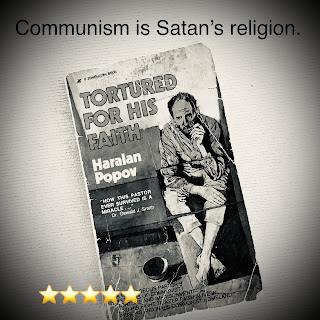
Tortured for His Faith by Haralan Popov

Tortured for His Faith
Haralan Popov
Published 1970
⭐⭐⭐⭐⭐

The more I read about communism, the more I believe it to be the religion of Satan. Why? Because communists hate Christianity. While these regimes cannot compete with any religion because they aim to be the only religion of the state, there is plenty of first hand evidence to support that communists particularly seek to eliminate or control Christian churches, the Bible, Christian history, and Christians in general. 

In Tortured for His Faith, Pastor Harlan Popov noted that the communists preferred to change the mind of Christians rather than have them die martyrs. It was a victory to force Christians to leave the faith and "conform to...the new society [communists] were building." Satan rather win one over to his side, especially a Christian. Popov described communism as the "cleverness and evil of Satan himself."

Yet, the obstacle that communists did not understand was that once a man gave his life to Christ, he was His forever, and no one could snatch him out of His hands. 

PRISONER FOR CHRIST

Popov was an important Christian pastor in Bulgaria at the time of the Russian take over of Eastern European nations in 1944, also known as the Iron Curtain. Popov anticipated persecution, though there were three years of religious freedom. Then in 1948, he was arrested (or kidnapped, he says) and taken in for a "little questioning." 

A little questioning turned into thirteen years of mental, emotional, and physical torture, hard labor, beatings, starvation, and imprisonment. He survived only by the grace of God.  He knew he was in that position for Jesus, and he called it the Great Persecution for Christ. 

Popov learned suffering for Christ was "more precious than gold," and he embraced it; however, he also knew he faced death, which brought peace because he knew he would instantly be with the Lord. Whatever God's will was for him, he accepted it. 

COMMUNIST METHODS
Communist parties out of power purposely seem reasonable and kind, but let them come to power and their true nature will be revealed.

Starvation was used to "break the will" as opposed to brainwashing. Breaking the will "require[d] only brutal, unrelenting beatings, starvation and torture building up to a rising peak and crescendo of horror where a person no longer ha[d] a will of his own." Breaking the will was temporary, but brainwashing was permanent, convincing people that communism was good. Popov said they could never brainwash him. To them, he was worse than a triple murderer. 

This was their tactic: "they began it with a fury and  brutality." In addition, he suffered sleeplessness and standing for weeks on end. This should have transformed any rational human being into an animal. 

And yet, in the end, it was the guard/interrogator who became animalistic. 

When the Secret Police gave him instruction to write down information about himself, his connections, and work, he decided to use the opportunity to share his testimony and the Word of God. All of this was in preparation for his unjust trial that was stacked against him, regardless of the truth.  

COMMUNIST MOTTO

Popov described communist teaching as "the end justifying the means." They justify using lies, deception, murder, and every measure to reach their goal. Their objective was to make a case against pastors -- to destroy the evangelical churches. The goal was to remove faithful pastors and replace them with puppet pastors who were easily programed for state propaganda. In truth, Christ and His Word were on trial. This was how Satan used false witnesses and accusations to erase Christ. But:

A lie is always a lie. Neither Marxists nor Leninists will ever succeed in building an earthly paradise upon a lie. 

During the thirteen years, Popov saw his wife and two young children one time. This was the most difficult aspect and worst torture: not knowing the whereabouts, safety, or well being of one's family. 

COMMUNIST CONTRADICTION

Popov shared a quote by Maxim Gorki, a communist writer, that was posted at the labor camp. It was translated: 

'Man is something to be proud of,' 

and yet, here thousands of men were treated like animals. Popov reasoned within himself: "God's Word teaches that man is the crown of creation. There is nothing on the face of the earth greater than man. It is strange that men who refuse to receive the Creator and who don't consider a human being to be of any value had written those words on the wall." 

Furthermore, a second Gorki quote: 

'If the enemy doesn't surrender, he must be annihilated.' 

Again, Popov "thought about the contradiction in the two phrases, reflecting the division in the mind of the writer. By this, one can understand the chasm between communism in theory and communism in practice. The first quotation showed communist theory in its effort to create an earthly paradise. The second phrase showed the harsh reality. On the one hand, man is something to be proud of; on the other, he is an enemy who must be annihilated!" 

In essence, the prisoners were enemies of the state because they would not permit the ideals of communism to triumph over their minds and hearts. Communism demanded total compliance and submissiveness. And yet, these prisoners had rejected the forces of the vilest enemy. 

GOD USED IT FOR GOOD

Popov said this experience taught him 

how low man can sink without God.

A man in prison is at the end of himself, and it is a good place for him to think about God. In prison, Popov built a prison ministry. Having secret access to a Bible, he was able to memorize 47 chapters. Once the Bible was confiscated, they could not take away what was already hidden away in his heart. He developed a way to share the gospel by doing a kind of morse code with prisoners in other cells. 

Another way he shared the truth was by pretending to teach English to prisoners. He spoke the gospel in English, while the guards did not understand it. 

For thirteen years, in every prison, cell, and work camp, Popov shared the gospel and left behind communities of Bible studies. He believed his years of torture, beatings, starvation, suffering, and separation were worth it. He kept his dignity because he never compromised his beliefs nor gave in to the scheme for early release, to spy on other pastors and help destroy Christianity in Bulgaria. 

When he was officially released from prison, in 1961, his faith was "intact and stronger than ever." 

CHRISTIANITY IS ONLY STRENGTHENED IN PERSECUTION

But his greatest work was about to begin. The churches behind the Iron Curtain were struggling, and believers were being tortured in silence. Pastor Popov learned from the Early Churches of Rome and helped to set up secret underground churches. There was a desperate need to get Bibles into Bulgaria immediately. For a time, people made their own copies of God's Word. As expected, persecution proved to be a positive work for the Church. 

Through God's Hand, Popov obtained a passport to go outside the Iron Curtain and tell the free nations about the persecuted churches and their need for Bibles. 

Finally, Popov left this message:

Christianity - true Bible-centered, evangelical Christianity - can never coexist with communism. 

(Look at the evidence!)

Then pray. Then Come. Join us in this mighty work God has raised up in answer to the Macedonian call and to the cry from the Suffering Church.  

Pastor Harlan Popov 1907 - 1988

Friday, January 08, 2021

I Am Malala How One Girl Stood Up for Education and Changed the World by Malala Yousafzai


I Am Malala How One Girl Stood Up for Education and Changed the World

[Young Readers Edition] Malala Yousafzai 

Published 2014  

Pakistani memoir 

⭐⭐⭐

This was a version for young people, but there is one written for adults. This was my daughter's copy, and I just wanted to read Malala's story regardless. 


Malala Yousafzai lived in a northern area of Pakistan called Swat, and she remembered growing up feeling "as free as a bird." She had an especially close relationship with her father, a school master. Both of her parents were generous and empathetic. 


Malala recalled how women wore veils to cover their faces, but when they were able to remove them, she described their faces as "radiant with freedom." She declared that she would never cover her face, and she was glad to know her father paid no mind to customs. 


At a young age, Malala noticed that women were illiterate and that most girls did not go to or stay in school very long. When she asked why, she was told about the Taliban, violent Islamic fundamentalists who prohibited education for women, among other restrictions.


But some girls did attend school, including Malala who attended her father's school for girls. Malala's father promised to protect her freedom to be educated. She said that at school she and her fellow classmates,


flew on wings of knowledge. In a country where women aren't allowed out in public without a man, we girls travel far and wide inside a book. 


In 2005, a powerful earthquake shook Pakistan, and the Islamic militants used it to instill more fear in the people by telling them, via radio, that it was punishment from God because the people were living sinful lives: listening to music, not wearing proper clothing, and educating girls. Gratefully, Malala's father disregarded what the radio mullah was spewing over the airways. 


But Malala sensed the coming danger. The Pakistani government did not protect its citizens by permitting the radical radio mullah to spread threats, lies, and fear. 


Malala's father kept his school open, while so many others closed their doors due to school bombings; but Malala and many of her schoolmates continued attending. Even after the school was targeted, even after she became concerned, she continued to attend school. She couldn't understand why school was such a threat to the Taliban. 


Why was the education of women such a threat?


For the next 1 1/2 years, the Pakistani army fought the Taliban. During this time, Malala's father and teacher had the girls write essays about their schools. They considered it a peace rally. I loved Malala's speech. She said:


This is not the Stone Age. But it feels like we are going backward. Girls are getting more deprived of our rights. We are afraid of no one, and we will continue our education. This is our dream. 


She said much more than this, and later she added that the Taliban wanted to turn the girls of Pakistan into "identical lifeless dolls."  This made me chuckle because it reminded me of "A Doll House" and The Feminine Mystique, which similarly argue how women were treated in Western society. 

This speech helped propel Malala into an opportunity to use her voice to describe to a larger audience outside Pakistan about what it was like to live under the Taliban. She began to write and submit diary entries to a British news magazine, using a pseudo name. Her parents believed it was their duty to stand up for their country, and they supported Malala. 

But she also did a TV interview, and her mother's friends were shocked that Malala was permitted to show her face. When given an example of Fazlullah's men who wore masks, Malala replied that it was because 

they are criminals. I have nothing to hide, and I have done nothing wrong.I'm proud to be a voice speaking out for girl's education. And proud to show my identity.

Eventually, the Taliban drove out Malala's family along with 2 million other Pakistani people. For three months, they were displaced. When they returned, their area was in ruins, but their home and even the school survived the bombings. It was then that she realized she no longer wanted to be a doctor; she rather help her country by becoming a political leader.

At 13-years old, Malala spoke out frequently for education. She was spoke publicly about child labor, for a way to send disabled children to school, and to rebuild schools destroyed by the Taliban. 

In 2010, fundamentalists blamed the monsoon floods on un-Islamic behaviors as punishment; in 2011, the violence increased; and then, a threatening letter arrived for her father, but he refused to close his school. 

Then Malala won the Pakistan National Peace Prize for children's rights. While accepting her award, she gave a list of demands including repairing the schools destroyed by the Taliban and building a girls' university in Swat. She meant to take advantage of these opportunities, although now her life was in grave danger. 

The Taliban specifically targeted Malala. They wanted her dead. Her father was in tears. He had once told Malala, regarding his own life, " Let them kill me. I will die for what I believe in." But now she needed to give him "a dose of his own courage." She said: 

Everybody knows they will die someday. No one can stop death. It doesn't matter if it comes from the Taliban or cancer. 

On October 9, 2012, while she was riding home from school on a bus with some of her schoolmates, Malala Yousafzai was shot in the head by the Taliban. She was just 15-years old. 

Malala was transferred to Queen Elizabeth Hospital in Birmingham, England, for surgery and recovery. Unfortunately, it was too dangerous to return to Swat. Her father had to close his school, and the rest of the family relocated to England. 

In 2013, on her 16th birthday, Malala addressed the United Nations in New York with every person in mind...that free education be available for all children everywhere. 

Growing up, Malala had always felt invisible. She was self conscious of her height and often prayed that God would give her more height. What she learned through all of this was that stature does not always come in inches. She believes that God answered her prayer through her voice. 

Malala's story is still on going today. She won the Nobel Peace Prize in 2014, and continues to dedicate her life serving others, especially deprived children in poor countries. 

Wednesday, November 11, 2020

Crusade for Justice: The Autobiography of Ida B. Wells

Crusade for Justice: 

The Autobiography of Ida B. Wells  

Edited by Alfreda M. Duster  

Published 1970

American biography  

⭐⭐⭐⭐


The more I read about Ida B. Wells, the more impressed and inspired I am.


Ida was born into slavery after the beginning of the Civil War, 1862. Following emancipation, she lived with her parents and seven younger siblings in a home built by her father, in Mississippi. Her parents placed high values in education, civic duty, and Christian principles. 


Regretfully, in 1878, her parents and youngest brother died from yellow fever. Neighbors and friends offered to take some of the children to care for them, but Ida was determined to keep the family together. With the help of her father's savings and a teaching job, she was able to care for them. She was only sixteen. 


In the early 1880s, while teaching in Memphis, Tennessee, her first fight for equality presented itself when she insisted on riding first class on the Chesapeake and Ohio Railroad. To the cheers of other passengers, she was physically removed and thrown out of the car. She sued the railroad and lost her initial dispute in court; but later it was reversed and she was awarded damages. Unfortunately, the railroad appealed and judgment was reversed in the Tennessee Supreme Court. She wrote in her journal: 


I felt so disappointed because I had hoped such great things from my suit for my people generally. I have firmly believed all along that the law was on our side and would, when we appealed to it, give us justice. I feel shorn of that belief and utterly discouraged, and just now, if it were possible, would gather my race in my arms and fly away with them. O God, is there no redress, no peace, no justice in this land for us? Thou hast always fought the battles of the weak and oppressed. Come to my aid at this moment and teach me what to do, for I am sorely, bitterly disappointed. 


Soon Wells began writing for a church paper, where she discovered her journalistic capabilities. And so did others. She was offered an editor's position for a small newspaper, to which she became part owner. After criticizing the Memphis school board for segregation, she was dismissed as a teacher. It was just as well because she was in the right place to bring light to what was becoming a disturbing darkness in the South: lynching. 


In 1892, three black businessmen were lynched. She wrote a contemptuous commentary on those responsible for the lynching and the white community that encouraged and condoned these actions. Her own business was targeted and her life threatened. At the time she was out of town, but she vowed to keep speaking out and bringing light to the truth. She was asked to travel abroad, which she did. 


Wells went to England and to talk about lynching in America. She was inspired by how the English women formed civic groups to address political and social issues. When she returned to America, Wells urged her followers to do the same. The first black civic club was named the Women's Era Club.


Ida also focused on why blacks were not able to participate in Chicago's World's Fair. She produced a booklet called: The Reason Why the Colored American Is Not in the World's Columbian Exposition -- the Afro-American's Contribution to Columbian Literature. You should read her scathing preface of the book. It is too long to include, but you can read it HERE. 


Wells returned to England in 1894 and an Anti-Lynching Committee was organized with citizens of Great Britain, who supported her work wholeheartedly. Upon returning to America, she continued lecturing throughout the North and organizing anti-lynching committees. She decided to settle down in Chicago where she continued writing, publishing A Red Record: Tabulated Statistics and Alleged Causes of Lynchings in the United States, which was a history of lynching since the Emancipation Proclamation. It was a warning to the world over mob violence, which is exactly why lynching culminated. Her hope was "to eradicate this form of barbarism."


In Chicago, she met and married a lawyer named Ferdinand Barnett. Together they had four children. This is where Ida really impressed me, even more than she had already! After her second child was born, she decided to take a break from her busy work to focus on the equally hard work of homemaker and mother. She firmly believed in the importance of the presence of a mother in the home during her children's impressionable years. Here is what she had to say about that: 


I had become a mother before I realized what a wonderful place in the scheme of things the Creator has given women. She it is upon whom rests the joint share of the work of creation, and I wonder if women who shirk their duties in that respect truly realize that they have not only deprived humanity of their contribution to perpetuity, but that they have robbed themselves of one of the most glorious advantages in the development of their own womanhood. I cannot begin to express how I reveled in having made this wonderful discovery for myself or how glad I was that I had not been swayed by advice given me on the night of my marriage which had for its object to teach me how to keep from having a baby. 


By the way, on several occasions, Ida had to bring her children to work. She once had to hold her young baby while giving a speech, and she also travelled with her five-month old to meet President McKinley, in D.C. 


In 1910, Ida established the Negro Fellowship League, with intent to aid uneducated blacks and teach them leadership. She sought financial support from upper class blacks, but found them indifferent or unwilling to venture into the lower class areas of the city to dedicate time to work with the less fortunate. Ida expected affluent individuals to be well mannered, of good morals, and good sense, not using their status to pay their way into upper society. She believed ministers should also be held to high standards and did not shy away from withdrawing support if she found they were living contrary to what they were teaching. 


She worked hard to motivate men to register to vote. She organized the first suffrage club of black women. She was friends with Susan B. Anthony. She and her husband were also friends of Frederick Douglass, Booker T. Washington, and W. E. B. Du Bois. 


Frustratingly, she felt like her work was in vain. She wrote her memoir to preserve black history, but felt like she accomplished nothing with her time or effort trying to change her nation. But it is not true because she lead the way for others who came after her. She would be pleased if she saw the progress today, which to us seems commonplace because we do not know otherwise. 


The only issue I think would be disappointing to Ida is that we have lost our values and standards as a nation. If Ida were alive today, it would devastate her to have to witness such accepted mob violence and immoral behavior; and I know she would shamelessly call [you] on it. 


Friday, October 09, 2020

The Interesting Narrative and Other Writings by Olaudah Equiano


The Interesting Narrative and Other Writings 

Olaudah Equiano 

Published 1789 

Memoirs 

⭐⭐⭐⭐⭐


This is the true story of Olaudah Equiano. He was born in 1745, in a part of Nigeria, kidnapped, and sold into the West Indie slave trade. 


Slavery was commonplace in Equiano's homeland and during his upbringing, especially as punishment for crime. Equiano described how "red men" brought them firearms and gunpowder and often brought slaves through the land. Sometimes Equiano's people sold slaves (either POWs or criminals) to the red men. 


When Equiano was eleven, he and his sister were taken from their family and sold and resold until they reached the coast and were put on a slave ship, in which he "fainted away." He was terrified that white men would eat him. Other blacks tried to reassure him to no avail. The whites were brutal, not only to the blacks, but even to each other. He described the whole scene below deck as horrid, and it was.


He ended his first chapter with a message to Christians, similar to what Harriet Beecher Stowe, in Uncle Tom's Cabin, declared to the Christian Church:


O, ye nominal Christians! might not an African ask you, learned you this from your God? who says unto you, Do unto all men as you would men should do unto you? 


Equiano was brought to Barbados and then Virginia, where he was purchased by a planter and later by an officer of the British Navy who took him to London. Equiano, now 12-years old, made friends wherever he went. His first companion told him about God. In London, he lived with a kind family that had servants who waited on him. His master, who always treated him well, often gave him the option to work with him or stay in London; Equiano preferred to go with his Master, never parting from him.


It wasn't long before Equiano felt at ease about his situation because he began to understand more; his fear subsided. After four years at sea and in England, he felt very comfortable around the English and understood the language. He considered the English superior even to his people and desired to resemble them in spirit and manners. 


A lady friend of his master's sent him to school and told him he needed to be baptized in order to go to heaven (which is absolutely false). He was baptized in 1759, but will understand later why this did nothing for him.


With his master, they sailed on the Mediterranean and even fought the French in a sea skirmish. It was rough. They sank a French frigate, but some of the English were killed. When his master was promoted to captain, he was promoted to captain's steward. But he really struggled with being good. He recognized God's hand in his protection and he thought he came to fear God alone. 


I thought I could very plainly trace the hand of God, without whose permission a sparrow cannot fall. I began to raise my fear from man to Him alone, and to call daily on His holy name with fear and reverence; and I trust he heard my supplications, and graciously condescended to answer me according to His holy word, and to implant the seeds of piety in me, even one of the meanest of His creatures. 


When he returned to London, he started to think of freedom, education, and working for himself. He learned to read the Bible and to write. People he met gave him hope that he could achieve these things. Olaudah knew his master had no right to him. Then his master unexpectedly tried to sell him, which caused him devastation and sorrow. He believed he had angered the Lord; therefore, he repented of past sin and asked for God's mercy. He later learned it was his master's new girlfriend who instigated his release to a new master. 


It was 1763, and Equiano was sold to good man, Mr. King, who was kind to his slaves. But his new environment exposed him to the cruelty of the slave trade, where he witnessed new shipments of slaves, the mistreatment of female slaves, the neglect and inhumane treatment and conditions, and the breakup of families. 


But is not the slave trade entirely at war with the heart of man?  


The slave trade had hardened man's heart. Harriet Beecher Stowe also said this in Uncle Tom's Cabin


Mr. King permitted Equiano to sell goods and turn a profit for himself, and he learned to be a shrewd businessman. Yet he still desired his freedom and hoped one day to purchase it with the money he saved from his business. He said "...life had lost its relish when liberty was gone." 


He witnessed free black men stolen away into slavery in Bermuda and Jamaica, and realized that a black man does not have recourse even if he is legally free. This was a fear that stayed with him. The West Indian laws were harsh and made a mockery of liberty, which is where he spent much of his time with Mr. King. Ultimately his desire was to return to England where he would never need to worry about being stolen back into slavery once he was free.


In 1766, Equiano had sailed to Philadelphia, and while there, sold his goods to the Quakers, whom he liked very much. Out of curiosity, he visited their crowded meetinghouse on day when the Rev. George Whitfield was preaching. 


Finally, after saving $47, he convinced Mr. King to give him his freedom, which was granted at half the price. He did hope to go immediately to England, but agreed to do a few more voyages for Mr. King. One trip turned out to be a nightmare when his ship almost sank and Equiano needed to save the slaves below deck, which he did by himself. After they repaired the ship, they sailed on to Georgia. 


A few other unbelievable incidents happened to him, which threatened his freedom, but good fortune always saved him; even Mr. King tried to keep him from returning to England by tempting him with land and his own slaves; but Equiano did not want those things. 


In 1768, after returning to England, Equiano went to sea frequently, and visited Italy and Turkey. He said he witnessed the Turks mistreat the Greeks just as the whites did the blacks in the Indies. He stopped in Portugal, in 1769, and learned that a Bible was an illegal item and would cost you ten years in slavery. He returned to the Mediterranean and saw galley ships with slaves in poor condition. He witnessed Mt. Vesuvius erupt and was in Smyrna during a great plague. 


Then, I cannot believe he did this, but he returned to Jamaica and Barbados, in 1771, and he said he saw blacks flogging and torturing other black slaves. And the craziest thing of all: he went on a voyage to explore the North East passage to India. The farthest they sailed was Greenland, where they almost died after becoming immoveable in ice. 


After all these dangers, Equiano reflected on God's mercy and tried to work out his own salvation. He wanted to be a first rate Christian, and he sought a relationship with Christ. All of these other religions - Quakers, Catholics, and Jews - he observed, were keeping the Ten Commandments. I suppose he recognized that he really couldn't do it. He was becoming very concerned about his soul. 


He prayed that God would show him better friends because the ones he was keeping company were wicked. He then met an old friend who invited him to church, and it was there that he finally heard the true gospel of new birth, Christ's blood, and faith alone. He struggled to understand how the Ten Commandments did not save us and how to know we were saved and forgiven. 


I thought I kept eight commandments out of ten; then my worthy interpreter told me I did not do it, nor could I; and he added that no man ever did or could keep the commandments, without offending in one point. 


The following page is my favorite. It reminds me of the reckoning Crusoe had in Robinson Crusoe when he came to understand grace and faith. 


 For example, Equiano said,


Now every leading providential circumstance that happened to me, from the day I was taken from my parents to that hour, was then, in my view, as if it had but just then occurred. I was sensible of the invisible hand of God, which guided and protected me, when in truth I knew not: still the Lord pursued me although I slighted and disregarded it; this mercy melted me down. 


I notice that no matter what I read or when it was written, that testimony of a person who comes to individual faith through grace has always been and always will be the same truth. It never changes. All of the stories are the same. 


Equiano continued his sea voyages and travels, as he liked to see the world, and on his way to Spain, his ship was involved in an accident. He thought he'd die, but he was quite ready to stand before God. All were amazed at his calm, and it was an opportunity for him to share the peace he had with God. 


In 1775, on a return voyage to Jamaica, he hoped to be used as God's instrument, but instead he found the people did not fear God, and the experience irked him. In 1784, he sailed to New York and Philadelphia, where he visited the Quakers again, whom he said were constantly working to free the slaves. 


The last quest written in Equiano's Narrative was his voyage to Sierra Leone and his communication with the Queen about the state of Africans and Britain's part in ending the slave trade. 


Equiano died 1797, ten years before Britain abolished the African slave trade, and thirty more years before slavery was finally abolished in all of the British colonies. Not that he was aggressively pursuing an end to the slave trade or slavery, in general, as slavery was commonplace, as I have already said; it was that he was aware that it was very wrong, and perhaps it was his desire to persuade others to see what he saw when he so eloquently wrote The Interesting Narrative.


Words that are useful even today: 


If, when [anyone] look[s] round the world, they feel exultation, let it be tempered with benevolence to others, and gratitude to God, "who hath made of one blood all nations of men for to dwell on all the face of the earth; and whose wisdom is not our wisdom, neither are our ways his ways."