For five or six days now, I have been down with a really bad flu or something, and while I am certainly improved, I am still feeling the effects of it. This illness has gone through almost every person in my household, but thank God, we are on the mend.
Meanwhile, I have neglected reading my books the entire days I have been sick and am only now hoping to review the three books I had finished a week ago. This first one should be the easiest to review because it was under 100 pages and had a simple premise: Christians need to recite to themselves the gospel every day. The author provided the why and how,with supporting references to and examples from Scripture.
PART I is a series of Reasons to Rehearse the Gospel Daily. But here, I just included a portion of my notes while reading through those reasons.
1. Paul taught believers how to apply the gospel to their own lives.
2. It is a daily battle to believe the gospel.
3. The gospel is the power of God.
4. We should give the gospel a central place in our thoughts each day.
5. We are commanded daily to take up and put on the whole armor of God for our own protection, and to put on each piece with prayer. We were actually chosen for prayer.
6. Make preaching the gospel to self an obsession of the heart.
7. Be in the gospel at all times, and God will supply all your needs.
8. Stop dwelling on your sin and the guilt thereof. Start using the gospel to liberate yourself from that guilt because Jesus took care of it for you.
9. Become practiced at celebrating the gospel. Should cause joy and then a passion for the lost.
10. You should come to realize: "I deserve hell. Jesus died for me (in my place) and now I do not have to go there. That's how much He loves me." (Jesus did not deserve to die. I do/did.)
11. Self-love is NOT liberating. It is lonely, mundane, and tiresome. The gospel frees us from the self-love shackles.
12. The gospel makes good news out of every aspect of life, including trials. Trials are for God's purpose to improve our character and conform us to Christ.
13. God had to do something so radical (like the death of His Son on the cross) because of the hardness of our hearts, the arrogance and selfishness of man. It could not have been something as simple as "Jesus loves you" that saves us from God's wrath.
14. God prepared works for us to do and prepared us to do them. The works He prepared for us to do are refreshing to our souls. The works are so valuable to Him that Jesus died on the cross so they could be performed.
Part II offers a gospel narrative, a refreshing prose version of the TRUTH. I highlighted every word because all of it was so good. Here are the sections and a favorite truth from each:
1. The Glory of God: He is unimaginably awesome in all of His perfections, absolutely righteous, holy, and just in all of His ways.
2. My Sin Against God: Instead of giving thanks to Him and humbly submitting to His rule over my life, I have rebelled against Him and have actually sought to exalt myself above Him.
3. God's Work on My Behalf: God loved me so much that He was willing to suffer the loss of His Son, and even more amazingly, He was willing to allow His Son to suffer the loss of Him at the cross.
4. My Salvation: In saving me, God also justified me, and being justified through Christ, I have a peace with God that will endure forever.
I don't deserve any of this, even on my best day, but this is my salvation, and herein I stand. Thank You, Jesus.
Part III is a poetic version of the Gospel Narrative, and it is very beautiful. It probably would be very nice to memorize, too.
I love this little book and will read it again and again until I lose my eyesight. It really is an essential help for Christians. It lays out a concise and uncomplicated understanding of the gospel in a way that is applicable to one's daily walk in faith.
After I finished this book, I was listening (via YouTube) to a pastor speak at a convention and he said that the gospel should be preached in every sermon, but the reason he gave was for those in church who had not heard it, yet. And immediately I corrected him in my mind and recalled why the gospel is absolutely crucial for every Christian to hear and recite daily, including in church. The gospel message is not just to reach the lost; it is especially for believers, and now I understand why.
This book had been on my unread shelf for a really long time -- a decade! Out of curiosity and need for encouragement, I created a GoodReads poll asking which unread book (I named seven) should I read next, in 2024. Les Misérables received the most, with 1/3 of the votes.
Staying true to the results, I began reading Les Misérables on January 1, and also discovered and joined a Les Miz read-along via Instagram. Unfortunately, I did not utilize the read-along, and quickly my expedition became a read-alone. And unlike the group, I was reading an abridged version. Given the size of the abridged, I was not about to exchange it for the unabridged.
Before starting, I had limited knowledge of the plot and characters, which I had obtained over the years through various children's versions, musical theater, and the 25th Anniversary concert at the O2 Arena in London (which is awesome). Naturally, reading the abridged novel filled in missing information, connected relationships, and introduced me to countless new characters.
Usually, with a tome like this, I prefer to write about my reading experience, rather than give a long review since readers have either already read it and know everything there is to know, or readers have not read it and do not want to be exposed to spoilers. This post is about how I did not fan over Les Misérables, yet, why I gave it four stars anyway.
Firstly, I rated it four stars because I did value some of the background features about characters, history, and places, which demonstrated depth and thoroughness to detail. Obviously, this was an important work to Hugo, and he took great care to write this novel.
Secondly, Hugo touched on all the major emotional themes of humanity: injustice, poverty, misery, compassion, sacrifice, selflessness, grace, redemption, forgiveness, love, hope, mercy, empathy, and morality. Engaged readers may find themselves cheering for particular characters and burning with retribution for others.
And thirdly, a major part of Les Misérables displayed the good side of humankind, that which warms hearts and produces hope. Maybe it even inspires readers to do what is good and right.
But now about why I did not fan over this novel.
For one, I was not overall moved while reading this. I read through it, not lived through it. While I recognized the scope, weight, and worth of the novel, as explained above, personally, it was more of a three-star experience.
As I have explained, it was excessively drawn out in places, and while I have not complained about long and drawn out works in the past, lately I no longer have a desire to peruse a long book. Does anyone else feel this way too? I say lately because this is new with me, in these last few years. When I look at the remaining tomes on my unread shelf, I know I am avoiding them, partly because I am not interested in the commitment. I only made myself read Les Miz because it was time. Unfortunately, I endured through the extensive storytelling as unimportant and grumbled as it veered off in tangents that I did not care about.
Now, a second and more concerning matter is that the Christian gospel message seemed obscured. I know, I know! An author is not required to share the gospel message, but my pet peeve is when the gospel message is rescinded by or equated with doing good works. While some point to the bishop showing grace toward Jean Valjean as the moment he gave his life to Christ -- I understood this as the Bishop "bought [Valjean's] life for God," and it was not explicit that Valjean made the personal decision to get right with God because of what Christ did for him. The bishop gave Valjean a second chance, a challenge, to live for God from now on or, what appeared for the remainder of the story, to do good works indefinitely. But I do not recall a time when Valjean recognized his depravity and corruption, the pending wrath of God, his need for a Savior, then, his repentance, and finally, a turning to Christ as his Lord and Savior for what Jesus did on the cross.
I was a definitely exasperated by Valjean's excessive, obsessive, bizarre behavior to continuously do good and right, to the point where he was often in mental peril and conflict; this novel felt like another one of those that placed good works on the same plane as the Christian gospel. Maybe I missed the gospel spelled out, but all I remember is Valjean's continuous striving for doing good. Of course, in the end, he wins the prize, which was obvious. But let it not be because he did good. This would be false promotion.
Maybe I am being legalistic or grumpy (like Javert, the law follower). Valjean obeyed the law of Christ moreso, to love one's neighbor as himself. He sacrificed for others and put others above himself. That is not arguable. Nonetheless, I was uncomfortable to think that maybe Hugo was making him a representation of Christ because of his ongoing sacrificial works. If Hugo meant to exploit good works and overshadow the reason we need the gospel message of Christ's sacrifice, then I am struggling with the story. But if I missed the clear gospel message that we are not good and therefore need a Savior, and that our good works are not to earn salvation but out of our graciousness for what Christ did for us, then I stand corrected.
And that is really all I have to say about it. I probably will never read it again. However, I will always watch the 25th Anniversary Concert at the O2 Arena, over and over again, because if nothing else, Les Misérables makes an poignant musical. It still gives me goosebumps.
A lie is always a lie. Neither Marxists nor Leninists
will ever succeed in building an earthly paradise upon a lie.
Haralan Popov (1907-1988), a Bulgarian Christian pastor, was arrested in 1948 for "treason" (ie. being Christian) by the communist state government. [Recall: following WWII, Eastern Europe fell under the authority and influence of the Soviet Union.] In prison, Popov survived thirteen years of unimaginable hard labor, starvation, isolation, separation from loved ones, and barbaric mental and physical torture. He did not see his wife and children for at least eleven years.
This is a startling, shocking, and yet, inspiring story about perseverance through persecution; by God's grace, Haralan Popov lived to tell it.
COMMUNISM REQUIRES BRAINLESSNESS
So, why did the communist government arrest pastors? Because communism (like most tyrannical governments) cannot compete with religion, particularly Christianity, especially because Satan knows that God's Word demands that we use our mind to think about why we believe. Communism cannot afford for people to think. It requires absolute empty-headedness, that one would be ripe for brainwashing.
As Popov explained in the breaking of one's will and brainwashing, one meant imprisonment, the other freedom...
Let me point out again the difference between breaking our will and brainwashing us. My will was broken after six months of being beaten into helplessness, until my human body reached its very limits and physically crumbled. It was temporary.
Breaking the will led to imprisonment, starvation, and suffering.
Brainwashing is permanently convincing someone communism is good. They could break my will, but they could never brainwash me!
Successful brainwashing brought the false sense of freedom.
UNDERSTANDING COMMUNISM, IN POPOV'S WORDS:
Popov saw a sign posted on [the guard house] that read * Man is something to be proud of, a Maxim Gorki quote. Popov found this ironic considering they were treated like animals. He thought about how "God's Word teaches that man is the crown of creation," and that "nothing on the face of the earth is greater than man." And yet, how odd that commies who refuse to receive Christ and do not value human life would post such a quote for all to read.
He said,
This is the difference between communism in theory and communism in reality...four or five thousand men had been gathered inside the barbed wire enclosure. We were called enemies, because we hadn't surrendered and hadn't permitted the communists' ideals to triumph over our minds and hearts. Communism demands complete conformity and subservience. We had refused to conform and were the vilest enemy. According to the words* on the guard house, these men, at one time, had been something to be proud of. In reality the quotation is a good argument against communism. It hurt us that only we, the enemies of communism, could read them.
WHILE IN PRISON
Popov courageously rose to the occasion and continued preaching the gospel to his fellow prisoners, and with God's help, he did move mountains.
We have faced not men, but Satan himself. Though he has done his work well, I for one am more determined than ever that in the end God will triumph. Brethren remember, 'He that is in you is greater than he that is in the world.' they have won the battle, but with God's help we will win the war.
I remind my readers, when man is without God there is no limit to his depravity or to the depths to which he will sink. These guards descended the ladder of humanity step by step until they had no humanity or kindness left.
Popov admitted that "men in prison are at the end of themselves." Their normal lives consist of a family and a job, as well as material things, "which can dull a man's need for God." In prison, "all this was taken away. Men had time to think. Their values became clear in prison and many genuinely realized their need of God." Hence, Popov found great demand for a prison pastor.
Once a Bible was found tucked away in the prison library. (How that escaped the noses of the commies, only God knows.) From it, Popov memorize 47 chapters before it was discovered and confiscated. Popov also taught Scripture while pretending to teach English to other prisoners. The guards did not know or understand English, and therefore were ignorant of these truth-sharing opportunities.
As more men wanted to hear the truth, they learned a kind of morse code and tapped it out on the prison walls to one another. This way the gospel spread and prisoners were saved. Popov praised God: "Thank you, Lord, for the new congregation you sent me."
HIS RELEASE!
Finally, after thirteen years of witnessing and experiencing savage horror, Popov was released from his prison sentence. He admitted this:
I could honestly and truthfully say that it was worth those 13 years of torture, beatings, starvation, suffering and separation from loved ones to be a pastor to the thousands of communist prisoners my path had crossed.
Outside of prison he prayed that "he could faithfully serve God in freedom as he tried to do in prison." Since he was prevented from traveling outside of Bulgaria, much time would pass before he would be reunited with his wife, who was living in Sweden, and his grown children.
Therefore, he made himself useful to God. His next mission was to help the local churches. He found that the commies took over the Churches and destroyed them. Uncooperative pastors were replaced with malleable types. Attendance had fallen from two and three hundred to under twenty.
HOW TO BEAT A COMMIE
As Winston learned in 1984, you cannot overcome the communists; the best you can do is break their rules. Therefore, the underground Secret Church was formed. People started to meet in homes for faux funerals and birthday parties. Lots of birthday parties. People had multiple birthdays all year long.
A beautiful thing began to happen in the Secret Church. As the fires of persecution grew, they burned away the chaff and stubble and left only the golden wheat. The suffering purified the Church and united the believers in a wonderful spirit of brotherly love such as must have existed in the Early Church. Petty differences were put aside. Brethren loved and cared for one another and carried one another's burdens. There were no "lukewarm" believers. It made no sense to be a halfhearted Christian when the price for faith was so great.
And to the Commies great regret, this was the healthiest thing they could have done for the church, for the insincere gave up but the true Christian became aware of what Christ meant to them...
But there was one more obstacle. Bibles were very difficult to find. People started handwriting their own Bibles from a lone Bible, which was a lengthy and arduous project. Popov realized that someone needed to get word out to the Church and "awaken fellow Christians living in the free world," to find a way to get Bibles to the persecuted Christians. Then by God's will, Popov was granted a passport, and on New Year's Eve 1962, he made his way Stockholm to reunite with his wife. He would be the one to carry the message to the free world.
Some years later, he founded a mission, Door of Hope International, to help persecuted and imprisoned Christians all over the world. And today that mission is still doing a good work all because of the love of Christ by one man, Haralan Popov, and his wife, Ruth.
Married to a Difficult Man is a comprehensive history/biography about the Colonial American Puritan pastor, Jonathan Edwards, his wife, Sarah, their children, and the times and places they lived.
THE UNION
The story began with the union of Jonathan and Sarah. Edwards was bookish and studious, and while women were not expected to be educated in the 1700's Puritan world, "Sarah had the best training a girl was allowed to have then." She was a "young lady of quality," and was trained well in many skills. She even practiced good posture for many hours - a lost art. Jonathan may have met his match in Sarah's mind, but he was terribly awkward in the area of social graces.
Nonetheless they discovered their shared love for nature and books, which could be enough to keep any union vigorous; but of course there was more to their union. Sarah would be marrying a minister, and with that came unique obligations and responsibilities. It takes an exceptional woman to wed and stay married to a man of the pulpit, particularly a man who disappeared for long periods of time reading, researching, writing, and traveling.
In addition to his "horrendous" working hours, she had to contend with her husband's not uncommon communications and connections with other women in the church, as "the majority of members in the New England church were women."
To be sure, the author makes a major portion of the book about their love and faithfulness to each other. A family friend recalled how Edwards
could trust everything...to the care of Mrs. Edwards with entire safety and undoubting confidence. She was most judicious and faithful mistress, habitually industrious, a sound economist, managing her household affairs with diligence and discretion.
She uniformly paid a becoming deerence to her husband and treated him with entire respect, conforming to his inclination and rendering everything in the family agreeable and pleasant. She accounted it her greatest glory and there wherein she could best serve God and her generation, to be the means of promoting his usefulness and happiness.
In return, Edwards "treated her as a fully mature being (as a person whose conversations entertained him, whose spirit nourished his own religious life, whose presence gave him repose).
RAISING UP CHILDREN
Sarah and Jonathan were blessed with eleven children. Jonathan believed that
as innocent as children seem to be to us, yet...they are naturally very senseless and stupid, being born as the wild ass's colt and need much to awaken them.
At the end of each day, Jonathan dedicated an hour to his family. He educated his children in church history, Latin, Greek, rhetoric, and penmanship. He listened to their lessons and expected them to compose their own prayers. But it was Sarah who trained them up in godly character and self-discipline.
It is impressive to consider what the sole union of Sarah and Jonathan produced. By 1900, the Edwards family could boast (though they probably wouldn't):
13 college presidents
65 professors
100 lawyers
1 dean of a law school
30 judges
66 physicians
1 dean of a medical school
80 holders of public office
3 U.S. senators
3 mayors
3 governors
1 U.S. Treasury Controller
1 U. S. Vice President
THE REVIVAL
There were two religious revivals under Jonathan Edwards, called The Great Awakenings. The colonial settlements of America had quieted into a lull, bored with religion and suspicious of church structure.
The beginnings of the first Great Awakening, in 1734, had fractured and weakened many churches. There was an emotional fervor taking over the town, and Edwards sought to channel it into sensible discernment. He wrote biblical directions to test if conviction was true or empty emotion. When the effect swung in the opposite course, and people wearied in "despair... [with] a terrifying sense of God's anger," Edwards worked to keep the movement well-grounded in truth. He focused their faith into action.
The second revival in 1740-41, occurred when George Whitefield, the English evangelist, visited America. It was also the same time that Edwards wrote his sermon: Sinners in the Hands of an Angry God. It fell on deaf ears when he read it to his own congregation; however, some months later as a guest pastor , he read the same sermon, and there it made history. That sermon may well have changed the face of New England.
But with religious revivals, there was a counter: churches further splintered and "religious experience [was] grotesquely distorted by emotionalism." And with it, a host of false teachers led false converts away.
BACK TO SARAH
The most interesting chapter was on Sarah and her nervous breakdown, which led to either her true "conversion" or further growth in her walk with Christ. Sarah struggled internally, particularly after childbirth. "Her disproportionate responsibilities began to overtax her." She was tempted to think the worst of her husband, her children and herself, and she fought to not reveal:
I'm not as endlessly giving as I appear to be, and this is an impossibly difficult man.
As her husband was frequently away, she carried the management of their large household solely on her own, without relief for her own fears or anxieties. She was crushed by the opinions of others in the congregation, of not only herself but also for her husband. The burdens became heavier. She eventually felt she was wrestling with God.
For Sarah, it was a personal Great Awakening, and when she literally came to, she
stopped straining to please God (and man) and began to live in the assurance of a salvation she didn't have to try to deserve. She stopped pushing herself to be worthy of Edwards' love and from then on had his unreserved admiration.
She recalled how she awoke and:
...was led to reflect on God's mercy to me in giving me, for many years, a willingness to die, and after that...in making me willing to live.
BACK TO JONATHAN
Edwards took on the sinfulness of the community, becoming very liberal in his opinions about trivial matters while stepping on some consciences along the way. He commented on his congregations' owning too few books - evidence for a lack of reading. (I mean, truly reprehensible!) The people were tired of Edward's lectures on his angry God. Sarah came to the defense of her husband by writing a long letter to the church membership, but this mattered not. Edwards wore out his welcome. It was 1750. The colonies were in a bad mood, and Edwards was voted out of his congregation and sent packing.
He was relegated to a missionary of the Mohican Nation, where he preached the gospel and taught the people. He maintained good relations with the Indians and also defended their rights to their homeland. This was the time of the French and Indian War, where the Edwardses were very much on the frontline.
UNFORTUNATELY...
There is much more to the story, but I will cut to the end of Jonathan and Sarah. In 1758, a smallpox epidemic was spreading, and Edwards decided to take a chance on the new inoculation. Jonathan and daughter Esther and her children were agreed to be part of the experiment. Unfortunately, they all contracted smallpox from the medical procedure, and Jonathan succumbed to the disease after all.
Sarah "tried to be prepared or any testing that life might require of her." She found ways to cling to and trust in God. While Esther suffered with the pox, Sarah wrote to her daughter about the loss of Mr. Edwards:
A holy and good God has covered us with a dark cloud. He has made me adore his goodness, that we had [Jonathan] so long. But my God lives; and he has my heart. O what a legacy my husband and your father has left us! We are given to God; and there I am and love to be.
Two weeks later, Esther died.
Not long after, Sarah lost the will to live without her life partner and she died of a broken heart.
FINAL WORDS
While reading, I did not fully appreciate the scope of this work until I started to write a review. I left out so much information. There are several more chapters after Sarah's death covering the Edwardses' legacy, which continued for over a century and is amazing when you consider how much an individual and family can do to alter a nation. Even with their failings and blunders, they affected history, a nation and its people for good. If it wasn't for Pfizer the smallpox experiment, how much more would they have accomplished?
I only gave it three stars because I thought the writing could have been better. That was my only pet peeve.
This has been on my to-do list for two weeks. Today we are stuck at home awaiting Hurricane Ian, and everything has been shut down for at least two days; I suppose this is a good time to write.
The Hiding Place is a gem. This is a memoir, a history, and a faithful testimony to God's grace, mercy, and power combined into a fast-paced Holocaust narrative. Corrie Ten Boom lived in Holland during the occupation of the Nazis and participated in smuggling and hiding Jews in, out, and around Holland. She lived with her elderly father and older sister, Betsie, running a very successful watch and repair business on the ground floor of their three-story home. They were Christians, and they consistently and daily practiced their deep faith of loving their neighbors. Hence it was no surprise that during the occupation, Corrie, Betsie, and her father, as well as the extended family quickly became involved in the "underground," doing all they could to protect Jews from the Nazis.
But the story is not about the underground operation. It is about what happened after the operation was exposed and they were all arrested. After three months in solitary confinement, only Corrie and Betsie were sent to a political concentration camp and later Ravensbrük. It was then that Corrie began to understand and learn more about the Hand of God, particularly through the faith of Betsie. Keep in mind, Corrie grew up in a faithful household and very well knew the Lord; however, it is through trials that faith grows and matures, and that is the lesson of The Hiding Place.
LESSONS AND THEMES
Normally, I like to do a narrative of the books I read, including spoilers, but I am not in a position to do that right now, given all that is going on about me. But I want to stress how important this story is to people, even today. This is truly what loving one's neighbor looks like. Even the world likes to use the phrase; and I ask you, "Is this what their version of 'love your neighbor' looks like?" I doubt this is what they mean.
Love your neighbor is so difficult and impossible without God. Loving your neighbor means sacrificing your comfort, safety, and well-being in exchange for the comfort, safety, and well-being of others. Loving your neighbor means forgiving your enemies. How many of us can do that? Betsie demonstrated to Corrie how to pray for the ones who beat them, cursed them, and hated them. Betsie showed Corrie how to love their enemies. Forgiveness is a major theme of the story, and with forgiveness is love, as well as God's power.
Of the examples about forgiveness, love, and God's power, Corrie said:
And so I discovered that it is not on our forgiveness and more than on our goodness that the world's healing hinges, but on HIS. When He tells us to love our enemies, He gives, along with the command, the love itself.
Other exceptional truths from this story include how perfect God's timing is; how He uses people and events for His purpose; how He rewards obedience, especially for telling the truth; and how we cannot do anything difficult apart from Him. Naturally, we do not want to do anything hard; but if we first obey, God gives the power to do so, and later our hearts will follow. (This is why follow your heart is bad advice.)
Taken from the preface of my copy, there are other lessons to learn from The Hiding Place, such as
handling separation
getting along with less
security in the midst of insecurity
how God can use weakness
facing death
dealing with difficult people
what to do when evil wins.
On that last point, Corrie asked within the story this pertinent question: "How should a Christian act when evil [is] in power?" If that is not a relevant question today, I am not sure I know what is.
I will share this: the title The Hiding Place has two-fold meaning. The first is that the Ten Booms used their home to hide Jews, yes. However, the most beautiful meaning is another major theme, and it is that God is our hiding place.
Thy word is a lamp unto my feet, and a light unto my path . . . Thou art my hiding place and my shield: I hope in thy word . . .
WHO SHOULD READ THIS?
The Hiding Place is essential reading for Christians to be encouraged about how to live in an evil world; however it is good for non-Christians to read, too, because so many complain that they know Christians who live as hypocrites. Many do. And it may be because they are not truly Christian. If you want to know what a true Christian looks like, learn from the Ten Booms. Don't get the wrong idea from a hypocrite.
Finally, I will leave you with a statement Corrie made about recalling the past. She said:
But this is what the past is for! Every experience God gives us, every person He puts in our lives is the perfect preparation for the future that only He can see.
(Don't listen to those who shun history - or the past. History is absolutely necessary to the present! Learn it!)
All of the explanations and reasons for our world's wickedness, chaos, and death can be found in the first eleven chapters of Genesis. Ken Ham, of Answers in Genesis, wrote this easy to read and study text to help families or individuals understand the foundation for human corruption and sin. I know: sounds awful.
Actually, it is liberating because for every explanation of the curse there is God's promise of a Savior, Jesus Christ. It is essential for Christians to know both the curse and the promise, to explain why we live in such a sinful, broken world; but also it is imperative that we know God's promise to redeem us, which is the hope that is within us.
I think Ham did a masterful job laying out the truth, broken up into easy to follow and chronological topics. He used Scripture from Genesis 1-11, to explain Creation Week, the origin of sin, Cain's murder of Abel, the genealogies of Adam's descendants to Noah, the worldwide Flood and its effects on the earth and climate, God's covenant with Noah, the descendants of Noah's sons, and finally the Tower of Babel, the dispersion of people groups, and the beginning of the diversity of language, cultures, and people. And each event points us back to the need for a Savior.
In addition, there is a tribute to godly parents who lay a foundation for belief, shaping a biblical worldview in their children. There are also several appendices for supporting historical and scientific claims and evidences. Ham answered numerous common questions, confusing arguments, and misconceptions throughout the text about Creation and foundation of our world.
It is truly an interesting book of study, easy enough to read aloud to older children. Ham called this a "commentary" on "apologetics," a lesson in "how to think foundationally to know what we believe as Christians and why, and how to develop a truly Christian worldview." Furthermore, Ham said "there is also a devotional aspect throughout as we gain understanding of who God is, what He has done for us, and thus why we should thank and praise Him."
The following video is over an hour, but if you are interested in the foundations of a Biblical worldview, Creation, Fall of man, sin's effects on the world, and the truths of Genesis 1-11, then this is a perfect hour spent. After I saw this presentation earlier this year, I thought, "That would be so cool if I could find a book on Genesis 1-11." And lo and behold! I found Creation to Babel by the speaker himself.
This is one of the multitude of questions Rebekah Merkle answers in Eve in Exile. She contends that modern day feminists have led women to a "boring dead end," and even feminists no longer understand what they are demanding. However, Christian women are not doing any better by "escaping" and "romanticising" the past, as a way to combat current feminism. Holding nothing back, Merkle offers an encouraging, victorious argument for (Christian) women by presenting our biblical calling and feminine attributes. It's time to "bring Eve back from exile."
God has called women to change the world through the gospel. Men cannot do this job alone if women are distracted. We have come to believe the lie that being a stay-at-home mom (SAHM) is a trap compared to the working/career woman, who experiences absolute fulfillment.
Scripture is clear that those who focus on saving their own lives will lose it; whereas, those who lay down their lives for others will find fulfillment. And yet, the world tells us that women who pursue their own dreams are the winners. Furthermore, it is not men telling women what to do. We have liberty, and we do this to ourselves.
Merkle includes a short overview of the history of feminism: overall, the message was to divorce women from the responsibility of fertility. Men were free from accountability of children, and it wasn't fair for a woman to remain celibate if she had to avoid pregnancy; hence birth control and abortion, which provided "the emancipation from restrictive biology."
After WWII, housewives became discontent. America had a technological growth spurt and modern day conveniences made work efficient and simple. Work became demeaning and women complained, bored of the technological blessings. While women of the 50s were not oppressed, the ideals for women became superficial.
Betty Friedan taught that women would be happier to leave hubby, kids, and home and pursue education or their own career. This idea was embraced wholeheartedly; but was Friedan right? Did it cure discontentment?
There is more evidence to support that women are less happy than ever. I am leaving out the details that Merkle includes, including how many women take antidepressants today (not to mention the divorce rates, counseling, stress and anxiety, etc.). Merkle states that what women truly needed was not a sexual revolution or careers, but God's grace.
The idealistic, superficial shallow view of homemaking of the 50s needed to be chucked. It was a lie.
To be fair, feminism sought to address essential issues:
education of women
end of slavery
drunk husbands and fathers as social ills
voting and citizen rights
end back-alley abortions
superficial ideal of housewife in the 50s as wrong
pornography and prostitution are both social ills.
However, today's third wave feminism - no one really knows what it stands for - is just a lot of angry women, lacking cohesive objectives. All of feminism's intentions have already been accomplished; all that is left is to erase femininity completely. Today's feminists embrace, approve, and celebrate many of the destructive practices that first and second wave feminism brought to light. This is absolutely backwards and confusing, especially the part where they are now advocating for transgenderism, men using women's restrooms, and men ruining sports for women indefinitely! But I digress.
SO WHAT ARE WOMEN DESIGNED FOR?
Work is GOOD. "God did not create Eve so Adam could have someone pretty to look at." Eve was made to help Adam subdue AND fill the earth. God designed women to be interesting. We were not created to be unable to think or speak for ourselves.
Women were designed to sacrifice for others, as we are natural caregivers. That is why replacing the work of caring for home and family with a career cannot make women happy. Also, the corporate world is the wrong setting. This is where women feel cooped up and forced to compete with men.
Women were designed for motherhood, but feminism separates women from their natural creation purpose. We were designed for a specific role with fixed limits on our feminine nature, and we must live within these boundaries while honoring God's intention.
We need to return to our abandoned stations and guard them by manning and securing our own homes, families, and lives, disciplining ourselves through faithfulness, obedience, and sacrifice. "Mothers are raising the next generation of souls forever."
Merkle points out that just because there is an obvious difference between two things does not imply that one is better than the other. Feminists hate that women and men are different with complementary roles.
The author examines 1 Corinthians 2 and explains how this verse is not about inferiority or superiority, but rather that men and women are equal in the Lord. She shows how submission out of love and servitude gloriously resembles Christ. "Submitting to one's OWN husband is the most powerful, magnificent, intoxicating, concentrated picture of glory. When a woman submits to her husband, then glory grows. When a woman rejects submission, glory fades."
The fruit of feminism is rotten to its core and barren; its beauty diminished. Women presenting themselves as sex objects or celebrating their sexual "liberty,' which is not the way the woman was created to share herself with her husband, is ugly. Sexual slavery is the standard in our culture today, and women falsely believe they are finally in control of their lives because they bypassed the submission part.
Running away from the scriptural requirement to submit to one man, as an equal, within the protection of marriage, has resulted in women living in submission to numerous men, with no protection at all, and with her bearing the entire weight of responsibility for the outcome. The fruit of this lifestyle must either be killed or she must raise the child alone.
The Titus Two Woman: Women WITH households (tend to be married and with children) are called to RUN THEIR OWN HOUSEHOLDS. "Women managing their own households are cities on a hill," raising up the next generation, passing down their wisdom to younger women, and impacting the rest of the world.
Feminism is just rebelliousness against God's creation, design, and command to women to help fill the earth, preferring sexual freedom from accountability and presenting birth control and abortion as basic human rights.
WHAT ARE WOMEN TO DO?
Christian women need to recover a sense of importance of the home, and being wives and mothers. Recognize that feminism focuses on the group - womankind - and its first duty is to thyself. A married woman's priority is to her home, husband, and family. If her work extends beyond the home and family, it should return in blessings to her husband and children, not take away from them.
A woman chasing her own dreams, beauty, and pleasure suffers loss of fulfillment. SAHM need to change their perspective about their work, challenge themselves to think creatively, and go beyond doing the bare minimum. "But to whom much is given, much is required." Consider how materially blessed we are.
We have been given talents, and we need to turn a profit; invest what God has given to us. Pursue excellence. Improve, create, and build. Glorify God with your attitude. Be an influencer instead of being influenced. Ask God to show you how to turn a profit with what He has given you.
The home is essential work and God wants women to tend to it.The home is power: it nurtures, feeds, provides rest, safety, and a pleasant atmosphere, gives shelter, and fosters loyalty. Don't bury your talents. "Working outside the home is not prohibited so long as it makes the home more potent, glorious, compelling."
"When Christian women trust God and obey Him, He will never trick us." Women influence the world by making it attractive, pleasant, and good. How many have been lured by the lies of false beauty? Our job is to make holiness beautiful. We draw people to the truth by showing beauty in Christ.
This is difficult, I know, but the author says: If you "lay [your] dreams down, He gives [you] fulfillment. Bury [your] own ambition, and He returns it with interest."
Imitate God in [y]our fruitfulness. It will look like what God shows [you] is beauty, not [y]our ridged expectations. Be the glory of your husband. Build your house. Work hard. Be ambitious and productive. Learn more, run harder. Use the gifts God has given you, the desires he has given you, the constraints he has given to you, and figure out how to weave those into something glorious, unique, compelling, special, beautiful that cannot be contained and beckons a broken world to come and see that that Lord is good.
* * *
This book targets women, particularly Christian women, and obviously wives and mothers, although there is a message for singles. It is a difficult topic and requires a change in thinking. This is about obedience, and we do not have the right to ignore God's commands or adopt the world's ways. All of us will be held to account for our disobedience in this area. The author makes clear that every woman has different talents and is in unique circumstances, and her work will look completely different than everyone else's. It is your challenge to find out how to tend to your garden by obeying God and glorifying Him in the role He has given you. By trusting and obeying Him, we not only find fulfillment, but the return will be multiplied.
I understand many women, including Christians, will disagree with Merkle. However, I believe she is correct because she uses Scripture to support her arguments; and we can't change God's intentions and commands.
I also did not go into my own marriage and motherhood knowing any of this. I chose to stay home with my kids out of a natural desire to be with them. It was not easy living on one income, and we had some difficult financial years. But I would never exchange being home for a "rewarding career or job or even my own business." Managing a home, raising five kids, homeschooling, and being married to a low maintenance husband is enough for me. Even still, Merkle convicted me because I realize I am not always putting in 100% of myself. I can be lazy and selfish, too. I still have a lot of work to do. So for me, this was definitely an excellent read. I hope other women will find it encouraging as well.
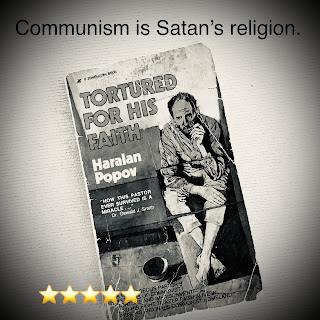
The more I read about communism, the more I believe it to be the religion of Satan. Why? Because communists hate Christianity. While these regimes cannot compete with any religion because they aim to be the only religion of the state, there is plenty of first hand evidence to support that communists particularly seek to eliminate or control Christian churches, the Bible, Christian history, and Christians in general.
In Tortured for His Faith, Pastor Harlan Popov noted that the communists preferred to change the mind of Christians rather than have them die martyrs. It was a victory to force Christians to leave the faith and "conform to...the new society [communists] were building." Satan rather win one over to his side, especially a Christian. Popov described communism as the "cleverness and evil of Satan himself."
Yet, the obstacle that communists did not understand was that once a man gave his life to Christ, he was His forever, and no one could snatch him out of His hands.
PRISONER FOR CHRIST
Popov was an important Christian pastor in Bulgaria at the time of the Russian take over of Eastern European nations in 1944, also known as the Iron Curtain. Popov anticipated persecution, though there were three years of religious freedom. Then in 1948, he was arrested (or kidnapped, he says) and taken in for a "little questioning."
A little questioning turned into thirteen years of mental, emotional, and physical torture, hard labor, beatings, starvation, and imprisonment. He survived only by the grace of God. He knew he was in that position for Jesus, and he called it the Great Persecution for Christ.
Popov learned suffering for Christ was "more precious than gold," and he embraced it; however, he also knew he faced death, which brought peace because he knew he would instantly be with the Lord. Whatever God's will was for him, he accepted it.
COMMUNIST METHODS
Communist parties out of power purposely seem reasonable and kind, but let them come to power and their true nature will be revealed.
Starvation was used to "break the will" as opposed to brainwashing. Breaking the will "require[d] only brutal, unrelenting beatings, starvation and torture building up to a rising peak and crescendo of horror where a person no longer ha[d] a will of his own." Breaking the will was temporary, but brainwashing was permanent, convincing people that communism was good. Popov said they could never brainwash him. To them, he was worse than a triple murderer.
This was their tactic: "they began it with a fury and brutality." In addition, he suffered sleeplessness and standing for weeks on end. This should have transformed any rational human being into an animal.
And yet, in the end, it was the guard/interrogator who became animalistic.
When the Secret Police gave him instruction to write down information about himself, his connections, and work, he decided to use the opportunity to share his testimony and the Word of God. All of this was in preparation for his unjust trial that was stacked against him, regardless of the truth.
COMMUNIST MOTTO
Popov described communist teaching as "the end justifying the means." They justify using lies, deception, murder, and every measure to reach their goal. Their objective was to make a case against pastors -- to destroy the evangelical churches. The goal was to remove faithful pastors and replace them with puppet pastors who were easily programed for state propaganda. In truth, Christ and His Word were on trial. This was how Satan used false witnesses and accusations to erase Christ. But:
A lie is always a lie. Neither Marxists nor Leninists will ever succeed in building an earthly paradise upon a lie.
During the thirteen years, Popov saw his wife and two young children one time. This was the most difficult aspect and worst torture: not knowing the whereabouts, safety, or well being of one's family.
COMMUNIST CONTRADICTION
Popov shared a quote by Maxim Gorki, a communist writer, that was posted at the labor camp. It was translated:
'Man is something to be proud of,'
and yet, here thousands of men were treated like animals. Popov reasoned within himself: "God's Word teaches that man is the crown of creation. There is nothing on the face of the earth greater than man. It is strange that men who refuse to receive the Creator and who don't consider a human being to be of any value had written those words on the wall."
Furthermore, a second Gorki quote:
'If the enemy doesn't surrender, he must be annihilated.'
Again, Popov "thought about the contradiction in the two phrases, reflecting the division in the mind of the writer. By this, one can understand the chasm between communism in theory and communism in practice. The first quotation showed communist theory in its effort to create an earthly paradise. The second phrase showed the harsh reality. On the one hand, man is something to be proud of; on the other, he is an enemy who must be annihilated!"
In essence, the prisoners were enemies of the state because they would not permit the ideals of communism to triumph over their minds and hearts. Communism demanded total compliance and submissiveness. And yet, these prisoners had rejected the forces of the vilest enemy.
GOD USED IT FOR GOOD
Popov said this experience taught him
how low man can sink without God.
A man in prison is at the end of himself, and it is a good place for him to think about God. In prison, Popov built a prison ministry. Having secret access to a Bible, he was able to memorize 47 chapters. Once the Bible was confiscated, they could not take away what was already hidden away in his heart. He developed a way to share the gospel by doing a kind of morse code with prisoners in other cells.
Another way he shared the truth was by pretending to teach English to prisoners. He spoke the gospel in English, while the guards did not understand it.
For thirteen years, in every prison, cell, and work camp, Popov shared the gospel and left behind communities of Bible studies. He believed his years of torture, beatings, starvation, suffering, and separation were worth it. He kept his dignity because he never compromised his beliefs nor gave in to the scheme for early release, to spy on other pastors and help destroy Christianity in Bulgaria.
When he was officially released from prison, in 1961, his faith was "intact and stronger than ever."
CHRISTIANITY IS ONLY STRENGTHENED IN PERSECUTION
But his greatest work was about to begin. The churches behind the Iron Curtain were struggling, and believers were being tortured in silence. Pastor Popov learned from the Early Churches of Rome and helped to set up secret underground churches. There was a desperate need to get Bibles into Bulgaria immediately. For a time, people made their own copies of God's Word. As expected, persecution proved to be a positive work for the Church.
Through God's Hand, Popov obtained a passport to go outside the Iron Curtain and tell the free nations about the persecuted churches and their need for Bibles.
Finally, Popov left this message:
Christianity - true Bible-centered, evangelical Christianity - can never coexist with communism.
(Look at the evidence!)
Then pray. Then Come. Join us in this mighty work God has raised up in answer to the Macedonian call and to the cry from the Suffering Church.
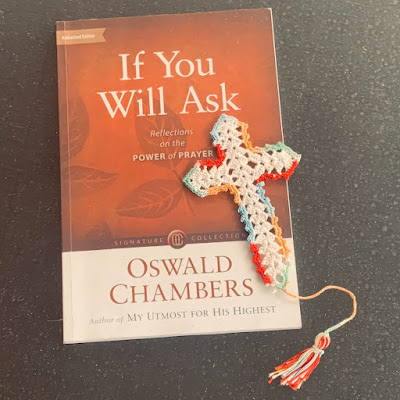
If You Will Ask: Reflection on the Power of Prayer
Oswald Chambers
Published 1937
⭐⭐⭐⭐⭐
This book came out of nowhere (a friend sent it to me and told me it looked really good). Obviously, it was not on my reading list for the year, but it seemed urgent enough and pertinent to read ASAP; and hence, I began reading a little every night. It is twelve short chapters, under 100 pages long.
Oswald Chambers, author of My Utmost for His Highest (another book I should read), asked the question: "What's the good of prayer?" Prayer is "an interruption of personal ambition, and no person who is busy has time to pray. If we do not pray, what...suffers is the life of God in us, which is nourished not by food but by prayer."
Prayer is more than "meditation." When a Christian is saved or born again, prayer is the means of maturing the life of God in him, or else that life will suffer. Prayer is how we know God and grow our life with Him. Prayer nourishes that [relationship] and prevents worry.
Worry, by the way, means we are not having our way, and in reality,
that is personal irritation with God.
Prayer also changes people, and in essences changes things or circumstances. We need prayer because human common sense, human will, and human wisdom are finite. We must pray to know God, to intercede for others, and to do God's will. And we can pray by asking, seeking, and knocking. That is how prayer influences conditions and people through us.
Prayer is easy because of the work that Jesus did on the cross. When you pray, recall what it cost God to make possible for us to pray and live a holy life, which was His agony for our redemption. It puts prayer into perspective.
Prayer is putting on the armor of God. It is "the place where God puts His soldiers, clad in His armor, and indwelt by his Spirit." And Christians are to pray everywhere always and for every little and big thing.
Prayer is watching and waiting. "Over and over again, God has to teach us how to stand and endure, watching actively and in wonder," while we wait to see how God will answer prayer.
There are times when God is silent. God always answers prayer, but during times of silence, he expects us to rely on him. They are signs that "God knows you can stand more of a revelation than you think you can." Your prayer is part of His purpose. He will answer.
Be eager and earnest in praying.
If God knows what we need, then why pray? Again, praying is how we know God, and we know God by praying through the Holy Spirit. The Holy Spirit is how we learn to "stand," "withstand," and "wrestle" through "flesh-and-blood circumstances" that mean to impede our prayer life.
Chambers encourages Christians to maintain a "childlike" habit and reliance on the Holy Spirit, always "exclaiming your heart to God." And remember: our bodies are the temple of the Holy Spirit and we must be vigilant to keep it "undefiled for Him."
My house shall be called a house of prayer. (Matthew 21:13)
What is sanctification? It is being separated for God, and it is seeing the world through God's point of view. Christians are made ONE WITH GOD IN MIND AND BODY, ONE IDENTITY. Christians do not get to pick and choose what to believe or what to obey. It is all or nothing. A man or woman full of the Holy Spirit demonstrates a "strong family likeness to Jesus and freedom from everything unlike Jesus."
Prayer is the essential work, not the prep-work. Prayer is intercession. When we fail to pray, we leave God out and make our business about us. We rely on ourselves, making us our own master. (How does praying to yourself work?)
Pray for others because you know not the work being done in them. This "kind of intercession...does the most damage to Satan's kingdom." God has told us to pray because it is "grounded on His redemption" and is "the mightiest factor He has put into our hands." Also, it is essential because of "the personal presence of the Holy Spirit."
Therefore pray.
Prayer is labor, not agony, but labor on the ground of our Lord's redemption in simple confidence in Him.
Prayer is simple to us because it cost Him so much to make it possible.
Prayer is God's answer to our poverty.
Is the Holy Spirit able to work God's will in you, or is He having to move aside for the countless desires of your heart? Is our every thought and imagination captive to Jesus Christ?
Finally, "when we are born again" and "indwelt by the Holy Spirit, He intercedes for us with a tenderness and an understanding akin to the Lord Jesus Christ and...to God -- that is, He expresses the unutterable for us." All the circumstances of the believer are ordered by God, not by chance, and are in the hand of God. Christians intercede for the people God has placed in their lives, and the Holy Spirit then intercedes for them.
* * *
Obviously, this is a book for Christians interested in knowing more about the Christian walk, especially prayer, which -- after reading this -- I now understand is one of the most important and essential responsibilities of our walk and life in Christ.
I debated doing a review for this juvenile historical-fiction biography about Polycarp, the bishop of the early church in Smyrna. It is one of the many minor books that I had acquired over the years and kept on my shelf but never read. I am reading my unread books in order to decide if I should keep or discard.
I decided to do a review after all. It is a typical story for young readers interested in people from the past or because their mom assigned it for reading. I gave it three stars because it was good, but I do not need to reread it, and in the end, I will donate it.
Polycarp (AD 69 - 155) was one of the church Fathers who learned under the Apostle John (the author of Revelation). He lived in the time of Ignatius and was a teacher of Irenaeus. What we know about Polycarp comes mostly from his student. In fact, this particular story of Polycarp is told through Irenaeus.
Many of the conflicts in the story incorporate living under the Roman Empire, dealing with heresies and false teachers, mediating disputes within the Church, and embracing martyrdom. Polycarp believed false doctrines to be a worse issue for the Christian Church than the threat from Rome, and he opposed false teachers with all his might. From the story, he said (though I cannot say it is an exact quote):
Rome is a tyranny and a scourge to men who love freedom, but a greater threat to the church than imperial persecutions has been the plague of false doctrine.
Martyrdom was a reality for Christians living in the Roman Empire. To escape an humiliating torturous public death, all they had to do was curse Christ and declare allegiance to Caesar. Many of them did at the last moment; but some did not. Polycarp desired to wear the crown of martyrdom, as he accepted his faith taught Christians to suffer persecution. He did not believe he was worthy of the crown of fire, but (he said),
I am also unworthy of all the grace and mercy God has ever shown me. He chooses broken vessels to show His glory, and He has appointed this road for me.
Polycarp was arrested and burned at the stake in Smyrna, in AD 155, at the age of 86.
* * *
One other reason I read this is because after reading You Who, the author Rachel Jankovic suggested that Christians read biographies of other Christians in order to learn how to live. After all, they are part of our family and they can teach us who we are, and their stories encourage us how to live in faith. Someone like Polycarp, who lived during an extremely dangerous time for Christians, demonstrated how Christians are to stand and watch, wrestle and defend, and live and die faithfully.
Rachel Jankovic states the goal of this book is to "encourage and equip believing women to see their identity in Christ as the most essential part of them, and to see all the ways that will work its way out in their lives, manifesting itself as strength, dignity, and clarity of purpose." Right away she opens the conversation about our obsession with identity and how we easily believe the foolish watered down philosophy of the self. Satan (IMO) wants people to replace God with this worldly philosophy.
Philosophy: Life's Questions
Man has asked the same questions about himself forever: Who am I? What am I for? How did I get here? What is the essential me? etc. Man wants to know HIS meaning in life.
Traditional philosophy argues that our minds make us human. But without God, might we be just animals? Some philosophers believe that our lives are worthless because we are the result of chance (there is no God); but that does not solve the desire for meaning of the self.
Now keep in mind two philosophies: good ol' nihilism, which states that all existence is devoid of meaning and nothing matters anyway, and existentialism, which is related to nihilism, but is associated mostly with action or doing.
Existentialism: You Make Your Own Meaning
Jean-Paul Sartre gave the definition for existentialism, which reiterated is:
You don't mean anything, objectively. You exist as a person before you mean anything. Existence comes before you have any essence or value at all. Essence is something that only happens through your own action, when you develop an essence. [Essentially], You make your own meaning.
Sartre believed his teaching to be the only means for hope. Sartre replaced God with a man-made remedy for hopelessness: You can be anything you want; you are what you make yourself; your story is yours to create; only you can make it happen. Sartre refuted that even proof of God existing cannot save man from himself; you still have to do something to save yourself from despair, hopelessness, etc.
Jankovic argued that Christians should naturally reject existentialism because "it is built on the absence of objective meaning, absence of God the Father, and absence of any intention or purpose for humanity that exists outside of each of us individually."
Sartre's ideas came directly from his own "private brain" for his own "private purposes," and his ideas became influential the whole world over. Basically Sartre put himself in the place of God and he told man how to live, and like obedient subjects of authority, the world listened and obeyed. Basically he said: There is no God, but I am going to act like God and tell you how to live.
Another philosopher, Abraham Maslow, developed the hierarchy of needs based on humanism and existentialism that focuses on self-actualization, the all-important what it means to be human: your essential SELF.
As humans achieve a level, starting at the bottom, they move up to the next level. You can only have a sense of self-worth or high self-esteem before you reach the "holy grail" of self-actualization. From the pinnacle of SA, you will know who you are and your place in the world. This is man's goal of feeling "right" in the world. Christians should recognize that this is not a biblical concept.
Under this philosophy, people look at others as a means to help them become the best version of themSELVES -- because others exist to help YOU fulfill YOUR needs. Again, Christians should recognize that this is not a biblical concept at all.
Conflicts with Worldly Philosophy
Many of us have grown up with the Sartre-Maslow philosophy of how to become what you are and what makes you you. It is part of the self-help movement that we use to be our best selves. We are working toward becoming us, and we are told our lives make up the story of who we are with a beginning, a middle, and an ending. We want to admire and flatter ourselves with the story of ourselves.
But when the story of ourselves - our degrees, careers, cars, hobbies, pleasures, social media, etc. -- becomes everything we are, this is a problem, not a solution. If our essence (our self-developed story) gives us value as humans, what happens when we change (because we do change!)? What about those who do not have the ability to direct their own lives, like those with handicaps or mental incapacitation, or dependent people? Remember Sartre: "Without action, we have no essence. Mere existence does not imply the presence of a true self."
If it is the will and action of the individual that makes us what we are, how could someone without a will or the ability for action matter as a human?
[This also made me think: What if you are unable, by something out of your control, to be who you desire to be? Is your life then a failure? I think this is a very real issue for people, which only leads to more hopelessness.]
When you remove Creator God from "the story," you remove our true human value. If there is no Creator, then it is easy to question the value of personhood. Regarding today's culture, I found this line relevant: "People are looking for their own human value in a society that they believe is denying them the opportunity." That just adds another level of hopelessness to the fight.
The Abortion Argument
How do we determine who matters and who does not when values clash? A woman creating her own self finds her fertility to be an obstacle in her path toward self-actualization, threatening her potential. You can see how pregnancy is a problem, and why a baby growing in her womb who cannot speak for itself, and in essence is not fully a self, does not take precedence over the pregnant woman who has achieved more of the levels on her way to self-actualization. She must be in charge of her destiny! This is why abortion and birth control (I added) are the means to get woman on the same level of freedom and opportunity as men (and higher)!
This is also why the abortion movement has been able to be honest about their mission. It used to be ignorance, but today they admit it is not a clump of cells. There is no shame in murdering a baby in the womb even up to birth because the highest cause for self-determination, absolute perfection, and ultimate self has been so elevated above life itself. Women must have freedom if they are going to be the author of their lives, and they must have ultimate control. Human babies do not have essence because they have never exercised their own will; therefore, they cannot be compared to their mother. The baby is not a person because it is not in the process of writing its own story.
Pushing the Boundaries of Culture
When people who come from nothing are writing their own stories, then it follows that there are no boundaries. It's one for himself and everyone else better get out of the way. People who believe the philosophy of self-creation must prove themselves. This leads to rebellion: rebellion of culture and rebelliousness towards God.
The issue for Christians is that we value life from conception as a unique life made in the image of God, regardless of its abilities. It does not need to do anything to have value. Its value is based in what God did by creating it and giving it life. For Christians, life should be protected at all stages and circumstances. To the world, only those exerting their own will have value and should be protected. That is why the culture does not have conflict with abortion, sexual experimentation, or even sex changes for children because it is recognized as pursuing one's will over his life in pursuit of his own story. Anything goes.
This is also why it feels and looks like HATE when Christians do not affirm the lifestyle choices of each self. It feels like direct unfair criticism of a unique story of self. It is an offense to disbelieve him. How dare you deny his truth? Yet, Christians know they are a small character in the greater story written by the Creator. "You cannot, as a character, outwrite the Author of you."
Christians Struggling With Identity Issues
The self-created you and the God-created you do not go together. If you are trying to recreate yourself, you will never be at peace. We cannot be a little of ourselves and mostly of God or a little of God and mostly ourselves. We must be all of God's. We cannot think that we can remake ourselves and He is going to approve.
Hard Truths
Jesus is our only hope. "There is nothing special about us if it is not resurrected in Him." Our selfishness, lust, self-centeredness, envy, greed, obsessions, guilt are dead in Christ. We cannot make them look good on social media. Our liberty in Christ is that we can let them go and submit to Him. You are not the author of your own identity; but rather, you live in Him and He in you.
What is Our Purpose?
We were created to be bigger than ourselves! We were created to be worshippers. Humans like worship, do we not? "The Westminster Confession of Faith states that the chief end of man was to glorify God and enjoy Him forever." Live to the glory of God in everything you do. Life is not about us, but the glory of God. We can never fill the empty selfish desire to reach absolute self-actualization and glorify ourselves. If you want to know yourself, know God. He knows you. Live for Him and you will be living toward your full potential.
It's About His Story
God's story about Creation is not finished. Our story begins with "In the beginning, God...," and the story of God and His people continues to this day. All of your life yesterday, today, and tomorrow - all of your great and small actions, housework, dinner decisions, conflicts at work, relationship issues - is all part of the story that is being told. And the end of the story is your eternal life (which actually does not seem like an end because it is eternal).
When Christians work on thier "own story," they should do so in obedience to God by way of sacrifice and faithfulness to Him. We become part of God's purpose as we submit to Him and He shapes us into something greater. Jankovic writes about planting flags, which is being intentional about what you do to the glory of God. Your work becomes an offering to God's glory. Even small things will be made great, as long as they are done to the glory of God. "The obedience of contentment and gratitude will not stay small."
So Why do Christians Struggle With Their Purpose?
When trials arise, as they will and do, faith is shaken, and Christians wonder how God could have made us for disappointments that oppose our wishes, abilities, or interests. We believe lies that God made us for more and better purposes. We struggle with rejoicing in our circumstances. However, in hindsight, we see, when we obey and submit, how God works through our trials. Then we pass on our glory to Him.
Jesus is more than we ever wanted, but when we look elsewhere for satisfaction, we are seeking something that satisfies for a term, if at all. We want to know that our lives matter, that someone loves and cares immensely for us, that we are truly known. But does not Christ already satisfy all of those desires by dying for us first on the cross before we even knew Him and while we were still in our sins? Does He not already know everything about us? Does He not know every little trouble, conflict, anxiety, sorrow of our lives?
We want to drink hesitantly from a sippy cup of comfort while God offers us the opportunity to stand under a Niagra Falls of glory.
We have eternal forgiveness, and we seek cheap validation. We have an omnipotent, omnipresent, and eternal God, and we just wish someone knew what we were going through.
Think of it: "God intentionally created YOU out of nothing without help from anything or anyone else." Under that understanding, "you are meaningful." You belong to and are accountable to the Creator. Compare that with the world's idea that you were a "wild accident" now tasked with being your best YOU, if you want to matter in this world. You only have to answer to yourself (or are accountable to the mob, in my opinion. Good luck with that). Until then, you are meaningless.
The world is wrong.
Believe in Yourself?
Self-worship and identity are lies. The brainwashed world repeats the lies, and people adopt it as truth. The lie replaced the truth of total belief, hope, and trust in God, causing the world's identity crisis, sending billions out to find their self-worth. It is a never ending cycle.
Meanwhile, we change constantly because we grow and mature, but our God does not change. He is the same yesterday, today, and forever. He is fixed and never goes through a midlife crisis. Christians are not shaken by change because they are steadfast in Christ.
Obedience and Sacrifice in Christ
Jankovic says obedience is what transforms us; acting on what we read in Scripture changes our knowledge of self. She says there are things God gives to us -- personalities, pleasures, weaknesses -- that we can sacrifice to God, to lay down, to give up, ways to obey. This obedience transforms you.
Jankovic also describes Christians as STAFF. We are workers for the Kingdom and we should be about His business. We are heirs to the King, but we are not princesses demanding to get everything we want. "We are called to imitate the King and the selfless work He accomplished for us." We are called to even turn trials and suffering into blessings for others. (So much for the idea that others are for our betterment.)
One great suggestion is to read Christian biographies or memoirs to see how they lived because we can learn about ourselves and how to live. It is like finding out about your descendents.
Another suggestion is for Christians to stop thinking of their feelings as insights. "Our feelings are something that need to be managed." It is part of God's commandment to practice self-control. Our feelings lie to us and they are not to be trusted. They distract us and lead us astray. Again, give your emotions to God and ask Him to lead and show you how to live your emotional life and obey Him.
Body Image
I think we women are more apt to struggle with body image than men. Either we worry too much about our bodies or we worship our bodies. Again, we don't need to love ourselves; we need to love our Maker. God made our bodies and we should be grateful. We do not need to make ourselves into the image of the woman on the magazine cover, but we do need to faithfully reflect our Creator, and that includes being grateful for our bodies as they are.
And it is not enough to look at Christ. He is not in the distance or part of the scenery. We reflect His glory like the moon reflects the sun's glorious light.
Sin
"Sin diminishes and destroys the self, worshipping and serving the creature instead of the Creator. Self-worship is self-destruction. It cuts us off from the source of ourselves -- the Creator. Fallen man wants to reject the truth and do the opposite, which is to glorify self -- not God."
The Choice is Ours
Think of the future: "do you want to be in your self-made costume in Hell or your true self, made in Christ and in Heaven?" You can't keep being "true to yourself." I bet the cycle is exhausting. But you can be true to Christ and set free of the burden of constantly improving yourself.
For Christians, we must feed daily on the Word of God without excuses of distractions, weakness, and lies. Reading your Bible is obedience and through obedience your faith will grow and you will become the best you in Him.
This is the work He has for us: that we speak His language here, live His story here, be thoroughly, completely, obediently His people here, and go about our daily lives planting flags for our homeland, claiming all the territories that we encounter here for His kingdom. We claim all of Christ for all of life, forever.
The more we worship Him, the more we know Him; the more we know Him, the more we will know ourselves.
* * *
If you would like more ideas from the book, here is the author discussing the issue at hand: