A woman in Lily Bart's world had only two options: marriage or death.
Lily was special -- primed to marry well, to be "decorative" and "ornamental," particularly for her exquisite beauty, and conditioned to avoid a "dingy" life. Except, Lily struggled to make decisions and had missed a few earlier opportunities to marry well. Now she was closer to being beyond marriageable age.
Unfortunately, Lily had expensive taste and was obsessed with money; and she was poor, sustained only by the pity of a wealthy aunt. She complained that men had a choice to marry or remain single, but women did not. If women were to appear successful and rich, they must marry into "partnership" with a successful man. Therefore, Lily was holding out for that unique man who was successful, well-off, and could also bring her happiness. But who?
Selden was a good friend to Lily, but he was not wealthy, and Lily knew he could never financially satisfy her thirst to keep up with high society. And yet, she considered him the "richest man she had ever met." He was free from the restraints of society.
Regrettably, high society was exhausting because there were so many rules that women had to obey, and many rules were hypocritical. Lily also felt the pressure to gamble because that is what women in her circle were expected to do. Lily's gambling addiction later cost her everything.
Lily frustrated me
Up to this point, Lily had frustrated me. She was malleable, indecisive, and foolish. And while I added up all of the lies she had told to cover her wretched lifestyle or to save herself from mortification, she showed a glimmer of noble character. Lily had received evidence that a married woman in her circle of acquaintances had pursued a romantic affair with Selden through letters. But instead of confronting either party, she kept the information to herself, specifically to protect her good friend; however, it could have been used to blackmail the wicked married woman who intentionally singled out Lily, took advantage of her, and finally, out of jealousy, sabotaged her reputation with rumors and, thus, isolated her from society.
It seemed everyone and everything had turned against Lily. She did not belong to that harsh "other world." Selden saw this clearly. He loved her and wanted to rescue her from it, but he could not help her. She was all alone.
That's Lily all over, you know: she works like a slave preparing the ground and sowing her seed; but the day she ought to be reaping the harvest she oversleeps herself or goes off on a picnic.
One of my own marginal notes stated: Lily would have married a rich prince, but self-sabotage is always her end. I don't think Lily wants to be married after all.
This story was hardly over when Lily's worldly aunt died of humiliation. She was outraged with her niece because of the rumors she had heard about Lily's "folly" and, therefore, decreased her legacy, leaving her in an extremely precarious circumstance. Lily had expected to pay off her debt with the inheritance, but now it could hardly be enough.
Lily was desperate and thought about a prosperous man who once admired and sought to marry her. She had declined because she knew she would have settled. Since circumstances had changed, she reconsidered marriage with him; however, he was no longer interested because her reputation had been tarnished. Yet, he knew about the damaging letters and the affairs of that particular woman who had ruined Lily, and he encouraged Lily to come out with the truth -- repairing her own reputation and "making her marriageable again." But because of her noble courage, she would not drag Selden's name through the mud.
Lily salvages my opinion of herself
By Book Two, Chapter Eight, I wrote: "Lily is a bigger person (even flawed) than all of us." She had declined in society, and yet, she refused to compromise her convictions. Not only was she alone -- she was invisible.
Hitherto her intermittent impulses of resistance had sufficed to maintain her self-respect.
Lily eventually resided at a boarding house and worked as a laborer, until that ended. And like Madame Bovary, she resorted to drugs to help her sleeplessness.
Reynolds: Mrs. Lloyd, 1775-76
Lily learned a lesson too late
In the final pages, Lily learned one simple lesson. She met a young working-girl whom she had once helped. The girl had married now and was a mother, and Lily had the opportunity to witness the "central truth of existence:" this young family was built in poverty, with faith and courage. They did not have the financial security of high society, but they were free to love each other and be happy.
In the end, she remained true to her word, and when her aunt's cheque arrived, she paid off all of her debts. She could have been happy with Selden, but she made her choice. This was the end for Lily. She will never have her life back.
A little soapbox
Though the demise of Lily is tragic, much of it was self-imposed. She complained about what it cost for [her] "to live on the rich":
--it's a privilege we have to pay for! We eat their dinners and drink their wine, and smoke their cigarettes, and use their carriages and their opera-boxes and their private cares -- yes, but there's a tax to pay on every one of those luxuries...the girl pays it by tips and cards too -- oh, yes, I've had to take up bridge again -- and by going to the best dress-makers, and having just the right dress for every occasion, and always keeping herself fresh and exquisite and amusing!
For Lily, her greatest fear was poverty; but it should have been fear of facing an angry God. I know that was not the point of the story, but I see it this way: man's problems are not caused by the discrepancy between rich and poor; man's problems are caused by his disobedience toward God and doing everything his own way. And that is why Lily was lost, indecisive, and obsessed with wealth. All of those people were lost because they lived life their way -- with gossip, adultery, covetousness, self-preservation, greed, materialism, lying, slothfulness, self-worship -- we know our ways are self-destructive; but there is a better way.
Nonetheless...
The House of Mirth is an intriguing and calculating story - never a dull chapter. The characters are believable, even as caricatures of society. And Edith Wharton is an exceptionally mature writer. She knows the human heart thoroughly and, I'm afraid, does not exaggerate or hide any rotten detail at all.
This is my second read of House of Mirth, and on some pages, I ran out of room in the margins to add any new notes.
If you have only considered reading House of Mirth or any other Edith Wharton, what are you waiting for? Do it now. You will not regret it.
Married to a Difficult Man is a comprehensive history/biography about the Colonial American Puritan pastor, Jonathan Edwards, his wife, Sarah, their children, and the times and places they lived.
THE UNION
The story began with the union of Jonathan and Sarah. Edwards was bookish and studious, and while women were not expected to be educated in the 1700's Puritan world, "Sarah had the best training a girl was allowed to have then." She was a "young lady of quality," and was trained well in many skills. She even practiced good posture for many hours - a lost art. Jonathan may have met his match in Sarah's mind, but he was terribly awkward in the area of social graces.
Nonetheless they discovered their shared love for nature and books, which could be enough to keep any union vigorous; but of course there was more to their union. Sarah would be marrying a minister, and with that came unique obligations and responsibilities. It takes an exceptional woman to wed and stay married to a man of the pulpit, particularly a man who disappeared for long periods of time reading, researching, writing, and traveling.
In addition to his "horrendous" working hours, she had to contend with her husband's not uncommon communications and connections with other women in the church, as "the majority of members in the New England church were women."
To be sure, the author makes a major portion of the book about their love and faithfulness to each other. A family friend recalled how Edwards
could trust everything...to the care of Mrs. Edwards with entire safety and undoubting confidence. She was most judicious and faithful mistress, habitually industrious, a sound economist, managing her household affairs with diligence and discretion.
She uniformly paid a becoming deerence to her husband and treated him with entire respect, conforming to his inclination and rendering everything in the family agreeable and pleasant. She accounted it her greatest glory and there wherein she could best serve God and her generation, to be the means of promoting his usefulness and happiness.
In return, Edwards "treated her as a fully mature being (as a person whose conversations entertained him, whose spirit nourished his own religious life, whose presence gave him repose).
RAISING UP CHILDREN
Sarah and Jonathan were blessed with eleven children. Jonathan believed that
as innocent as children seem to be to us, yet...they are naturally very senseless and stupid, being born as the wild ass's colt and need much to awaken them.
At the end of each day, Jonathan dedicated an hour to his family. He educated his children in church history, Latin, Greek, rhetoric, and penmanship. He listened to their lessons and expected them to compose their own prayers. But it was Sarah who trained them up in godly character and self-discipline.
It is impressive to consider what the sole union of Sarah and Jonathan produced. By 1900, the Edwards family could boast (though they probably wouldn't):
13 college presidents
65 professors
100 lawyers
1 dean of a law school
30 judges
66 physicians
1 dean of a medical school
80 holders of public office
3 U.S. senators
3 mayors
3 governors
1 U.S. Treasury Controller
1 U. S. Vice President
THE REVIVAL
There were two religious revivals under Jonathan Edwards, called The Great Awakenings. The colonial settlements of America had quieted into a lull, bored with religion and suspicious of church structure.
The beginnings of the first Great Awakening, in 1734, had fractured and weakened many churches. There was an emotional fervor taking over the town, and Edwards sought to channel it into sensible discernment. He wrote biblical directions to test if conviction was true or empty emotion. When the effect swung in the opposite course, and people wearied in "despair... [with] a terrifying sense of God's anger," Edwards worked to keep the movement well-grounded in truth. He focused their faith into action.
The second revival in 1740-41, occurred when George Whitefield, the English evangelist, visited America. It was also the same time that Edwards wrote his sermon: Sinners in the Hands of an Angry God. It fell on deaf ears when he read it to his own congregation; however, some months later as a guest pastor , he read the same sermon, and there it made history. That sermon may well have changed the face of New England.
But with religious revivals, there was a counter: churches further splintered and "religious experience [was] grotesquely distorted by emotionalism." And with it, a host of false teachers led false converts away.
BACK TO SARAH
The most interesting chapter was on Sarah and her nervous breakdown, which led to either her true "conversion" or further growth in her walk with Christ. Sarah struggled internally, particularly after childbirth. "Her disproportionate responsibilities began to overtax her." She was tempted to think the worst of her husband, her children and herself, and she fought to not reveal:
I'm not as endlessly giving as I appear to be, and this is an impossibly difficult man.
As her husband was frequently away, she carried the management of their large household solely on her own, without relief for her own fears or anxieties. She was crushed by the opinions of others in the congregation, of not only herself but also for her husband. The burdens became heavier. She eventually felt she was wrestling with God.
For Sarah, it was a personal Great Awakening, and when she literally came to, she
stopped straining to please God (and man) and began to live in the assurance of a salvation she didn't have to try to deserve. She stopped pushing herself to be worthy of Edwards' love and from then on had his unreserved admiration.
She recalled how she awoke and:
...was led to reflect on God's mercy to me in giving me, for many years, a willingness to die, and after that...in making me willing to live.
BACK TO JONATHAN
Edwards took on the sinfulness of the community, becoming very liberal in his opinions about trivial matters while stepping on some consciences along the way. He commented on his congregations' owning too few books - evidence for a lack of reading. (I mean, truly reprehensible!) The people were tired of Edward's lectures on his angry God. Sarah came to the defense of her husband by writing a long letter to the church membership, but this mattered not. Edwards wore out his welcome. It was 1750. The colonies were in a bad mood, and Edwards was voted out of his congregation and sent packing.
He was relegated to a missionary of the Mohican Nation, where he preached the gospel and taught the people. He maintained good relations with the Indians and also defended their rights to their homeland. This was the time of the French and Indian War, where the Edwardses were very much on the frontline.
UNFORTUNATELY...
There is much more to the story, but I will cut to the end of Jonathan and Sarah. In 1758, a smallpox epidemic was spreading, and Edwards decided to take a chance on the new inoculation. Jonathan and daughter Esther and her children were agreed to be part of the experiment. Unfortunately, they all contracted smallpox from the medical procedure, and Jonathan succumbed to the disease after all.
Sarah "tried to be prepared or any testing that life might require of her." She found ways to cling to and trust in God. While Esther suffered with the pox, Sarah wrote to her daughter about the loss of Mr. Edwards:
A holy and good God has covered us with a dark cloud. He has made me adore his goodness, that we had [Jonathan] so long. But my God lives; and he has my heart. O what a legacy my husband and your father has left us! We are given to God; and there I am and love to be.
Two weeks later, Esther died.
Not long after, Sarah lost the will to live without her life partner and she died of a broken heart.
FINAL WORDS
While reading, I did not fully appreciate the scope of this work until I started to write a review. I left out so much information. There are several more chapters after Sarah's death covering the Edwardses' legacy, which continued for over a century and is amazing when you consider how much an individual and family can do to alter a nation. Even with their failings and blunders, they affected history, a nation and its people for good. If it wasn't for Pfizer the smallpox experiment, how much more would they have accomplished?
I only gave it three stars because I thought the writing could have been better. That was my only pet peeve.
What is Madame Bovary Syndrome? It is a psychological condition named after the female protagonist in Madame Bovary. Philosopher Jules De Gaultier described it as a "chronic dissatisfaction with one's life." Another definition described it as a "shopping disorder." As to the behaviors displayed by Emma Bovary, both descriptions fit.
But there is more: Madame Bovary syndrome involves escaping reality - a typical coping mechanism - through idealism of religion, memories, reading, music, dreams, passion, romantic love, shopping, and even living through the achievements of others (like one's spouse or child).
This behavior was commonly present in nineteenth century novels, in which female protagonists suffered from an inability to achieve their coveted desires and were either driven to madness or suicide because there was no solution or a way out of the syndrome. In fact, I am reading Anna Karenina right now, and there are so many similarities to Madame Bovary.
But, hold on...men are not entirely exempt from Madame Bovary Syndrome.
A short summary (with spoiler)
In the novel, Emma is a young country girl who was married off to a good, kind-hearted widower, Charles Bovary, who genuinely loved Emma very much. He is a mediocre doctor and not well off; also he is rather dull. Emma had expectations that marriage would bring excitement, but Charles was blah and Emma's life felt boring.
When Charles aided an elite patient, the gentleman invited Charles and Emma to his ball to show his gratitude, sort of. For the first time, Emma witnessed how the other half of society lived and imagined it was the world she had been destined, not the passion-less life she was living with Charles. Her disillusions pushed her into depression. Her caring husband thought a change of environment would improve her health, and they moved into town.
Young Lady in a Boat - Tissot, 1870
Town was no better, but Emma befriended a young clerk, Leon, who shared her passions: music, poetry, art, love -- they had much in common. Leon wanted to pursue a relationship, but Emma restrained herself. She desperately sought assistance through the church, but the priest was useless.
Emma grew possessive of Leon, eventually chasing him away; he left town to escape her obsessiveness. Needless to say, she was shattered. By this time, Emma and Charles had a daughter. Unfortunately, she neglected her, never truly bonding. (Emma had hoped for a boy because she believed only boys could achieve their dreams and live as they chose.) Unfortunately, like marriage, motherhood was unfulfilling.
But then...enter Rodolphe, a wealthy socialite who set his target on Emma and pursued her. It was not too difficult. He was a smooth talker, and she was hooked. The connection immediately developed into a physical affair, and he eventually became bored of Emma. Their steamy relationship heavily clouded her opinion of her husband and marriage; she disliked everything about Charles. She plotted to run away with Rodolphe, and he pretended to agree; but he left a Dear John letter instead and skipped out of town as quickly as he could.
Naturally, Emma was devastated and became deeply depressed. To lift her spirits, Charles took Emma to the opera where they ran into...Leon! Charles was either oblivious to Emma's emotional and physical affairs or he encouraged them. He suggested she remain in Rouen to see the opera the following night. Instead she reignited her connection with Leon. For a long time, she lied to maintain their time together and lived like an unpaid prostitute. She also became obsessive and controlling.
In addition to the affair, Emma's behavior had become more reckless, like a drug addict. She spent money on credit to buy frivolous things that she thought would bring her happiness and contentment. She plunged her husband into debt, with no way to pay it off unless she turned herself into a prostitute, as her lawyer had suggested.
Since she could not pay off her financial debt -- nor would her unsuspecting husband be able to save her once he found out -- she decided death was the only way out.
No more spoilers
Now, this may seem very one-sided, but it is not. The men in this story have their own issues. For one, while Charles was a good, kind man who did love Emma, he was quite ignorant of her needs and he did not understand her. Or he was too stupid to comprehend. In Scripture, a husband is supposed to know his wife in an understanding way. That means he needs to make time and an effort to figure her out, know her desires and feelings, and never quit until it is clear.
Either he was truly blind about her affairs or he knew he was incompetent as Emma's husband and, therefore, encouraged her to maintain the illicit relationships because he could not make her happy. But probably it was the first idea. He was a LAZY husband who did not rise to the occasion to be a capable husband. While her affairs were forbidden, so too, he did not keep his vows.
I do not want to get into how constricted Emma's life was because she was a 19th century woman. At one point she had a child, and that was not enough for her. She was still chasing what was not her reality. She was in the wrong, Charles was wrong; in fact, every character in Madame Bovary was wrong.
Also, as I suggested, Madame Bovary syndrome is not just for women. Charles suffered from his own desire to escape reality. Before Emma, he had developed obsessions for pleasure. And maybe marrying Emma was also part of his seeking happiness through his attractive young wife. He couldn't wait to get rid of his late-wife's wedding bouquet to make room for Emma. Even after Emma's death, he developed interests in all pursuits Emma was interested, albeit too late. He also initially avoided reading the love letters from her lovers. He preferred to keep a particular image of Emma -- the ideal image he had created in his mind.
Finally, there was another man who suffered from Madame Bovary syndrome before it had a name: Gustave Flaubert. Yep! According to the author, he was the inspiration for Emma, having experienced disillusions of life, love, romance, happiness, relationships, and the like.
None of this is surprising to me, and I bet everyone experiences some disillusionment of life in some way or at some point. I know I have. A lot! True -- books, movies, music, idols, even pride, and self-importance can mislead us into false expectations. We create romantic illusions and passions which reality cannot compare, setting ourselves up for disappointment and failure. We falsely believe others have it better than us, and we covet their lives.
The only remedy for MB syndrome
The only solution, the only remedy for Madame Bovary syndrome is the gospel. Yep!! Bottom line! There is no other reality cleanser better than knowing who Christ is and where you stand in relation to Him. There are no disillusions with Him. And most of all, our desires for something better stem from a missing relationship with Him. He fulfills that longing.
Knowing where you came from, where you are going when you die, and that Jesus Christ died for you is a life changer. I always think about how a relationship with Christ would have changed the characters in the books I read. Surely, Charles would have been a present and attentive husband; Emma would have spared her marriage, her daughter, and her own life by finding contentment in her relationship in Christ, regardless how incompetent her husband was; Rodolphe and Leon would respected women; the priest would have been of better service to others; the pharmacist would have been an honest man, etc.
Final parting words
This is an excellent novel, well written, never boring. Flaubert's characters are comical in a serious way, like caricatures. This may not be a plot many can relate, thankfully, but it certainly is a relatable issue. Flaubert used a woman as his example to demonstrate social inequalities (of his time), but what Emma Bovary suffered from is the human heart defect that both men and women experience even today when they pursue fleeting happiness in all the wrong people, places, and material things. Until they find the Truth, they will always end up disappointed and disillusioned in life.
This is one of the multitude of questions Rebekah Merkle answers in Eve in Exile. She contends that modern day feminists have led women to a "boring dead end," and even feminists no longer understand what they are demanding. However, Christian women are not doing any better by "escaping" and "romanticising" the past, as a way to combat current feminism. Holding nothing back, Merkle offers an encouraging, victorious argument for (Christian) women by presenting our biblical calling and feminine attributes. It's time to "bring Eve back from exile."
God has called women to change the world through the gospel. Men cannot do this job alone if women are distracted. We have come to believe the lie that being a stay-at-home mom (SAHM) is a trap compared to the working/career woman, who experiences absolute fulfillment.
Scripture is clear that those who focus on saving their own lives will lose it; whereas, those who lay down their lives for others will find fulfillment. And yet, the world tells us that women who pursue their own dreams are the winners. Furthermore, it is not men telling women what to do. We have liberty, and we do this to ourselves.
Merkle includes a short overview of the history of feminism: overall, the message was to divorce women from the responsibility of fertility. Men were free from accountability of children, and it wasn't fair for a woman to remain celibate if she had to avoid pregnancy; hence birth control and abortion, which provided "the emancipation from restrictive biology."
After WWII, housewives became discontent. America had a technological growth spurt and modern day conveniences made work efficient and simple. Work became demeaning and women complained, bored of the technological blessings. While women of the 50s were not oppressed, the ideals for women became superficial.
Betty Friedan taught that women would be happier to leave hubby, kids, and home and pursue education or their own career. This idea was embraced wholeheartedly; but was Friedan right? Did it cure discontentment?
There is more evidence to support that women are less happy than ever. I am leaving out the details that Merkle includes, including how many women take antidepressants today (not to mention the divorce rates, counseling, stress and anxiety, etc.). Merkle states that what women truly needed was not a sexual revolution or careers, but God's grace.
The idealistic, superficial shallow view of homemaking of the 50s needed to be chucked. It was a lie.
To be fair, feminism sought to address essential issues:
education of women
end of slavery
drunk husbands and fathers as social ills
voting and citizen rights
end back-alley abortions
superficial ideal of housewife in the 50s as wrong
pornography and prostitution are both social ills.
However, today's third wave feminism - no one really knows what it stands for - is just a lot of angry women, lacking cohesive objectives. All of feminism's intentions have already been accomplished; all that is left is to erase femininity completely. Today's feminists embrace, approve, and celebrate many of the destructive practices that first and second wave feminism brought to light. This is absolutely backwards and confusing, especially the part where they are now advocating for transgenderism, men using women's restrooms, and men ruining sports for women indefinitely! But I digress.
SO WHAT ARE WOMEN DESIGNED FOR?
Work is GOOD. "God did not create Eve so Adam could have someone pretty to look at." Eve was made to help Adam subdue AND fill the earth. God designed women to be interesting. We were not created to be unable to think or speak for ourselves.
Women were designed to sacrifice for others, as we are natural caregivers. That is why replacing the work of caring for home and family with a career cannot make women happy. Also, the corporate world is the wrong setting. This is where women feel cooped up and forced to compete with men.
Women were designed for motherhood, but feminism separates women from their natural creation purpose. We were designed for a specific role with fixed limits on our feminine nature, and we must live within these boundaries while honoring God's intention.
We need to return to our abandoned stations and guard them by manning and securing our own homes, families, and lives, disciplining ourselves through faithfulness, obedience, and sacrifice. "Mothers are raising the next generation of souls forever."
Merkle points out that just because there is an obvious difference between two things does not imply that one is better than the other. Feminists hate that women and men are different with complementary roles.
The author examines 1 Corinthians 2 and explains how this verse is not about inferiority or superiority, but rather that men and women are equal in the Lord. She shows how submission out of love and servitude gloriously resembles Christ. "Submitting to one's OWN husband is the most powerful, magnificent, intoxicating, concentrated picture of glory. When a woman submits to her husband, then glory grows. When a woman rejects submission, glory fades."
The fruit of feminism is rotten to its core and barren; its beauty diminished. Women presenting themselves as sex objects or celebrating their sexual "liberty,' which is not the way the woman was created to share herself with her husband, is ugly. Sexual slavery is the standard in our culture today, and women falsely believe they are finally in control of their lives because they bypassed the submission part.
Running away from the scriptural requirement to submit to one man, as an equal, within the protection of marriage, has resulted in women living in submission to numerous men, with no protection at all, and with her bearing the entire weight of responsibility for the outcome. The fruit of this lifestyle must either be killed or she must raise the child alone.
The Titus Two Woman: Women WITH households (tend to be married and with children) are called to RUN THEIR OWN HOUSEHOLDS. "Women managing their own households are cities on a hill," raising up the next generation, passing down their wisdom to younger women, and impacting the rest of the world.
Feminism is just rebelliousness against God's creation, design, and command to women to help fill the earth, preferring sexual freedom from accountability and presenting birth control and abortion as basic human rights.
WHAT ARE WOMEN TO DO?
Christian women need to recover a sense of importance of the home, and being wives and mothers. Recognize that feminism focuses on the group - womankind - and its first duty is to thyself. A married woman's priority is to her home, husband, and family. If her work extends beyond the home and family, it should return in blessings to her husband and children, not take away from them.
A woman chasing her own dreams, beauty, and pleasure suffers loss of fulfillment. SAHM need to change their perspective about their work, challenge themselves to think creatively, and go beyond doing the bare minimum. "But to whom much is given, much is required." Consider how materially blessed we are.
We have been given talents, and we need to turn a profit; invest what God has given to us. Pursue excellence. Improve, create, and build. Glorify God with your attitude. Be an influencer instead of being influenced. Ask God to show you how to turn a profit with what He has given you.
The home is essential work and God wants women to tend to it.The home is power: it nurtures, feeds, provides rest, safety, and a pleasant atmosphere, gives shelter, and fosters loyalty. Don't bury your talents. "Working outside the home is not prohibited so long as it makes the home more potent, glorious, compelling."
"When Christian women trust God and obey Him, He will never trick us." Women influence the world by making it attractive, pleasant, and good. How many have been lured by the lies of false beauty? Our job is to make holiness beautiful. We draw people to the truth by showing beauty in Christ.
This is difficult, I know, but the author says: If you "lay [your] dreams down, He gives [you] fulfillment. Bury [your] own ambition, and He returns it with interest."
Imitate God in [y]our fruitfulness. It will look like what God shows [you] is beauty, not [y]our ridged expectations. Be the glory of your husband. Build your house. Work hard. Be ambitious and productive. Learn more, run harder. Use the gifts God has given you, the desires he has given you, the constraints he has given to you, and figure out how to weave those into something glorious, unique, compelling, special, beautiful that cannot be contained and beckons a broken world to come and see that that Lord is good.
* * *
This book targets women, particularly Christian women, and obviously wives and mothers, although there is a message for singles. It is a difficult topic and requires a change in thinking. This is about obedience, and we do not have the right to ignore God's commands or adopt the world's ways. All of us will be held to account for our disobedience in this area. The author makes clear that every woman has different talents and is in unique circumstances, and her work will look completely different than everyone else's. It is your challenge to find out how to tend to your garden by obeying God and glorifying Him in the role He has given you. By trusting and obeying Him, we not only find fulfillment, but the return will be multiplied.
I understand many women, including Christians, will disagree with Merkle. However, I believe she is correct because she uses Scripture to support her arguments; and we can't change God's intentions and commands.
I also did not go into my own marriage and motherhood knowing any of this. I chose to stay home with my kids out of a natural desire to be with them. It was not easy living on one income, and we had some difficult financial years. But I would never exchange being home for a "rewarding career or job or even my own business." Managing a home, raising five kids, homeschooling, and being married to a low maintenance husband is enough for me. Even still, Merkle convicted me because I realize I am not always putting in 100% of myself. I can be lazy and selfish, too. I still have a lot of work to do. So for me, this was definitely an excellent read. I hope other women will find it encouraging as well.
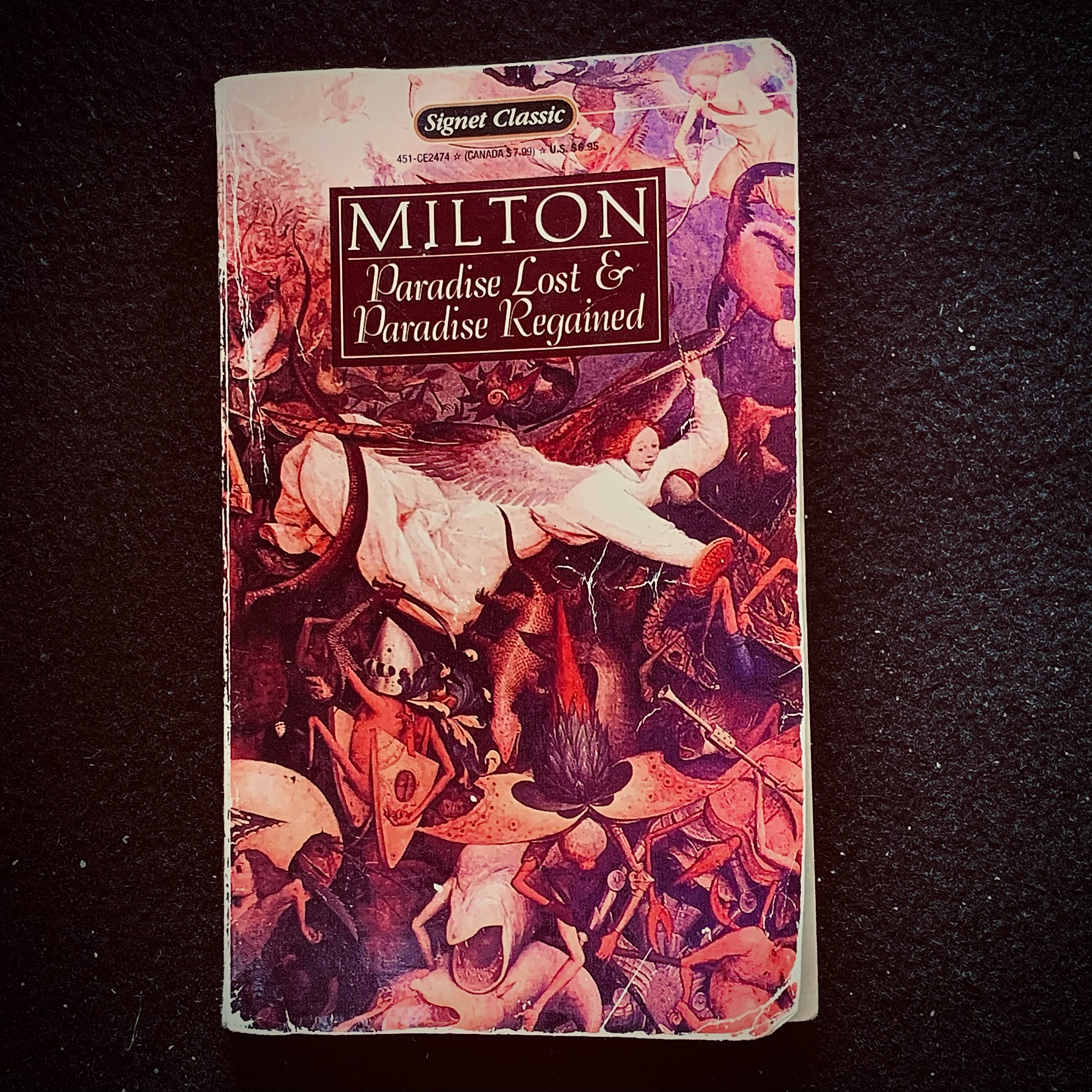
Next on TWEM poetry list was Paradise Lost by John Milton. My used copy also includes Paradise Regained, though I did not read it. I certainly would like to read it after I reread Paradise Lost. I have to reread Paradise Lost because I missed so much in the beginning. It took two months to read, but mainly because I initially avoided it.
For the first quarter of the poem I felt lost. While the language was not difficult, I was not always sure what was happening. Only when I got to the narrative of Creation, the story started to make sense. The good news is that when I arrived at Book IX, everything changed! I truly started to enjoy Paradise Lost. Yay!
Paradise Lost is an "exploration of the moral problems of God's justice," and was considered to be controversial in its time. The poem covers the temptation and fall of Adam and Eve and their removal from Paradise. It tells of Satan's rebellion against God, his expulsion from heaven, his trickery with Adam and Eve, and his banishment to hell. It also includes God's promise to redeem all mankind.
Milton took liberty to include conversations and accounts of God, Satan, Adam, Eve, and angels that we have no way of knowing are true or accurate; hence the reader has to use his imagination. With that, I think the poem is creative and fruitful. Obviously, I wouldn't read it for its biblical theology, but instead for its literary genius.
It helps to have biblical knowledge of Creation, the Book of Genesis, and the Gospel among other biblical topics. Also, my edition was somewhat modernized. Each book (or chapter) offered a truncated argument before presenting the poem, which was also helpful in understanding what to expect.
Instead of rehashing this complex poem, I just want to share two observations I had. First, what caused me to have a change of heart three-fourths of the way through the poem: Milton's description of Eve, or women in general, I believe, is hysterical. Either Milton was sarcastic, or maybe he truly represented women of his time.
Observation #1 The Presentation of Women
In Book IX, Satan devised a way to gain access into Paradise disguised as mist, and entered the serpent. Meanwhile, Adam and Eve were discussing the day's work when Eve proposed that they divide the work and go about separately expediting their tasks; but Adam, who believed that solitude was good sometimes and encouraged return again, opposed Eve's idea and reminded her of the angel's warning of the Enemy, in case he find her alone. He argued that his wife would be safest by his side. Yet, Eve disliked to be considered unable to be careful enough and insisted on separating, anxious to exhibit her remarkable abilities. And Adam yielded.
Oh, Adam.
Poor Adam tried to make a good, strong case for himself, for husband's in general, but Eve confidently rebuked him. She trusted herself more. And off she went and was caught by Satan's lies anyway.
My first thought was that nothing has changed, at least according to the presentation Milton gave. We know that the biblical story of Adam blaming God for giving him the woman, and Eve blaming the serpent for deceiving her, that this is very relatable. But for Milton to define Eve as seeking separation from her husband (in part due to his smothering ways) and a desire to prove herself apart from him, makes me think that woman has not changed, at least, since Milton's time. And that makes a lot of sense to me.
Observation #2 Incorporating History
My second observation was that, in addition to the biblical story, Paradise Lost is full of references to Classical mythology, Greek and Roman terminology and science, and mixed with literary, religious, and English history. The more foreknowledge that the reader has of these topics, the deeper comprehension and appreciation he may have of the poem. That's why it makes me cringe when I hear snobs like Yuval Noah Hirari shun the knowledge of the past as irrelevant. Yuck!
So history is not about the past. It is about the present. The past is gone. All the people who lived in the past are dead, and we cannot go back there. If history is just the study of the past, it is irrelevant.
- Yuval Noah Harari, Global Elitist
The history of the world's peoples who came before us, their religious histories, their literary stories, their myths, contribute to our world and who we are today. To dismiss it as irrelevant, to make it all about us and what evil purposes and gain "we" can use the past for today, is arrogant, shallow, and unintelligent. If Yuval has his way, no one will read Paradise Lost because it will be unreadable and unnecessary. I'm afraid we are already there, with a complete disconnect and disinterest in the past. History is becoming...history.
Yet, I believe, to incorporate a variety of histories with Classical mythology into a complex biblical epic poem is an ambitious feat. Even with my delayed appreciation of the work, I recognized that this was a great piece of literature, and I am glad I finished it.
* * *
Next on TWEM poetry list: Songs of Innocence and Experience [Blake]
Rachel Jankovic states the goal of this book is to "encourage and equip believing women to see their identity in Christ as the most essential part of them, and to see all the ways that will work its way out in their lives, manifesting itself as strength, dignity, and clarity of purpose." Right away she opens the conversation about our obsession with identity and how we easily believe the foolish watered down philosophy of the self. Satan (IMO) wants people to replace God with this worldly philosophy.
Philosophy: Life's Questions
Man has asked the same questions about himself forever: Who am I? What am I for? How did I get here? What is the essential me? etc. Man wants to know HIS meaning in life.
Traditional philosophy argues that our minds make us human. But without God, might we be just animals? Some philosophers believe that our lives are worthless because we are the result of chance (there is no God); but that does not solve the desire for meaning of the self.
Now keep in mind two philosophies: good ol' nihilism, which states that all existence is devoid of meaning and nothing matters anyway, and existentialism, which is related to nihilism, but is associated mostly with action or doing.
Existentialism: You Make Your Own Meaning
Jean-Paul Sartre gave the definition for existentialism, which reiterated is:
You don't mean anything, objectively. You exist as a person before you mean anything. Existence comes before you have any essence or value at all. Essence is something that only happens through your own action, when you develop an essence. [Essentially], You make your own meaning.
Sartre believed his teaching to be the only means for hope. Sartre replaced God with a man-made remedy for hopelessness: You can be anything you want; you are what you make yourself; your story is yours to create; only you can make it happen. Sartre refuted that even proof of God existing cannot save man from himself; you still have to do something to save yourself from despair, hopelessness, etc.
Jankovic argued that Christians should naturally reject existentialism because "it is built on the absence of objective meaning, absence of God the Father, and absence of any intention or purpose for humanity that exists outside of each of us individually."
Sartre's ideas came directly from his own "private brain" for his own "private purposes," and his ideas became influential the whole world over. Basically Sartre put himself in the place of God and he told man how to live, and like obedient subjects of authority, the world listened and obeyed. Basically he said: There is no God, but I am going to act like God and tell you how to live.
Another philosopher, Abraham Maslow, developed the hierarchy of needs based on humanism and existentialism that focuses on self-actualization, the all-important what it means to be human: your essential SELF.
As humans achieve a level, starting at the bottom, they move up to the next level. You can only have a sense of self-worth or high self-esteem before you reach the "holy grail" of self-actualization. From the pinnacle of SA, you will know who you are and your place in the world. This is man's goal of feeling "right" in the world. Christians should recognize that this is not a biblical concept.
Under this philosophy, people look at others as a means to help them become the best version of themSELVES -- because others exist to help YOU fulfill YOUR needs. Again, Christians should recognize that this is not a biblical concept at all.
Conflicts with Worldly Philosophy
Many of us have grown up with the Sartre-Maslow philosophy of how to become what you are and what makes you you. It is part of the self-help movement that we use to be our best selves. We are working toward becoming us, and we are told our lives make up the story of who we are with a beginning, a middle, and an ending. We want to admire and flatter ourselves with the story of ourselves.
But when the story of ourselves - our degrees, careers, cars, hobbies, pleasures, social media, etc. -- becomes everything we are, this is a problem, not a solution. If our essence (our self-developed story) gives us value as humans, what happens when we change (because we do change!)? What about those who do not have the ability to direct their own lives, like those with handicaps or mental incapacitation, or dependent people? Remember Sartre: "Without action, we have no essence. Mere existence does not imply the presence of a true self."
If it is the will and action of the individual that makes us what we are, how could someone without a will or the ability for action matter as a human?
[This also made me think: What if you are unable, by something out of your control, to be who you desire to be? Is your life then a failure? I think this is a very real issue for people, which only leads to more hopelessness.]
When you remove Creator God from "the story," you remove our true human value. If there is no Creator, then it is easy to question the value of personhood. Regarding today's culture, I found this line relevant: "People are looking for their own human value in a society that they believe is denying them the opportunity." That just adds another level of hopelessness to the fight.
The Abortion Argument
How do we determine who matters and who does not when values clash? A woman creating her own self finds her fertility to be an obstacle in her path toward self-actualization, threatening her potential. You can see how pregnancy is a problem, and why a baby growing in her womb who cannot speak for itself, and in essence is not fully a self, does not take precedence over the pregnant woman who has achieved more of the levels on her way to self-actualization. She must be in charge of her destiny! This is why abortion and birth control (I added) are the means to get woman on the same level of freedom and opportunity as men (and higher)!
This is also why the abortion movement has been able to be honest about their mission. It used to be ignorance, but today they admit it is not a clump of cells. There is no shame in murdering a baby in the womb even up to birth because the highest cause for self-determination, absolute perfection, and ultimate self has been so elevated above life itself. Women must have freedom if they are going to be the author of their lives, and they must have ultimate control. Human babies do not have essence because they have never exercised their own will; therefore, they cannot be compared to their mother. The baby is not a person because it is not in the process of writing its own story.
Pushing the Boundaries of Culture
When people who come from nothing are writing their own stories, then it follows that there are no boundaries. It's one for himself and everyone else better get out of the way. People who believe the philosophy of self-creation must prove themselves. This leads to rebellion: rebellion of culture and rebelliousness towards God.
The issue for Christians is that we value life from conception as a unique life made in the image of God, regardless of its abilities. It does not need to do anything to have value. Its value is based in what God did by creating it and giving it life. For Christians, life should be protected at all stages and circumstances. To the world, only those exerting their own will have value and should be protected. That is why the culture does not have conflict with abortion, sexual experimentation, or even sex changes for children because it is recognized as pursuing one's will over his life in pursuit of his own story. Anything goes.
This is also why it feels and looks like HATE when Christians do not affirm the lifestyle choices of each self. It feels like direct unfair criticism of a unique story of self. It is an offense to disbelieve him. How dare you deny his truth? Yet, Christians know they are a small character in the greater story written by the Creator. "You cannot, as a character, outwrite the Author of you."
Christians Struggling With Identity Issues
The self-created you and the God-created you do not go together. If you are trying to recreate yourself, you will never be at peace. We cannot be a little of ourselves and mostly of God or a little of God and mostly ourselves. We must be all of God's. We cannot think that we can remake ourselves and He is going to approve.
Hard Truths
Jesus is our only hope. "There is nothing special about us if it is not resurrected in Him." Our selfishness, lust, self-centeredness, envy, greed, obsessions, guilt are dead in Christ. We cannot make them look good on social media. Our liberty in Christ is that we can let them go and submit to Him. You are not the author of your own identity; but rather, you live in Him and He in you.
What is Our Purpose?
We were created to be bigger than ourselves! We were created to be worshippers. Humans like worship, do we not? "The Westminster Confession of Faith states that the chief end of man was to glorify God and enjoy Him forever." Live to the glory of God in everything you do. Life is not about us, but the glory of God. We can never fill the empty selfish desire to reach absolute self-actualization and glorify ourselves. If you want to know yourself, know God. He knows you. Live for Him and you will be living toward your full potential.
It's About His Story
God's story about Creation is not finished. Our story begins with "In the beginning, God...," and the story of God and His people continues to this day. All of your life yesterday, today, and tomorrow - all of your great and small actions, housework, dinner decisions, conflicts at work, relationship issues - is all part of the story that is being told. And the end of the story is your eternal life (which actually does not seem like an end because it is eternal).
When Christians work on thier "own story," they should do so in obedience to God by way of sacrifice and faithfulness to Him. We become part of God's purpose as we submit to Him and He shapes us into something greater. Jankovic writes about planting flags, which is being intentional about what you do to the glory of God. Your work becomes an offering to God's glory. Even small things will be made great, as long as they are done to the glory of God. "The obedience of contentment and gratitude will not stay small."
So Why do Christians Struggle With Their Purpose?
When trials arise, as they will and do, faith is shaken, and Christians wonder how God could have made us for disappointments that oppose our wishes, abilities, or interests. We believe lies that God made us for more and better purposes. We struggle with rejoicing in our circumstances. However, in hindsight, we see, when we obey and submit, how God works through our trials. Then we pass on our glory to Him.
Jesus is more than we ever wanted, but when we look elsewhere for satisfaction, we are seeking something that satisfies for a term, if at all. We want to know that our lives matter, that someone loves and cares immensely for us, that we are truly known. But does not Christ already satisfy all of those desires by dying for us first on the cross before we even knew Him and while we were still in our sins? Does He not already know everything about us? Does He not know every little trouble, conflict, anxiety, sorrow of our lives?
We want to drink hesitantly from a sippy cup of comfort while God offers us the opportunity to stand under a Niagra Falls of glory.
We have eternal forgiveness, and we seek cheap validation. We have an omnipotent, omnipresent, and eternal God, and we just wish someone knew what we were going through.
Think of it: "God intentionally created YOU out of nothing without help from anything or anyone else." Under that understanding, "you are meaningful." You belong to and are accountable to the Creator. Compare that with the world's idea that you were a "wild accident" now tasked with being your best YOU, if you want to matter in this world. You only have to answer to yourself (or are accountable to the mob, in my opinion. Good luck with that). Until then, you are meaningless.
The world is wrong.
Believe in Yourself?
Self-worship and identity are lies. The brainwashed world repeats the lies, and people adopt it as truth. The lie replaced the truth of total belief, hope, and trust in God, causing the world's identity crisis, sending billions out to find their self-worth. It is a never ending cycle.
Meanwhile, we change constantly because we grow and mature, but our God does not change. He is the same yesterday, today, and forever. He is fixed and never goes through a midlife crisis. Christians are not shaken by change because they are steadfast in Christ.
Obedience and Sacrifice in Christ
Jankovic says obedience is what transforms us; acting on what we read in Scripture changes our knowledge of self. She says there are things God gives to us -- personalities, pleasures, weaknesses -- that we can sacrifice to God, to lay down, to give up, ways to obey. This obedience transforms you.
Jankovic also describes Christians as STAFF. We are workers for the Kingdom and we should be about His business. We are heirs to the King, but we are not princesses demanding to get everything we want. "We are called to imitate the King and the selfless work He accomplished for us." We are called to even turn trials and suffering into blessings for others. (So much for the idea that others are for our betterment.)
One great suggestion is to read Christian biographies or memoirs to see how they lived because we can learn about ourselves and how to live. It is like finding out about your descendents.
Another suggestion is for Christians to stop thinking of their feelings as insights. "Our feelings are something that need to be managed." It is part of God's commandment to practice self-control. Our feelings lie to us and they are not to be trusted. They distract us and lead us astray. Again, give your emotions to God and ask Him to lead and show you how to live your emotional life and obey Him.
Body Image
I think we women are more apt to struggle with body image than men. Either we worry too much about our bodies or we worship our bodies. Again, we don't need to love ourselves; we need to love our Maker. God made our bodies and we should be grateful. We do not need to make ourselves into the image of the woman on the magazine cover, but we do need to faithfully reflect our Creator, and that includes being grateful for our bodies as they are.
And it is not enough to look at Christ. He is not in the distance or part of the scenery. We reflect His glory like the moon reflects the sun's glorious light.
Sin
"Sin diminishes and destroys the self, worshipping and serving the creature instead of the Creator. Self-worship is self-destruction. It cuts us off from the source of ourselves -- the Creator. Fallen man wants to reject the truth and do the opposite, which is to glorify self -- not God."
The Choice is Ours
Think of the future: "do you want to be in your self-made costume in Hell or your true self, made in Christ and in Heaven?" You can't keep being "true to yourself." I bet the cycle is exhausting. But you can be true to Christ and set free of the burden of constantly improving yourself.
For Christians, we must feed daily on the Word of God without excuses of distractions, weakness, and lies. Reading your Bible is obedience and through obedience your faith will grow and you will become the best you in Him.
This is the work He has for us: that we speak His language here, live His story here, be thoroughly, completely, obediently His people here, and go about our daily lives planting flags for our homeland, claiming all the territories that we encounter here for His kingdom. We claim all of Christ for all of life, forever.
The more we worship Him, the more we know Him; the more we know Him, the more we will know ourselves.
* * *
If you would like more ideas from the book, here is the author discussing the issue at hand:
I Know Why the Caged Bird Sings is a coming of age story for Marguerite Johnson, a black girl growing up during the 1930s and 40s. She was born in St. Louis, Missouri, but when her parents divorced, she and her older brother Bailey were sent to live with their grandmother, an independent and self-sufficient woman living in a little segregated town, in Arkansas.
Maya (a nickname) and Bailey were intellectual, and their grandmother fed them a healthy diet of literature. They loved to read and often escaped through books. Maya said she "fell in love with Shakespeare."
In Arkansas, a wiser, older woman, Mrs. Flowers, befriended Maya. Maya liked her because she showed her it was ok to be yourself. She told Maya that
words mean more than what is set down on paper. It takes the human voice to infuse them with the shades of deeper meaning.
She encouraged Maya to read books aloud and "in as many different ways as possible," to embolden her to find her voice. Maya had stopped talking after a horrific crime was committed against her when she was only eight-years old. Mrs. Flowers also gave her a book of poems to memorize and recite. I love how Maya described the joy of reading. She said:
To be allowed, no, invited, into the private lives of a stranger, and to share their joys and fears, was a chance to exchange the Southern bitter wormwood for a cup of mead with Beowulf or a hot cup of tea and milk with Oliver Twist. When I said aloud, 'It is a far, far better thing to do, than I have ever done...' tears of love filled my eyes at my selflessness.
Maya said Mrs. Flowers "had given [her] her secret word which called forth a djinn who was to serve [her] all [her] life: books." 💜
But aside from the joy of reading, there were severe issues to confront in the story. Racism was one of many. Growing up in a segregated town, Maya said she knew "whites were to be dreaded." She said they were not referred to as people because they were "see-through, had small feet, and walked on their heels." They were "folks, not people," "pale creatures," "aliens," the "un-life."
In fact, whites were referred to as "powhitetrash." It was easy to understand why Maya could write so sharply about the white race. When she was ten, she had a painful experience with white kids mocking her grandmother. She also had to learn "female training" while serving a white woman for a short time, though this woman humiliated and disrespected Maya terribly that Maya "found a masterful way to be released from her service."
I think a most heartbreaking moment for Maya was when a white dentist refused to care for her while she suffered a painful toothache; he adamantly refused to see black patients. She described how this dentist treated them and how he spoke to Maya's grandmother. It was disheartening!
At twelve-years old, Maya graduated co-valedictorian of her eighth grade class. The guest speaker was a white politician who talked only about how the boys would go on to be great athletes. Aside from only talking about the boys, Maya felt like her graduation was for nothing. If one wasn't athletic enough to be an athlete, he could be a farmer or a handyman; and girls...they could be a maid or washer woman.
Nothing else mattered anymore. Not "Invictus," "I am the master of my fate, I am the captain of my soul." Not the valedictory address, "To be or not to be."
Hadn't he heard the whitefolks? We couldn't be, so the question was a waste of time.
And later, another prejudiced incident occurred, this time to Bailey, which prompted him to ask questions like what colored people did to white people in the first place, and "...why do they hate us so much?"
This caused Maya's grandmother to take Maya and Bailey to their mother, who was now living in San Francisco. Their mother, Viviane, was a self-reliant, self-determined worldly woman, and San Francisco was a culture shock. Maya said that San Franciscans did not think racism existed in their city, but evidently, it did.
For a short time she went to stay with her father and his girlfriend, in Los Angeles. That did not turn out well, and Maya ended up on the street for a month, though she learned a few valuable life lessons, including tolerance.
Then it was back to San Francisco to live with her mother. At sixteen, Maya was determined to do something that no other black woman had done before. Her mother's advice was this:
That's what you want to do? Then nothing beats a trial but a failure. Give it everything you've got. I've told you many times, "Can't do is like Don't Care." Neither of them have a home.
Maya said "it was the most positive encouragement [she] could have hoped for." What Maya went through next was a most disturbing series of events, which I had to continue reminding myself that this was the 1940s. I was very proud of her for her persistence because it paid off.
While her memoir ended soon after, at seventeen, she experienced another major live change, albeit, after a very unexpected decision; but I don't want to share any more because I have already shared too much. If you do decide to read I Know Why the Caged Bird Sings, just be forewarned of heavy topics on race, child rape, and sexual curiosity.
I Know Why the Caged Bird Sings is such a popular book and already an American classic. At times it is provoking, yet also absorbing and inspiring. While there are trials, they are not without victory. Graceful and seamless, it is a story that will stay with every reader long after she is done reading it.