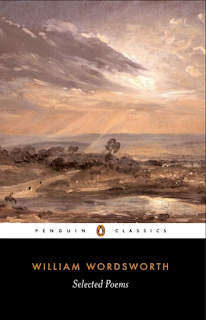
For the sake of time, I only read Susan Wise Bauer's suggested reading selections from William Wordsworth's poetry. According to Bauer, Wordsworth's poetry [partially marks] the beginning of the Romantic period, which explains why I am so fond of many that I have read. Wordsworth was "suspicious of reality," and he believed that "a divine force (the Sublime) exists in humans....as a gentle enlightening presence that infuses both man and nature."
I do not believe in any of that, but I find his poetry very inviting and pleasant and alluring. Maybe it is also because his poems demonstrate a love of the natural world and individuals, but a discomfort with society as a whole. Like one of my favorite authors, Thomas Hardy, Wordsworth also presented the tragic side of nature.
A couple of my favorite poems from the selections were "I Wandered Lonely as a Cloud," because my kids and I had read Wordsworth many years ago, and this one was sweet and true; and also "Ode: Intimations of Immortality." As I read the lines:
What though the radiance which was once so bright
Be now for ever taken from my sight,
Though nothing can bring back the hour
Of splendour in the grass, of glory in the flower;
We will grieve not, rather find
Strength in what remains behind...,
I knew it instantly! Splendor in the Grass (1961) is a film starring Natalie Wood and a very young Warren Beatty, and the title was taken from the line in "Intimations of Immortality."
It's always fun to make connections to literature.
Having read about Wordsworth's philosophy about man and God, I find it difficult to accept wrong ideas that man is a god, man is equal to God, or man has to find himself, and that all life's answers are within himself. These ideas have led us to the messy world we find ourselves today, and they also contradict with what I know to be truth.
Having said that, I would return to Wordsworth's works because I found a kin in his style and I would like to read more. I have to find a way to appreciate poetry for its literary beauty that I may philosophically and occasionally disagree with, if that makes sense. I have to accept that what I read may have been written by a poetic genius who was also human with a wrong understanding of Truth. Somewhat how I feel about Thomas Hardy.
Following are the poems I read, and I am also getting ready to read a close friend of Wordsworth - the next poet on TWEM list.
Rachel Jankovic states the goal of this book is to "encourage and equip believing women to see their identity in Christ as the most essential part of them, and to see all the ways that will work its way out in their lives, manifesting itself as strength, dignity, and clarity of purpose." Right away she opens the conversation about our obsession with identity and how we easily believe the foolish watered down philosophy of the self. Satan (IMO) wants people to replace God with this worldly philosophy.
Philosophy: Life's Questions
Man has asked the same questions about himself forever: Who am I? What am I for? How did I get here? What is the essential me? etc. Man wants to know HIS meaning in life.
Traditional philosophy argues that our minds make us human. But without God, might we be just animals? Some philosophers believe that our lives are worthless because we are the result of chance (there is no God); but that does not solve the desire for meaning of the self.
Now keep in mind two philosophies: good ol' nihilism, which states that all existence is devoid of meaning and nothing matters anyway, and existentialism, which is related to nihilism, but is associated mostly with action or doing.
Existentialism: You Make Your Own Meaning
Jean-Paul Sartre gave the definition for existentialism, which reiterated is:
You don't mean anything, objectively. You exist as a person before you mean anything. Existence comes before you have any essence or value at all. Essence is something that only happens through your own action, when you develop an essence. [Essentially], You make your own meaning.
Sartre believed his teaching to be the only means for hope. Sartre replaced God with a man-made remedy for hopelessness: You can be anything you want; you are what you make yourself; your story is yours to create; only you can make it happen. Sartre refuted that even proof of God existing cannot save man from himself; you still have to do something to save yourself from despair, hopelessness, etc.
Jankovic argued that Christians should naturally reject existentialism because "it is built on the absence of objective meaning, absence of God the Father, and absence of any intention or purpose for humanity that exists outside of each of us individually."
Sartre's ideas came directly from his own "private brain" for his own "private purposes," and his ideas became influential the whole world over. Basically Sartre put himself in the place of God and he told man how to live, and like obedient subjects of authority, the world listened and obeyed. Basically he said: There is no God, but I am going to act like God and tell you how to live.
Another philosopher, Abraham Maslow, developed the hierarchy of needs based on humanism and existentialism that focuses on self-actualization, the all-important what it means to be human: your essential SELF.
As humans achieve a level, starting at the bottom, they move up to the next level. You can only have a sense of self-worth or high self-esteem before you reach the "holy grail" of self-actualization. From the pinnacle of SA, you will know who you are and your place in the world. This is man's goal of feeling "right" in the world. Christians should recognize that this is not a biblical concept.
Under this philosophy, people look at others as a means to help them become the best version of themSELVES -- because others exist to help YOU fulfill YOUR needs. Again, Christians should recognize that this is not a biblical concept at all.
Conflicts with Worldly Philosophy
Many of us have grown up with the Sartre-Maslow philosophy of how to become what you are and what makes you you. It is part of the self-help movement that we use to be our best selves. We are working toward becoming us, and we are told our lives make up the story of who we are with a beginning, a middle, and an ending. We want to admire and flatter ourselves with the story of ourselves.
But when the story of ourselves - our degrees, careers, cars, hobbies, pleasures, social media, etc. -- becomes everything we are, this is a problem, not a solution. If our essence (our self-developed story) gives us value as humans, what happens when we change (because we do change!)? What about those who do not have the ability to direct their own lives, like those with handicaps or mental incapacitation, or dependent people? Remember Sartre: "Without action, we have no essence. Mere existence does not imply the presence of a true self."
If it is the will and action of the individual that makes us what we are, how could someone without a will or the ability for action matter as a human?
[This also made me think: What if you are unable, by something out of your control, to be who you desire to be? Is your life then a failure? I think this is a very real issue for people, which only leads to more hopelessness.]
When you remove Creator God from "the story," you remove our true human value. If there is no Creator, then it is easy to question the value of personhood. Regarding today's culture, I found this line relevant: "People are looking for their own human value in a society that they believe is denying them the opportunity." That just adds another level of hopelessness to the fight.
The Abortion Argument
How do we determine who matters and who does not when values clash? A woman creating her own self finds her fertility to be an obstacle in her path toward self-actualization, threatening her potential. You can see how pregnancy is a problem, and why a baby growing in her womb who cannot speak for itself, and in essence is not fully a self, does not take precedence over the pregnant woman who has achieved more of the levels on her way to self-actualization. She must be in charge of her destiny! This is why abortion and birth control (I added) are the means to get woman on the same level of freedom and opportunity as men (and higher)!
This is also why the abortion movement has been able to be honest about their mission. It used to be ignorance, but today they admit it is not a clump of cells. There is no shame in murdering a baby in the womb even up to birth because the highest cause for self-determination, absolute perfection, and ultimate self has been so elevated above life itself. Women must have freedom if they are going to be the author of their lives, and they must have ultimate control. Human babies do not have essence because they have never exercised their own will; therefore, they cannot be compared to their mother. The baby is not a person because it is not in the process of writing its own story.
Pushing the Boundaries of Culture
When people who come from nothing are writing their own stories, then it follows that there are no boundaries. It's one for himself and everyone else better get out of the way. People who believe the philosophy of self-creation must prove themselves. This leads to rebellion: rebellion of culture and rebelliousness towards God.
The issue for Christians is that we value life from conception as a unique life made in the image of God, regardless of its abilities. It does not need to do anything to have value. Its value is based in what God did by creating it and giving it life. For Christians, life should be protected at all stages and circumstances. To the world, only those exerting their own will have value and should be protected. That is why the culture does not have conflict with abortion, sexual experimentation, or even sex changes for children because it is recognized as pursuing one's will over his life in pursuit of his own story. Anything goes.
This is also why it feels and looks like HATE when Christians do not affirm the lifestyle choices of each self. It feels like direct unfair criticism of a unique story of self. It is an offense to disbelieve him. How dare you deny his truth? Yet, Christians know they are a small character in the greater story written by the Creator. "You cannot, as a character, outwrite the Author of you."
Christians Struggling With Identity Issues
The self-created you and the God-created you do not go together. If you are trying to recreate yourself, you will never be at peace. We cannot be a little of ourselves and mostly of God or a little of God and mostly ourselves. We must be all of God's. We cannot think that we can remake ourselves and He is going to approve.
Hard Truths
Jesus is our only hope. "There is nothing special about us if it is not resurrected in Him." Our selfishness, lust, self-centeredness, envy, greed, obsessions, guilt are dead in Christ. We cannot make them look good on social media. Our liberty in Christ is that we can let them go and submit to Him. You are not the author of your own identity; but rather, you live in Him and He in you.
What is Our Purpose?
We were created to be bigger than ourselves! We were created to be worshippers. Humans like worship, do we not? "The Westminster Confession of Faith states that the chief end of man was to glorify God and enjoy Him forever." Live to the glory of God in everything you do. Life is not about us, but the glory of God. We can never fill the empty selfish desire to reach absolute self-actualization and glorify ourselves. If you want to know yourself, know God. He knows you. Live for Him and you will be living toward your full potential.
It's About His Story
God's story about Creation is not finished. Our story begins with "In the beginning, God...," and the story of God and His people continues to this day. All of your life yesterday, today, and tomorrow - all of your great and small actions, housework, dinner decisions, conflicts at work, relationship issues - is all part of the story that is being told. And the end of the story is your eternal life (which actually does not seem like an end because it is eternal).
When Christians work on thier "own story," they should do so in obedience to God by way of sacrifice and faithfulness to Him. We become part of God's purpose as we submit to Him and He shapes us into something greater. Jankovic writes about planting flags, which is being intentional about what you do to the glory of God. Your work becomes an offering to God's glory. Even small things will be made great, as long as they are done to the glory of God. "The obedience of contentment and gratitude will not stay small."
So Why do Christians Struggle With Their Purpose?
When trials arise, as they will and do, faith is shaken, and Christians wonder how God could have made us for disappointments that oppose our wishes, abilities, or interests. We believe lies that God made us for more and better purposes. We struggle with rejoicing in our circumstances. However, in hindsight, we see, when we obey and submit, how God works through our trials. Then we pass on our glory to Him.
Jesus is more than we ever wanted, but when we look elsewhere for satisfaction, we are seeking something that satisfies for a term, if at all. We want to know that our lives matter, that someone loves and cares immensely for us, that we are truly known. But does not Christ already satisfy all of those desires by dying for us first on the cross before we even knew Him and while we were still in our sins? Does He not already know everything about us? Does He not know every little trouble, conflict, anxiety, sorrow of our lives?
We want to drink hesitantly from a sippy cup of comfort while God offers us the opportunity to stand under a Niagra Falls of glory.
We have eternal forgiveness, and we seek cheap validation. We have an omnipotent, omnipresent, and eternal God, and we just wish someone knew what we were going through.
Think of it: "God intentionally created YOU out of nothing without help from anything or anyone else." Under that understanding, "you are meaningful." You belong to and are accountable to the Creator. Compare that with the world's idea that you were a "wild accident" now tasked with being your best YOU, if you want to matter in this world. You only have to answer to yourself (or are accountable to the mob, in my opinion. Good luck with that). Until then, you are meaningless.
The world is wrong.
Believe in Yourself?
Self-worship and identity are lies. The brainwashed world repeats the lies, and people adopt it as truth. The lie replaced the truth of total belief, hope, and trust in God, causing the world's identity crisis, sending billions out to find their self-worth. It is a never ending cycle.
Meanwhile, we change constantly because we grow and mature, but our God does not change. He is the same yesterday, today, and forever. He is fixed and never goes through a midlife crisis. Christians are not shaken by change because they are steadfast in Christ.
Obedience and Sacrifice in Christ
Jankovic says obedience is what transforms us; acting on what we read in Scripture changes our knowledge of self. She says there are things God gives to us -- personalities, pleasures, weaknesses -- that we can sacrifice to God, to lay down, to give up, ways to obey. This obedience transforms you.
Jankovic also describes Christians as STAFF. We are workers for the Kingdom and we should be about His business. We are heirs to the King, but we are not princesses demanding to get everything we want. "We are called to imitate the King and the selfless work He accomplished for us." We are called to even turn trials and suffering into blessings for others. (So much for the idea that others are for our betterment.)
One great suggestion is to read Christian biographies or memoirs to see how they lived because we can learn about ourselves and how to live. It is like finding out about your descendents.
Another suggestion is for Christians to stop thinking of their feelings as insights. "Our feelings are something that need to be managed." It is part of God's commandment to practice self-control. Our feelings lie to us and they are not to be trusted. They distract us and lead us astray. Again, give your emotions to God and ask Him to lead and show you how to live your emotional life and obey Him.
Body Image
I think we women are more apt to struggle with body image than men. Either we worry too much about our bodies or we worship our bodies. Again, we don't need to love ourselves; we need to love our Maker. God made our bodies and we should be grateful. We do not need to make ourselves into the image of the woman on the magazine cover, but we do need to faithfully reflect our Creator, and that includes being grateful for our bodies as they are.
And it is not enough to look at Christ. He is not in the distance or part of the scenery. We reflect His glory like the moon reflects the sun's glorious light.
Sin
"Sin diminishes and destroys the self, worshipping and serving the creature instead of the Creator. Self-worship is self-destruction. It cuts us off from the source of ourselves -- the Creator. Fallen man wants to reject the truth and do the opposite, which is to glorify self -- not God."
The Choice is Ours
Think of the future: "do you want to be in your self-made costume in Hell or your true self, made in Christ and in Heaven?" You can't keep being "true to yourself." I bet the cycle is exhausting. But you can be true to Christ and set free of the burden of constantly improving yourself.
For Christians, we must feed daily on the Word of God without excuses of distractions, weakness, and lies. Reading your Bible is obedience and through obedience your faith will grow and you will become the best you in Him.
This is the work He has for us: that we speak His language here, live His story here, be thoroughly, completely, obediently His people here, and go about our daily lives planting flags for our homeland, claiming all the territories that we encounter here for His kingdom. We claim all of Christ for all of life, forever.
The more we worship Him, the more we know Him; the more we know Him, the more we will know ourselves.
* * *
If you would like more ideas from the book, here is the author discussing the issue at hand:
The Stranger by Albert Camusis a super short novel, but its substance is heavy. The main character, Meursault, unsympathetically attends his mother’s funeral, begins an immoral relationship with a female co-worker the next day, becomes involved in his debauched neighbor’s problems, and ends up murdering a man without reasonable motive.
The Stranger is appealing, specifically because it highlights philosophical ideas that express why we are where we are today as a society. As much as I appreciated the opportunity to read The Stranger, I completely disagree with this philosophy.
To begin, Meursault is honest about the way he views everything; I value that. But he does not seem human: he is without emotion or empathy; is animalistic in his thoughts; and is disconnected from people. I wondered if he was not a little mentally challenged or childlike.
I suppose his story would be acceptable if my speculations were true; but the problem is that this is his attitude. He does not judge between what is right and what is evil. He thinks society ineptly seeks logical meaning behind man’s behavior and purpose; yet, he thinks there is no explanation for either. Society cannot know if there is truly a purpose to life; therefore, there is no reason to care. Man is like nature, and nature does not care either.
Grammar-Stage philosophy
Meursault only scans the physical world around him. It reminds me of grammar stage of reading, in which I focus only on main points of the plot or actions of characters - as a child would observe. There is no deep reasoning or exploration. So, too, this attitude claims that man can only observe the physical attributes of nature and man, but he cannot know anymore than that. Meursault comes to the conclusion that life is really rather hopeless, not purposeful or meaningful. We all die – what does it matter how or when? All life is equally worthless.
A stranger among us
Meanwhile, society does not understand this, and hence, Meursault is like a stranger within our society. Moral human beings grieve or love or feel empathy, and those who do not have feelings are odd - a danger to us.
The author tries to make the case that man is irrational for trying to make sense out of senselessness by proving how dangerous Meursault’s apathy is to society. He does not follow a moral code; therefore he should be removed from society. Hence, there is a hint of the idea that we should never judge the behavior of others because we cannot reason.
Another soapbox
I cannot consent to any of this because I believe otherwise. When I observe the natural world around me, I see a Creator who designed everything to work together in order and with purpose. Everything is integrated into life cycles, including man. And as for man – he was created in the image and likeness of God. Man naturally has mood and emotion and does not need to be taught how to feel or react to life emotionally. These are acts that separate us from animals.
In addition, God created man capable of thinking rationally, logically, and deeply about the world. Great minds have come before us and did not achieve greatness by being mind-numb imbeciles who never went beyond the grammar stage of their observations of life. They have proven or reflected order and structure of the world and man’s purpose and significance within their works of religion, art, music, literature, medicine, science, and government.
Isn't “Judge not” judging?
This attitude displayed by Meursault is in the roots of today’s arrogances about morality being ambiguous or not judging others’ behaviors. Man is called to judge sinfulness, immorality, and to recognize truth, and on and on. Isn't Meursault also judging by assuming one is absurd for trying to make sense where there is none? Society is meant to have a moral standard, and when society removes morality from behavior, then we are left with a lack of accountability and disorder, as was the case with Meursault expecting to get away with murder.
Man’s idea of hope is hopeless
Meursault expressed a feeling of hopelessness in life, and he only rids himself of the gloom once he admits his inevitable end. What does it matter if he dies now or in old age?
This is irrational to me!
Here is his problem: he utterly rejects his only chance for real hope – and that is in forgiveness and salvation through Jesus Christ. A few tried to save Meursault, but he chose to hold on to his own ideas about the world.
The purpose of man: to glorify God and enjoy Him forever.
The only true hope is in Christ; one in absolute despair can still experience fullness of life if he has the Truth. This world can leave man totally empty and low, but if he has salvation through Christ, he will be full and complete and know what it is to have hope in this world. His eyes are open to the Truth, and he will never fall for false doctrines of man, such as this philosophy that offers nothing but hopelessness and lies.
Absurdism is absurd
Finally, in my research I learned that this philosophy that Albert Camus practiced was called Absurdism, named for man’s absurd and futile attempt to make sense of the world and of human behavior; but I am certain that the only absurdity about it is how anyone could accept such nonsense.
About:
Absurdism, therefore, is a philosophical school of thought stating that the efforts of humanity to find inherent meaning will ultimately fail (and hence are absurd) because the sheer amount of information as well as the vast realm of the unknown make certainty impossible.
In absurdist philosophy, the Absurd arises out of the fundamental disharmony between the individual's search for meaning and the meaninglessness of the universe.
Lastly, a person can choose to embrace their own absurd condition. According to Camus, one's freedom – and the opportunity to give life meaning – lies in the recognition of absurdity. If the absurd experience is truly the realization that the universe is fundamentally devoid of absolutes, then we as individuals are truly free. "To live without appeal,"[15] as he puts it, is a philosophical move to define absolutes and universals subjectively, rather than objectively. The freedom of humans is thus established in a human's natural ability and opportunity to create his own meaning and purpose; to decide (or think) for him- or herself. The individual becomes the most precious unit of existence, representing a set of unique ideals that can be characterized as an entire universe in its own right. In acknowledging the absurdity of seeking any inherent meaning, but continuing this search regardless, one can be happy, gradually developing meaning from the search alone.