Showing posts with label liberty. Show all posts

Sunday, June 19, 2022

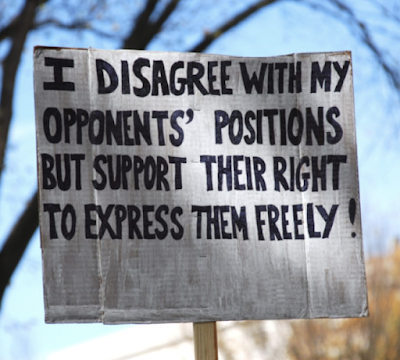
Book Bloggers: Do you believe what you write to be true? Then don't delete comments that challenge you. (And I mean that encouragingly.)


The other day I read a blog post written by a book blogger regarding one of my favorite dystopian novels, and the writer said something that prompted me to comment. There is no reason to quote what was said or name the blog because they are not important. The reason for my writing is to point out something that I find too common and very disappointing, though very telling about our culture and society. 

QUESTION

If someone disagreed with you or dared to own a different viewpoint than yourself, and that person civilly and well meaningly commented on your blog in reference to a statement or opinion you made about a book, why on earth would you delete the comment? And furthermore, why would you NOT respond to the one who engaged you? 

You keep a blog publicly because you want to share your opinions and thoughts, I assume. You want to connect and make conversation with others who also read and are interested in books -- maybe even the same books. But do you only invite others who agree with you to read and comment? At least make that clear ahead of time that you do not appreciate or tolerate different opinions or opposition, and that those comments will be deleted. 

I know of one blogger who informed and threatened readers within the post that they would delete comments by anyone who mentioned this particular individual by name. And of course I commented that I didn't care if they deleted my comment because I still felt compelled to share my opinion. Granted, I brought that on myself because I was forewarned. But my goodness, how protective and defensive we have become as a society.

While it has only happened a few times that I have been deleted because a blogger disliked my comment, the sad truth is that I know of more times when I said, "Just forget it!" and decided against commenting altogether because I suspected it would not go over well if I said what I thought or even asked a question to better understand why someone thinks the way that they do. 

I do not want to start a confrontation, which is why I take time to carefully word my thoughts and am always civil and kind. I am more surprised that a blogger would delete a civil comment. Why not dialogue about what you believe; make your case, and win me over. Why not make use of your platform and promote your ideas further with someone who is engaging you? Why do they always have to agree with you?

ONE CONCERN

This is part of what is troubling to me: that today people are less likely to debate, dialogue, and have civil discord about their opposing opinions, worldview, and differences. They are more likely to immediately censor, cancel, and delete your comment.

Some irony: this particular blogger had read and blogged about my other favorite dystopian novels by Orwell, in which I totally disagreed with [their] synopsis, but I restrained myself. The blogger did not see the irony in [their] own behavior, to delete my little comment, to shut out a different viewpoint, and yet to be equally incensed by the tyranny and totalitarianism demonstrated in the books [they] just reviewed. Yikes!

I once had a very civil conversation with someone who completely disagreed with me on my religious opinion within a post I had published on my blog, and he began with a very hostile tone. Nonetheless, I knew that to engage him kindly would win him over. We had a discussion, and when it ended, he was much calmer, and I was able to get him to see some truth in what I had said; he didn't change his mind, but his mind opened more. 

There was another blogger who always shared her opinions with me, of which I am so grateful. She was engaging and inspiring. She once apologized for soapboxing on my blog, explaining that it was my personal blog and she had no businesses being so opinionated toward my writing; and all I could think was: this is why I write publicly. I invite conversation with those who agree or not. If I wanted to protect and shelter my opinionated ego, I would have kept my blog private. 

ANOTHER CONCERN

And here is the other part of my concern: you cannot argue for the protection of democracy -- a rule of the majority -- and then demand that the majority obey the minority; and you cannot cling to democracy if you are going to chop off the fingers of those who do not think the same thoughts or speak the same words as the minority. Democracy, if we must, is rule of the majority, and under American Democracy, particularly, we provide for protection of the minority. To provide for the protection of the minority, we must have, protect, and defend free speech. MUST! Speech must be protected because there will be different opinions and ideas, and they should be open to debate, acceptance, or rejection.  

Now, of course, you are not forced to listen to one's opposing view or opinion if you disagree and do not want to hear. You are not even forced to defend your own ideas. But how can you not defend your views or worldview, especially if you demand others think, speak, tolerate, accept, and obey your opinion??? If you cannot stand to have a civil discussion - even about democracy and especially truth - then you are demonstrating weakness, and your worldview is equally weak. You show that you cannot stand up for what you believe in. You have no argument. It's not a good look. 

If you have a blog -- any kind of blog -- and you write your opinions publicly for all to read, then you should be steadfast in what you write as true and solid. If you are challenged because a reader comments against your judgment, and you do not want to defend your words, then maybe you do not know what you are talking about. Maybe you don't even believe it to be true yourself. That is ultimately what you convey to others when you refuse to respond to someone's questions about what you wrote or to answer for your opinions. And when you delete civil comments altogether, well, then obviously you have absolutely nothing to offer. 

Books are a great opportunity to talk about the ideas we hold true, and a civil and engaging discussion is the best way to exercise those ideas, to see if we agree, or maybe to even change our mind. The free exchange of ideas is liberating and freeing. If the best retort you have is to hit the delete button on your keyboard, then I am very sorry for you.

* * *

Wednesday, June 01, 2022

Helga's Diary by Helga Weiss

Helga's Diary: A Young Girl's Account of Life in a Concentration Camp
Helga Weiss
Published 2013
⭐⭐⭐⭐

Why bother reading another Holocaust story? 

To answer that, Francine Prose noted in her introduction of Helga's Diary that more than a century later it still seems amazing that such a thing could have happened: 

that millions of innocent men, women, and children could have been murdered by the Nazi's remarkably efficient killing system, in broad daylight and with the full knowledge of so many.  The further these horrors recede into history, the fewer the living witnesses who remain to provide us with firsthand accounts, the more important it is for those amazing stories to continue to be told. 

Helga was a young Jewish girl in Prague, who began a diary at age ten. It was 1938, before the Nazi occupation. Helga recorded her observations and experiences of the Nazi treatment --  the increasing  demoralization, humiliation, and absolute seclusion from society; the growing prohibitions of public use, like theaters, parks, schools, and travel; and later the physical mark of the yellow star. She saw her neighbors, friends, and family taken away when called up for transport, which they suspected would mean a work camp. 

As is typical of young children, Helga adapted to the changes in her new world, and seemed to only want order and sanity. She remained cheerfully optimistic throughout much of her experiences, including suppressing any feelings of anguish or sadness. 

The Guardian: artwork of Helga Weiss

At the end of December 1941, Helga and her parents were selected for transport and ended up at Terezin. Here the Jews recreated and maintained as close to normal life as possible by working, keeping house, cooking, playing, and doing school. Their lives were made more difficult, almost impossible, and yet they still rose to the occasion to confront every challenge and excelled. 

Helga's writings in her diary demonstrated the spirit to overcome obstacles, even tolerate things like bed bugs and fleas, and at times hunger. At one point she said:

They want to destroy us but we won't give in.

By October 1944, Helga and her mother were selected for transport out of Terezin, to Auschwitz. She gave her diary to an uncle, along with her drawings, in which he hid behind a brick wall. The remainder of her entries were from memory, written down after she was liberated. 

She recalled the miserable long trip to Auschwitz, the hunger, the sleeplessness, the cold. She described how freezing was worse than starving, and I remembered that Frederick Douglass said the same: he could stand being hungry, but being cold was unbearable. 

At Auschwitz, Helga and her mother lied about their ages so that they would remain together, not too young or too old, which could mean instant gas chamber. It worked. They were given very little to wear and very little to eat. Their work was tedious and dangerous, but again, they rose to the occasion. Often times they stood for hours and hours in insufferable temperatures for roll call, and sometimes it was just to wear them down mentally. 

As it became obvious that the Allies were closing in on Germany, the prisoners were removed to Freiberg and then Mauthausen. They had been on one transport for sixteen days. Then the Nazis forced them on foot. Helga wrote:

I can't go on. I'll lie down here - let them shoot me. If they'd only let us rest a moment, an instant, just to catch our breath. Or allow us a drink. If we'd been allowed to drink from the pump at the train station, we'd be able to go on. They drive us on at a mad pace. A drop of water, a single swallow. . . I can't go on. 

May 1945, something was happening. In the middle of distributing soup, Helga heard voices. The people dispersed. She dropped her soup bowl and ran outside. "A white flag flutters! A flag of peace!"

Mauthusen has capitulated, peace has come to us. My legs break into a run all by themselves. Muddied, in my bare stockings just the way I'd run out, I arrive back at our space. Mom stands up- where has she found the strength all of a sudden? I hang myself around her neck and, between kisses, I spill out, jubilantly, the word we've dreamed of for years. The word we indulged ourselves with in the most secret corner of our being and feared to pronounce aloud. That sacred word, which contains so many beautiful unbelievable  things: liberty, freedom. The end of tyranny, misery, slavery, hunger. 

We survived the war. PEACE IS HERE. 

Helga and her mother returned to Prague, only to suffer under the Communist regime of the U.S.S.R. She never saw her father again. He probably died in the gas chamber immediately after arriving at Auschwitz. Helga went on to study at the Academy of Fine Arts and became an artist. 

At the end of the diary, there is an interview with Helga. She was asked what contribution her diary [brought] to the stories of the Holocaust, and she said that her diary is truthful. It is "half-childish, accessible and expressive, and it will help people to understand those times." 

What I take away most is this passage: toward the very end of the war, as she sees the demise of the people in the camp, what she describes as "Death herself walking past." And, yet, even in her own demise she longs to reach them, to encourage them. 

You want to entice a smile on to these people's faces? Fool! Weeks, maybe months without food and drink. Yes, that's the last system. Physical and spiritual torture became commonplace and then -- the mortality rate wasn't high enough -- the sickbed, at the whim of lice and the typhus bacilli, what have these -- people? -- gone through?

Yes, they were once people. Healthy, strong, with their own will and thoughts, with feelings, interests, and love. Love for life, for good things, for beauty, with faith in a better tomorrow. What's left are phantoms, bodies, skeletons without souls. 

* * *

For me, I still need to read these Holocaust stories. They deserve to be read. I wish not to believe that man can be this evil, but -- yes, he can. There was a time when I did not think the Holocaust could ever happen again, but in the last two years, I have changed my mind. Man is still willing to practice segregation, prejudice, humiliation, separation, public shaming, class and group warfare, and just plain evil in order to gain power and control -- including my own government. Man does not seem to want to learn from history; but some, in fact, are desirous to capitalize on the very devilish systems of centralized power, control of the masses, suppression of truth, and elimination of powerless groups. Today's global power grabs are no different than the Nazis or the Romans. Man is all the same; he just finds new creative and technological ways to accomplish his evil.

Monday, May 02, 2022

In Order to Live by Yeonmi Park

In Order to Live 
A North Korean Girl's Journey to Freedom
Yeonmi Park
Published 2015
⭐⭐⭐⭐⭐

This story is such a dilemma, I do not know where to begin. I wish all I needed to say was: read this! Americans especially should read this book. It serves as a warning of what is to come in the new world order: tyranny, starvation, loss of privacy, mobility, independence, individuality, and definitely the termination of any concept of equality - equality being a false idol. Some people may think a collective government will satisfy justice, fairness, and right; but it is a lie. All of humanity's nightmares, the exact opposite of what people covet, will actually come true. 

In Order to Live demonstrates that nightmare -- the story of what happens when evil wins and good men do nothing, when totalitarianism rules and only the loyal elites are protected, and the remainder of the people are enslaved. 

It is the story about a young girl's wasteful existence in and terrifying escape, in 2007, from North Korea, through China, and to South Korea. She, her older sister, and their mother planned an escape, not for liberty, but because they were starving. Yeonmi Park was only thirteen-years old.  

Back Track

After WWII, the USSR helped build up North Korea and installed Communist sympathizer and Stalinist, Kim Sung Il, as premiere. When Kim invaded South Korea, the United States entered the War. The Americans pushed the Communists back to the Chinese border, but China pushed the Americans back to the 38th parallel, which today marks the division between North and South Korea. 

The North Koreans lived (and still live) in a caste system. Families were (and are) ranked according to their loyalty to the regime. In the early years of her life, Yeonmi's family lived better than most North Koreans because her father had family and party connections. He was resourceful, not brainwashed like most people, and knew how to work around the system. He took chances doing any kind of business that would provide for his family. By taking risks, he could bribe guards who looked for a handout.

After the end of the Cold War and the decline of Communism in Russia, the USSR began cutting off North Korea. In 1994, Kim Sung Il died and his son Jong Il took his place. North Korea suffered a terrible famine. Any aid received from the outside was given to the military. It is estimated that over one million North Koreans starved to death. 

After her father was arrested and sent to a prison camp for his illegal business, Park's mother had to do what she could to get food for her daughters, often being away for many months at a time and leaving her young girls at home to fend for themselves. Because her father was in prison, all of their relatives suffered, too, and no one wanted to help them. She and her sister had to eat bugs to survive.

Yeonmi's family began whispering about escaping North Korea. When her father was permitted (via a bribe) to leave prison on medical leave (although where he would get proper medical care, no one knew), life was just unbearable. She and her sister could no longer attend school (though school was only for  propaganda); her parents had to fake a divorce in order for her mother to get permission to move to another town; and, as I have said, they were totally shunned by relatives because of her father's imprisonment. 

Furthermore, Yeonmi noticed that her father's five years in prison had successfully broken his spirit. His state issued ID was destroyed forever. He was reduced to an animal. 

Walking home one night with her mother and sister and looking over the river toward the lights in China, Yeonmi realized she just wanted to go where there was food and light (North Korea has a problem with electricity). She thought: It was like being drawn to a light without knowing why." 
I wish I'd known at the time what that light really meant to North Koreans like me. Following it would cost me my innocence and, for a while, my humanity. 

The Escape 

Suffering starvation, poverty, loss of dignity, humiliation, shame, and fear in North Korea were not enough to prepare Yeonmi (and her mother and sister) for what they were about to suffer in China. Yeonmi was ignorant of so many truths because the North Korean regime controls the media, the language, emotions, and thought. For Yeonmi, it was like being born again and having to experience the world for the first time. And imagine being born into a new world of rape, trafficking, cruelty, and indignity. But there was food, and for awhile it contented her. 

Because of China's one child policy, the country suffered a deficit of women. The excess of males, many of them undesirable, were willing to pay for the young North Korean women who used the service that helped them to escape to China. Yeonmi and her mother found themselves stuck in this very degrading system that Yeonmi declares China is unwilling to do anything about.

Eventually, the man Yeonmi became involved helped her and her mother complete their goal to reach South Korea, and that was another ordeal in itself. 

Freedom

Life in South Korea had its challenges, too. In the end, Yeonmi faced the challenge head on, and today she is a voice for the voiceless. Through reading literature, classics, Western philosophies, and biographies she learned to live. She read one hundred books in one year, increased in learning, and earned a college degree. 

But more importantly, it was through reading that she learned how to think. She could now see and understand what happened in North Korea. People are not taught to think critically, and if you never have to practice thinking, then you simply see what you are told to see. And that is the truth. 
I found that as I read more, my thoughts were getting deeper, my vision wider, and my emotions less shallow."

When you have more words to describe the world, you increase your ability to think complex thoughts.  

After reading George Orwell's Animal Farm, Yeonmi saw the obvious resemblance to the North Korean regime. And when she read Nineteen Eighty-Four, she recognized her father in the protagonist, Winston, "who secretly saw past Big Brother's propaganda."

She learned that North Korea is one of the poorest and most repressive countries on the planet; that Kim Jong lived in a luxurious mansion while the people starved. She even had to be told that he was fat. She knew that, but because she had not thought for herself, she needed someone to point it out. 

It was not until they were suffering a long and dangerous trek through the Gobi Desert on their way to South Korea, that it had occurred to Yeomni that she hated Kim Song Il and blamed him for everything. And yet, she admitted, "Betraying the Dear Leader was the hardest thing she did." Her mother agreed.

When someone asked her what her hobby was, she did not understand hobby. When it was explained to her that it was something you did for pleasure, she was perplexed because she was only required to please the regime. In North Korea, there is no "I."
I could finally think about something beyond food and safety, and It made me feel more fully human. I never knew that happiness could come from knowledge.

My only disappointment, which has nothing to do with the author or the book, was that she was not given the proper gospel. It was through a Christian missionary that she and her mother were able to make it to South Korea, and they had to "become Christian." But because of the work she did in China, which was done out of survival, these missionaries (mainly Chinese and South Koreans) could not forgive her. 

Well, it wasn't for THEM to forgive her; it is the business of Christ to forgive. And if they had explained to her what Jesus did on the cross -- how He died for all humanity, for all the sins of the world -- it did not matter what she did or why. His forgiveness that He offers is greater than her worst crimes! But sadly, they did not teach her properly. To this day, I am not sure she has gotten the proper good news, even when she went to Texas to work for a Christian missionary, which tells you that even "Christians" can be in name only. 

What About Now?

You can learn more about Yeonmi and what she has accomplished beyond the story she wrote. She recently graduated from Columbia University. Unfortunately, she said it was a waste of money and time because every subject, class, and professor was programed with lies: lies about racism, lies about sexism, lies about equality. She fears that the world is headed into the same dangerous situation as North Korea. 

Yeonmi said breathing was the only thing you were able to do on your own in North Korea. Meanwhile, at Columbia, because of the hostile environment, she had to self-censor her thought and speech; and, again, all she could do on her own was breathe. Not think or have an opinion. In other words, the setting at Columbia was similar to North Korea.

You can hear more about it in this conversation between Yeonmi and Dr. Jordan Peterson. They discuss the entire book, and then at 1:40:00 they discuss Columbia University. Extremely disheartening If you love liberty and free thought, you will cry, too.

Furthermore: Yeonmi's protests that no one (Hollywood, the media, and international governments) have the courage to challenge the destructive Chinese Communist Party; she calls China an enabler of North Korea. 

I hope you get to read this book, but definitely check out this interview.   


Wednesday, April 27, 2022

The Five Thousand Year Leap by W. Cleon Skousen

The Five Thousand year Leap

28 Great Ideas That Changed the World

W. Cleon Skousen

Published 1981

⭐⭐⭐⭐⭐

The Five Thousand Year Leap is a compelling manual for all Americans to study, learn, and understand the ideas that make our nation unique and exceptional. It is the true account of our story, an essential examination of our history, and an analysis of the structure of our government. It is a thorough exploration on the origins of the distinctive American government, which gave birth to the writing of the U.S. Constitution. The Five Thousand Year Leap explores the twenty-eight founding principles that shaped the United States of America. 

As per the author's opening statement:

The American people are now two centuries away from the nation's original launching. Our ship of state is far out to sea and is being tossed about in stormy waters, which the Founders felt could have been avoided if we had stayed within sight of our initial moorings.

They also felt that each ingredient set forth in their great success formula was of the highest value. They would no doubt be alarmed to see how may of those ingredients have been abandoned, or have been allowed to become seriously eroded.  

America had a "hard beginning," as far as Jamestown was concerned; but it was a good lesson, and a lesson well-taken for the Founders who wrote the Constitution. It was the greatest comprehensive experiment in liberty and self-government ever taken in the history of nations.

But, as Skousen warns: "...when we don't teach the rising generation those cultural and moral lessons that keep society healthy and safe, the people end up making all the same mistakes..." 

Americans are in danger of losing their Republic. 

We have no reason to be in this position because these twenty-eight principles have been clearly laid out for us; except that if we fail to teach them to every generation, and practice them, then, yes, we will continue to make the same mistakes that man has fallen into over and over again, out of selfishness and slothfulness. 

These principles or great ideas took over 180 years to be assembled, as they had already existed in history, and were brought together through the Founders who studied the same concepts and arguments of the past.

There are two parts of the book, and both sections are direct and precise in their statements and supporting examples, which include countless quotes from history, documentation, letters, and speeches, many from the Founders.

Part I includes: The Founders' Monumental Task

This section covers political spectrum, political parties, and the importance of the People's Law. It follows the Founders knowledge of Anglo Saxon Common Law, which leads to the new order of self-government. Most power is in the hands of the people or individual, then power becomes diminished as you climb upward: family, municipal (city), provincial/state, and ends with the least amount of power in a national/federal head. (A similar structure can be found in Exodus 18:13-26.)

The Founders sought to create a balance of power between tyranny and anarchy. They kept power close to the individual (self-government); the states focused on internal affairs; and the federal covered issues not effectively handled by the state or individual. This was also aided by a balance of and check on powers within legislative, judicial, and executive branches.

They also warned against a welfare state (redistribution of wealth) and of the need for an educated electorate.

If a nation expects to be ignorant and free, in a state of civilization, it expects what never was and never will be. ~Thomas Jefferson

Part II: The Founders' Basic Principles:

  1. The only reliable basis for sound government and just human relations is Natural Law.
  2. A free people cannot survive under a republican constitution unless they remain virtuous and morally strong.
  3. The most promising method of securing a virtuous and morally stable people is to elect virtuous and moral leaders.
  4. Without religion the government of a free people cannot be maintained.
  5. All things were created by God, therefore upon Him all mankind are equally dependent and to Him they are equally responsible.
  6. All men are created equal.
  7. The proper role of government is to protect equal rights, not provide equal things.
  8. Men are endowed by their Creator with certain unalienable rights.
  9. To protect man's rights, God has revealed certain principles of divine law.
  10. The God-given right to govern is vested in the sovereign authority of the whole people.
  11. The majority of the people may alter or abolish a government which has become tyrannical.
  12. The United States of America shall be a Republic.
  13. A constitution should be structured to permanently protect the people from the human frailties of their rulers.
  14. Life and liberty are secure only so long as the right to property is secure.
  15. The highest level of prosperity occurs when there is a free-market economy and a minimum of government regulations.
  16. The government should be separated into three branches: Legislative, Executive, and Judicial.
  17. A system of checks and balances should be adopted to prevent the abuse of power.
  18. The unalienable rights of the people are most likely to be preserved if the principles of government are set forth in a written constitution.
  19. Only limited and carefully defined powers should be delegated to government, all others being retained in the people. 
  20. Efficiency and dispatch require government to operate according to the will of the majority, but constitutional provisions must be made to protect the rights of the minority.
  21. Strong local self-government is the keystone to preserving human freedom.
  22. A free people should be governed by law and not by the whims of men.
  23. A free society cannot survive as a republic without a broad program of general education.
  24. A free people will not survive unless they stay strong.
  25. Peace, commerce, and honest friendship with all nations - entangling alliances with none.
  26. The core unit which determines the strength of any society is the family; therefore, the government should foster and protect its integrity.  
  27. The burden of debt is as destructive to freedom as subjugation by conquest. 
  28. The United States has a manifest destiny to be an example and a blessing to the entire human race. 
My copy includes bonus material: a copy of the United States Constitution and the Declaration of Independence, the essay Common Sense by Thomas Paine, and 101 Constitutional Questions to Ask Candidates (or yourself!).


As Glenn Beck writes in the Forward: 

You, me, all of us were born for this day, to stand responsible before God and future generations to keep this torch of freedom lit, and bear it away from ruin. 

Remember those minutemen in the days of our Revolutionary War? Do you remember their job, to be ready to defend the encroachment of the Redcoats with a minute's notice? 

Well, that is where we stand today. 

The power is ours to blast our horns and shake those rotted scales off our freedoms, shake them to rubble and get our country back.  

* * *  

I would suggest this as an excellent resource for high schoolers, in addition to the Declaration of Independence and U.S. Constitution.

Sunday, April 24, 2022

Covid Operation : What Happened, Why It Happened, and What's Next by Pamela Popper / Shane Prier


Covid Operation : What Happened, Why It Happened, and What's Next
Pamela Popper / Shane Prier
Published 2020
⭐⭐⭐⭐

If you figured things out a long time ago, then great! But for those only now questioning the truth, good; this is a book to start with if you want to know more. 

Covid Operation is cohesively organized, sensibly written, and well documented with supporting evidence at the end of each chapter. The title and subtitle tell you exactly what to expect. It is a quick, easy read about the origins, the players, the purposes, the consequences, and the possibilities beyond. In addition, personal stories (often heart breaking) are included in the "Consequences" chapter. 


Covid Operation was written and released in August 2020. Popper suspected early on that the numbers of cases, hospitalizations, and deaths did not justify lockdowns, restrictions, or masks, and she spoke out about it immediately. I cannot remember  how I discovered Pam's show, but it was early 2020. I found her short videos on YouTube regarding the universal response to the virus. She talked about how none of it made sense: the obsession with cases, the inconsistent lockdowns for small businesses but not big businesses, the science that did not support masks, the hypocritical governors turned emperors, the encouraged violent riots in the summer while restrictions for sports and other outdoor activities remained, and many other contradictions addressed in Covid Operation

On her channel, she highlighted the consequences of the lockdowns, school shutdowns, job losses, and business closures. People began writing letters to her, sharing their heartbreak and frustrations, including suicides of loved ones, and Pam read those stories on her show. 


Pam even discussed how she lost friends and colleagues whom she had worked with for years on issues of health and healthy living and eating, because they did not agree with her questioning government, the health departments, CDC, WHO, lockdowns, masks, and the like. They could no longer support her because of her position on the state of things, though she came to accept it because she made new friends and encouraged others in her position to make new friends with people who shared similar ideas. 

And even better...very, VERY early on, Pam mobilized people. Talk about being pro active: she formed groups and encouraged people to do in their communities what she was doing. (See Make Americans Free Again.) She wanted people to connect locally and help each other - doctors, teachers, nurses, farmers, ranchers, construction workers, mothers, fathers, church members, and anyone who knew how to do anything at all - converge and work together, form local systems and serve one another. 

I love Pam's spirit and perseverance. She is a leader and a stateswoman. She loves liberty and self-government, not power and control. She expects Americans to be responsible grownups. Pam pointed out daily that Americans were cowering in fear under the lies of little egomaniacs like Anthony Fauci and the threats of tyrannical governors and their unelected health officers. She basically encouraged her viewers to just ignore them and get on with life. 

I totally agreed with her because in my environment that was my personal experience and observation. Nothing made sense, and I could not stand living in a world where nothing made sense. It was maddening! 

I think it would be great if she did a follow up for 2021 - the year of the jab - because I believe the story behind the jab and the psychology implemented to make people comply is just as dangerous to American liberties and survival. But I sense that Popper has moved on, and she wants us to do the same. Ignore these liars and thieves. 

That is exactly how I have always felt about this entire mess. Is there a new virus? You bet.  Was it manufactured? Definitely. Did people die from it? Yes. But the numbers were inflated to create fear and hysteria so that everyone would comply with the draconian instructions. Everything was done differently than typical epidemics of years past because now there is a global concerted purpose and effort to prepare the world for new mandatory vaccinations, mass surveillance and control, digital currencies, and to usher in a global elite-controlled corporatist/technocratic government. Don't take my word for it; read Klown Schwab's own words: Covid 19: The Great Reset. (That's just my review, but I mean for you to read it and hear it from the elite's own mouth.)


I knew it was all a BIG/FAT lie because of the inconsistency of those whom the media propped up, like Fauci. That man was all over the place about masks, the spread of the virus, and later the jab. It was apparent to me that he did not know the truth about anything. He was basically making things up as he rolled along. I knew he was a fraud even before I read The Real Anthony Fauci. (Again, my review, but read the book yourself to get a history of the man.)

There are so many other warriors out there armed with the truth. Some of us cannot be scammed, and we don't want anyone else to be fooled. If you are done with the lies, Covid Operation is one of many sources; and here are some others:

Amazing Polly  (out of Canada) An amazing independent voice, kicked off YouTube for telling too much truth. 

Peggy Hall  and her YoutTube Channel (out of California) A champion, never tires of fighting the rubbish coming form Emperor Newsom and his Health Oppressors. She has armed Californians with the law.

The Great Barrington Declaration Three reputable doctors came together to point out the farce of lockdowns of healthy people and warned of the dangers very early on. It was a cry for sanity, but the world has not listened. 

Dr. Malone One of the many doctors who has given up his peace and quiet to stop the medical tyranny. He reminds me of a Modern Day George Washington. 

Dark Horse Podcast clips  Bret Weinstein and Heather Heying: an example of what free speech looks like when adults come together and logically pull apart issues to get to the truth. It's called critical thinking. 

Children's Health Defense  Robert Kennedy Jr.'s organization that has worked hard to spread truth about health -- healthy eating and living and environments -- trying to educate the world on the dangers of drugging and vaccinating our kids for every little illness. 

Man In America on YouTube, Rumble, etc. Soft spoken, always positive voice on being self sufficient, independent, pro active, realistic, and prepared for what is inevitable. 

The Truth About Covid by Dr. Mercola

There is so much more out there. This is only a sample of people I found in the early days and listened to what they were saying, and of course, remained in tuned only because they were saying what I was already thinking. 


One more thing: this is not an insult to people who lost love ones because of the virus. I know people who died, too. I also know a lot of people who got sick, including my husband and me, our kids, and our entire church family. We never made such a fuss about the flu, but here we are permitting our state and federal government to trample our Constitution in the name of health.

This post addresses the lies (overreaching and unconstitutional response) from our government (and the media). It is about losing our right to be in control of our lives and the sovereignty of our nation. That is why it is imperative that Americans stop complying, stop obeying the lies, and resist NOW. The lockdowns and mandates and school closures and rollercoaster ride has not ended. It is in a lull, but it will not go away unless we say NO MORE. It is a battle of the wills. And all I am saying is we have to stop it. Now. 

Wednesday, March 02, 2022

Update: what's going on

It has been a few weeks since I have reviewed any books, and that is because we have now relocated to Florida. I've not been reading very much. 

I wanted to share that two days before we moved, a friend and I took our kids to the US version of the Trucker's/People's Convoy send off, which started at Adelanto Stadium and was right around the corner from where we live[d]. The truckers and vehicles are driving to Washington D.C. We thought it would be a memorable history lesson for our kids.


It was freezing cold. I think it snowed later that night.


Speakers included Dr. Pierre Kory and Pastor Rob McCoy.


After speeches, Pastor McCoy read a Psalm and prayed, and we sang "Amazing Grace."

Leigh Dundas spoke to the crowd, also.

Another thing I did before we left Cali was took one more picture of a full California moon. I often take pics of the moon, but they always look the same. I cannot tell them apart.


Here is what I have been "reading" or listening to, specifically during the four day trip to Florida. 


Finally, we gratefully arrived at our Florida destination on Monday. I have moved our "California exodus" story to a separate blog. You can find it H E R E.


I look forward to having a routine again and finding the energy to read and finish a book. I miss reading because reading is an indication that I am settled. And things are just not settled yet. 

Maybe a few more weeks. I hope.
💗

Monday, November 15, 2021

Sweet Land of Liberty (Old Times in the Colonies) by Charles Coffin


Sweet Land of Liberty (Old Times in the Colonies)
Charles C. Coffin
Published 1880
Early / Colonial American History
⭐⭐⭐⭐ 

When I looked upon my unread bookshelf for another book to begin, I pulled Sweet Land of Liberty down and read the cover. The inscription beneath the title reads: To inspire Americans to return to, "...one nation, under God, with liberty and justice for all." That is what prompted me to read it, without hesitation.

Charles C. Coffin (1823-1896), an American Civil War correspondent, wrote numerous wonderful books about important topics, including independence, liberty, and the fight against tyranny. This particular title, also known as Old Times in the Colonies, focuses on the American Colonial period -- from the European discovery of the new continent to the eve of the Revolutionary War. 

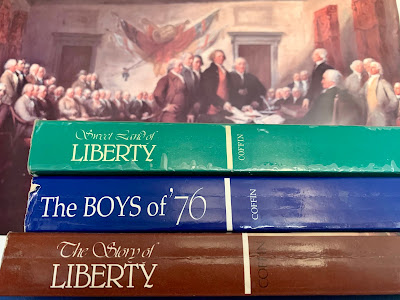
Before this book, Coffin had written two other stories -- I call them stories because his method of writing about history is a pleasantly-told narrative. One was The Boys of '76, published in 1876, and is purely about the battles of the Revolutionary War. Then he wrote The Story of Liberty, an amazing work of five hundred years of history from the signing of the Magna Charta in Runnymede, England, to the settlements of Jamestown and Plymouth in America. Old Times in the Colonies was meant to fill in the time between these two other titles.


Coffin wrote Old Times for children that they may see how history is connected and how events cause other events; how men and women have struggled against tyranny for ages; and how the advancement of certain situations and impacts helped prepared new civilizations for self-government. 
Men die, generations come and go, but ideas live on.

By the way, this is not a typical child's history book. I suppose it was written with children of the late 1800s in mind, but it is not child-like, nor does it shade the truth about war, mass slaughter, and indiscriminate bloodshed. Coffin made obvious the connections between England and America, and how the English colonists were affected by the conflicts between England and France or Spain. I did not realize how much carnage and butchery there was before the Revolution.

The author followed the story of exploration into Canada and the American colonies; development of individual colonies, which later become independent states; interaction with Native Americans and their involvement with the European and French forces in America; and conflicts between France, the Catholic Church, and the Protestants.

All of the events which took place leading up to America's Revolution had a purpose and meaning. These events "tell the story of a great nation, the growth of individual liberty, and the coming of constitutional government in the Western World." But through it all, Coffin was certain that "Right, Justice, and Liberty" always "advances" and that America would spread great ideas and lead the world to something great and glorious. 

Since I have read three of his books, I am confident that he is one of my favorite early American historical writers. I would like to read more from Coffin in the future. Here are some of this other titles, many of which can be read for free on Internet Archive:

Our New Way Around the World

My Days and Nights on the Battlefield

Redeeming the Republic

Freedom Triumphant

Abraham Lincoln

Daughters of the Revolution and Their Times

Marching to Victory


Chalres Carleton Coffin
1823-1896

Wednesday, March 22, 2017

Reading Lolita in Tehran: A Memoir in Books by Azar Nafisi


Reading Lolita in Tehran: A Memoir in Books 

Azar Nafisi

Published 2003

Iranian Memoir

⭐⭐⭐⭐⭐ 


I LOVE THIS STORY!!!  Where do I begin?  


This true story is a unique and intimate memoir by a woman, Azar Nafisi, who lived in Iran during the Islamic Revolution (1978-81), the Iran-Iraq War (1980-88), and thereafter.  It is her own personal journey of life in Iran as a university professor of literature (between 1979-87), and later as a friend to seven young female students who met weekly to read and discuss Western literature in the privacy of her home (1995-97), and finally to her difficult decision to leave Iran and emigrate to the United States (1997).  


Reading Lolita in Tehran is broken up into four sections that represent different ideas or themes.  It is not in chronological order. 


"LOLITA"

Nafisi begins a private book club with "her girls," seven young serious women whom she deliberately chose to discuss great works of literature with, at her home.  The setting is sometimes somber as the women use literature to make sense of life in the Islamic Republic.  Nafisi told her students that "these great works of imagination could help [them] in [their] present trapped situation as women."  At the end of this section, Nafisi uses Invitation to a Beheading by Nabokov to express their existence with the Islamic Republic:


The only way to leave the circle, to stop dancing with the jailer, is to find a way to preserve one's individuality, the unique quality that evades descriptions but differentiates one human being from the other.  [The State] invaded all private spaces and tried to shape every gesture, to force us to become one of them, and that in itself was another form of execution.


"GATSBY"

Backtrack to the Revolutionary period.  Teaching literature at the University of Tehran, Nafisi explained to her students that "great works of the imagination were meant to make you feel like a stranger in your own home.  The best fiction always forced us to question what we took for granted. It questioned traditions and expectations when they seemed to be immutable." 


During this time, she rejected Islam as a political entity.  She said the veil "had now become an instrument of power, turning the women who wore them into political signs and symbols."  She said, "The Islamic Revolution . . . did more damage to Islam by using it as an instrument of oppression than any alien ever could have done."


It is only through literature that one can put oneself in someone else's shoes and understand the other's different and contradictory sides and refrain from becoming too ruthless.  Outside the sphere of literature only one aspect of individuals is revealed.  But if you understand their different dimensions you cannot easily murder them . . .


The students of Nafisi's university class put the novel, The Great Gatsby, on trial.  Some students claimed they had to read Gatsby to understand that adultery was immoral, but Nafisi contradicted: 


A great novel heightens your senses and sensitivity to the complexities of life and of individuals, and prevents you from the self-righteousness that sees morality in fixed formulas about good and evil.

She also discovered that Iran's fate was that of Gatsby's.  "[Gatsby] wanted to fulfill his dream by repeating the past and . . . he discovered the past was dead, the present a sham, and there was no future.  Was this not similar to our revolution, which had come in the name of our collective past and had wrecked our lives in the name of a dream?"


Nafisi called The Great Gatsby the quintessential American novel.  "We in ancient countries have our past - we obsess over the past.  They, the Americans, have a dream: they feel nostalgia about the promise of the future."  The ability to dream had been extinguished from the Iranian people.


During the Revolution, women became the punching bag or pawn of the new Iranian theocratic leadership, even though men felt the iron fist of government, too. No longer were women able to choose to wear the veil or not (as some did choose to wear it for religious symbolism), but now they must also wear a black robe to cover themselves entirely.  It was like a cloak of invisibility; all individual creativity was stolen from the people, though women mainly felt the brunt of that MAN-MADE statute.

Iran was being purged of everything Westernized - because the West invented immorality [insert SarcMark] - so you can imagine how challenging it was for Nafisi to continue teaching Western literature to her students.  She saw no other way to think about and teach fiction than through Western literature, and she never compromised her ideas.  Eventually, Iran began closing the universities.


"JAMES"

Iran was now involved in a war with Iraq, which lasted eight years; their enemies: fellow Muslims.  

This is when Nafisi is expelled for refusing to obey the mandatory veil law.  To Nafisi, the Ayatollah "decided to impose his dream on a country and a people to re-create [women] in his own myopic vision.  So he had formulated an ideal of me as a Muslim woman, as a Muslim woman teacher, and wanted me to look, act, and in short, live according to that ideal."  It was not the veil that she rejected, "it was the transformation being imposed upon [her] that made [her] look in the mirror and hate the stranger [she] had become."  


The Ayatollah was more concerned with perception than truth.  (This reminds me of Matthew 23, when Jesus rebuked the Pharisees who only cared about what their morality looked like in public, but inside they were hypocrites.  They only cared about the "outside of the cup.")  


During her time away from teaching, she wrote and focused on her family; but there seemed a great disappointment and void in her life.  When universities were permitted to open their doors again, searching for professors, she returned to teach literature at a different university, which was quite a fascinating experience; but she later resigned and eventually started her private book club.


"AUSTEN"

Finally, return to the period after "Lolita."  This  last section is all for the women of Iran.  Nafisi compiled the themes of discussions "her girls" had about marriage, being in love, and desiring freedom.  Unfortunately, after the Revolution, Sharia law had replaced existing law.  A man was permitted to have up to four wives and temporary wives on the side (because . . . convenience).  He could beat his wife, and it would be her fault.  Mothers had no rights to their children.  This is what Nafisi's "girls" had to consider.  No wonder they all wanted to leave Iran.  But through the works of Jane Austen, they could pretend. That is what life in Iran had been reduced to.


It is during this regretful time that Nafisi decided to leave "her girls," her home, Iran, and go to America.  


NOW FOR MY POLITICAL OPINION:
This is only a small portion of the story.  Nafisi's journey is profound and individualized.  When I read some negative reviews on Goodreads, I realized that some readers will never connect or understand how deeply personal this story is.  I am grateful I was able to appreciate it; I know what it means to use literature to define seasons of your life, be they full of joy or disappointment.  I will read this book over and over again.  


This story caused me to think about the recent political protests in America.  Feminist Leftists and political Muslims are marching in union and using one another to push their agendas; though one day this union will come crashing down because both actually contradict each other.  In the meantime, non-Muslim women treat religious headscarves like trendy beanies, chant "Allah Akbar" for political slogans, or bow down during the Muslim call to prayer (like Eloi in the Time Machine being summoned underground).  If nothing else, this should offend Muslims, but for now it is deliberately expedient. 


Nonetheless, ignorant American women should read this book. 


They need someone who lived under political Islam to expose them to what it feels like when their individuality, livelihood, sanity, hope, future, imagination, creativity, liberty, spirit, and life are snuffed out (by men, no less).  Not suggesting that Nafisi was preaching against Islam - she was not - I am saying that there is enough evidence to prove political Islam is disguised as a religion and does not have a favorable history toward women.  Some Americans are dangerously oblivious about this, and they need to have their eyes opened.  Stories like Nafisi's may help.

Thursday, July 16, 2015

The Gulag Archipelago by Aleksandr Solzhenitsyn


The Gulag Archipelago    

Aleksandr Solzhenitsyn    

Published 1973

Russian Literary Investigation

The Well-Educated Mind Biographies

⭐⭐⭐⭐⭐


Aleksandr Solzhenitsyn was born in Russia, 1918, after the Russian Revolution had begun.  In his youth, he supported the Communist regime, and during WWII, after he graduated from the university, he joined the Russian army and spent three years in combat.  Before the end of WWII, he was arrested by the Soviet spy agency for disrespecting the Soviet leader, Joseph Stalin, in a letter to a friend.  He was sentenced to a labor camp for eight years, which he called the Gulag Archipelago. The book he wrote (titled by the same name) is about his life during those years he was in prison.


Since my pages are defaced with notes, stars, underlining, circles, and arrows, making it difficult to focus on any one topic or point, I am just going to write what comes to mind, as opposed to a synopsis.  I know this will be one of the more enduring books I have read in my life.  I mean, I will remember Aleksandr Solzhenitsyn for a long time.


Solzhenitsyn experienced first hand what it was to have his freedom stolen from him; hence I appreciate how he values freedom and liberty.  He wrote about it and talked about it, like it is one of the most important human struggles.  His story is direct and grim, and at times told with bitter sarcasm.  He wrote extensively on his experience in the labor camp, but I have only captured a few points here.  For example:


The goal of the prison and labor camp was to retrain the people.


[The State] find[s] in forced labor one of the highest forms of blazing, conscientious creativity.  Here is the theoretical basis of re-education; "Criminals are the result of the repulsive condition of former times, and our country is beautiful, powerful and generous, and it needs to be beautified."


Thanks to Marx's and Engels' socialist philosophy, Stalin believed that forced human labor was the key to human correction.


Engels discovered that the human being had arisen not through the perception of a moral idea and not through the process of thought, but out of happenstance and meaningless work.  Marx . . . declared with equal conviction that the one and only means of correcting offenders was not solitary contemplation, not moral soul-searching, not repentance, and not languishing - but productive labor.


To compel a prisoner to labor every day (sometimes fourteen hours . . .) was humane and would lead to his correction.  


And so, for this correction, families were divided, marriages dissolved, people starved and exposed to the elements and sickness, and women were raped, not only by soldiers but also other prisoners.   A quarter of a million lives were ruined, for what?


Since WWII, Nazis were arrested and convicted of their crimes against humanity; however, Russians were discouraged from talking about their government's past sins.  According to Solzhenitsyn, sixty million of lives were destroyed, and "no one was to blame for it," for fear of opening up old wounds.


Have you noticed that there are no films or stories about Stalin (like there are about Hitler)?  Why?

Hitler was a mere disciple, but he had all the luck: his murder camps have made him famous, whereas no one has any interest in ours at all.


Solzhenitsyn also claims that the U.S. and its allies abandoned the Russians after WWII.  They liberated the Jews from the Nazis, as if the West were only concerned for its own freedom, but would not help deliver the Russians from Communism.


        The most memorable part for me was a female prisoner who was interrogated about her Christian faith.  Why would a nation destroy its own citizens? After reading her arrest file she broke out into a sermon.  She spoke about her religious faith and religious believers:

Formerly, unbridled passions were the basis for everything - "Steal the stolen good" - and, in that state of affairs, religious believers were naturally a hindrance to you.  But now, hen you want to build and prosper in this world, why do you persecute your best citizens?  They represent your most precious material: after all, believers don't need to be watched, they do not teal, and they do not shirk.  Do you think you can build a just society on a foundation of self-serving and envious people?  Everything in the country is falling apart.  Why do you spit in the heart of your best people?  Separate church and state properly and do not touch the church you will not lose a thing thereby.  


If Aleksandr Solzhenitsyn seemed like an angry man, maybe he had a right to be.  He loved his native Russia, but Communism was destroying her people.  After his release from prison, he began a career in writing literature, and in 1970, he won a Nobel Prize.  He continued writing and speaking in defense of liberty, self-government, democracy, and peace.  Eventually he was expelled from Russia in 1974 because of his opinions against the Soviet Union.  After the break up of the Soviet Union in 1991, Solzhenitsyn returned to his homeland in 1994, and died of heart failure in 2008.  


All you freedom-loving "left-wing" thinkers in the West! You left laborites! You progressive American, German, and French students! As far as you are concerned, none of this amounts to much.  As far as you are concerned, this whole book of mine is a waste of effort.  You may suddenly understand it all someday - but only when you yourselves hear "hands behind your backs there!" and step ashore on our Archipelago.